This learning resource is available in interactive and printable formats. The interactive worksheet can be played online and assigned to students. The Printable PDF version can be downloaded and printed for completion by hand.
This educational passage explores how rivers carry and deposit sediment to build deltas, aligning with NGSS standards for grades 4-5. Students will learn about processes like erosion, deposition, and the formation of landforms such as deltas. Key vocabulary is defined and highlighted, making scientific concepts accessible to young learners. Real-world examples, such as the Mississippi Delta, help students connect science to their environment. The passage includes an engaging 'Interesting Fact,' a glossary, a Spanish translation, and interactive activities. Audio integration supports all learners. Includes an 8-question multiple-choice quiz and 3 writing prompts to deepen understanding of river systems, cause and effect, and connections to daily life. This resource is ideal for teachers seeking engaging, standards-aligned science literacy materials.
CONTENT PREVIEW
Expand content preview
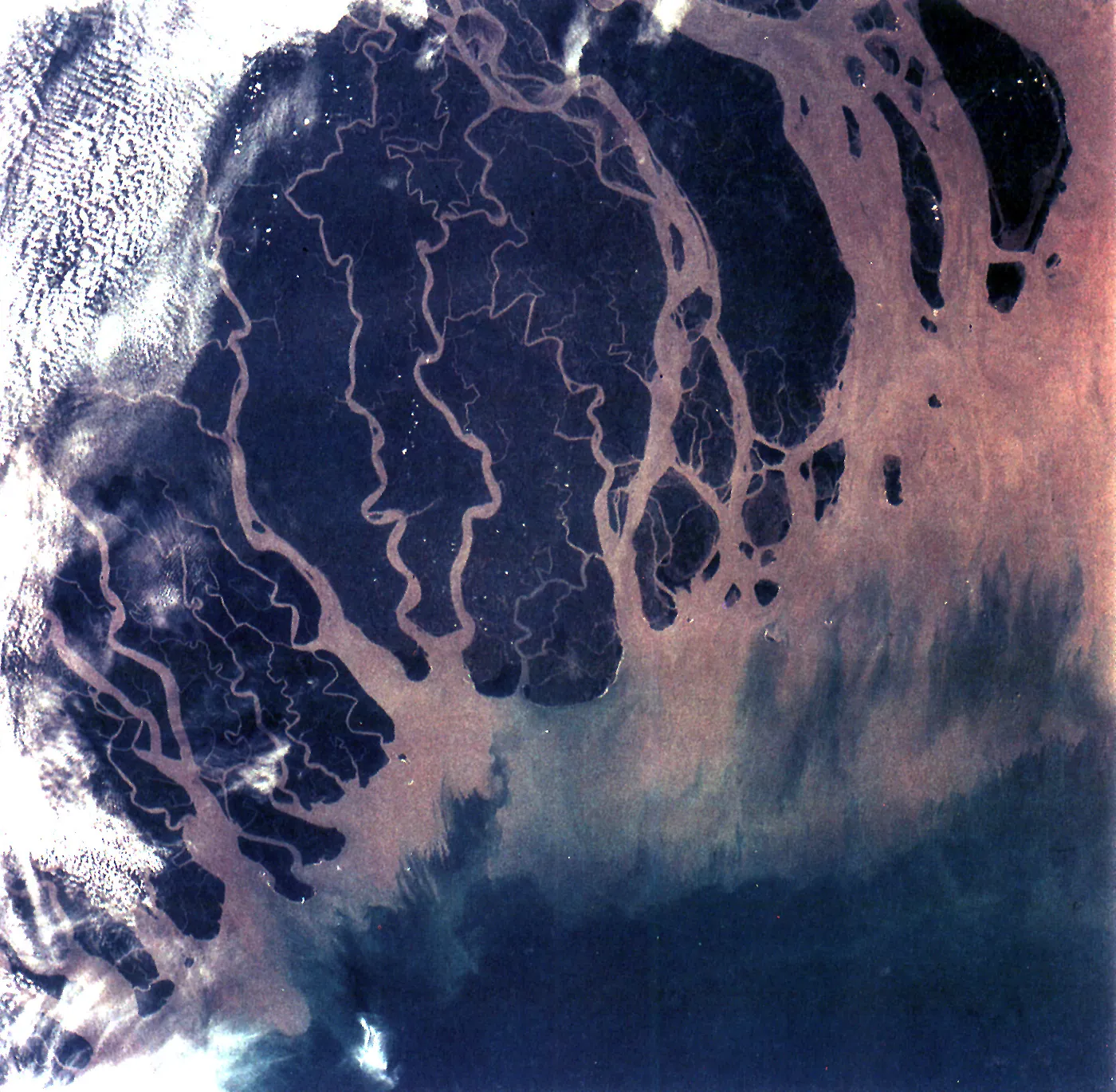
"Ganges River Delta, Bangladesh, India" by NASA / Source: Wikimedia Commons (Public domain).
A delta is a flat area of land shaped like a triangle that forms where a river meets an ocean or lake. Deltas form because rivers carry tiny pieces of rock and soil called sediment. Understanding how deltas form helps us protect our land and water.
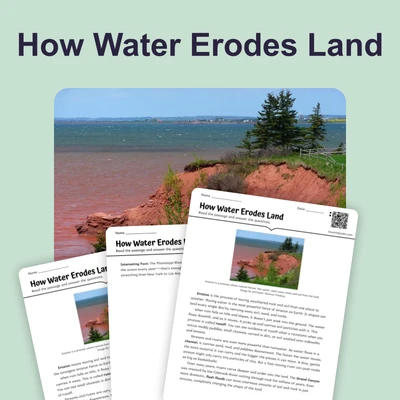
When rivers flow downhill, they pick up sediment through a process called erosion. Erosion happens when moving water wears away soil and rocks. The river carries this sediment along as it flows. Think of it like a conveyor belt moving material from one place to another.
When the river reaches the ocean or lake, it slows down. Slower water cannot carry as much sediment, so the sediment settles to the bottom. This process is called deposition. Over many years, the deposited sediment builds up and creates new land—the delta.
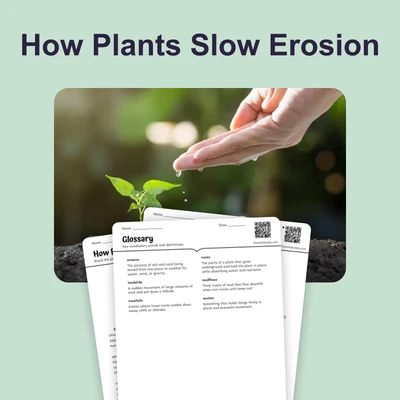
Plant roots play an important role in controlling erosion. Roots hold soil in place like a net. When rain falls on land covered with grass, trees, or bushes, the roots keep the soil from washing away. On bare land with no plants, rain washes soil away quickly. This is why hillsides with trees rarely have landslides, but cleared hillsides often do. Farmers plant cover crops to protect soil between growing seasons. Along riverbanks, plants prevent the banks from crumbling. Vegetation is nature's best erosion prevention.
Interesting Fact: The Mississippi River Delta in Louisiana grows about 300 feet into the Gulf of Mexico each year from all the sediment the river deposits!
What shape is a delta?
CircleTriangleSquareRectangle
What are tiny pieces of rock called?
PebblesSedimentGravelSand
Where do deltas form?
On top of mountainsIn the middle of riversWhere rivers meet oceans or lakesIn underground caves
Why does sediment settle when water slows?
Slow water cannot carry heavy sedimentFish push the sediment downThe ocean pulls it downPlants grab the sediment
How do plant roots help soil?
They make soil softerThey hold soil in placeThey add water to soilThey remove rocks from soil
Why do hillsides with trees have fewer landslides?
Trees block the rainTree roots hold the soilTrees make the ground harderTrees absorb all the water
Plant roots work like a net.
TrueFalse
What does erosion mean?
Water freezing on rocksPlants growing in soilWater wearing away soil and rocksAnimals digging in the ground
Perfect For:
👩🏫 Teachers
• Reading comprehension practice
• Auto-graded assessments
• Literacy skill development
👨👩👧👦 Parents
• Reading practice at home
• Comprehension improvement
• Educational reading time
🏠 Homeschoolers
• Reading curriculum support
• Independent reading practice
• Progress monitoring
Reading Features:
📖
Reading Passage
Engaging fiction or nonfiction text
❓
Comprehension Quiz
Auto-graded questions
📊
Instant Feedback
Immediate results and scoring
📄
Printable Version
Download for offline reading
🔊
Read Aloud
Voice-over with word highlighting
Reviews & Ratings
No reviews yet. Be the first to share your experience!
Related Content
Tools and Technology in Earth Science
This middle school science reading passage explores the wide range of tools and technologies used in Earth science, from...
MS-ESS2-2MS-ESS3-2MS-ETS1-1MS-PS4-3
Scientific Inquiry in Earth Science
This passage explores scientific inquiry in Earth science for grades 6-8, aligned with NGSS standards MS-ESS1-4, MS-ESS2...
MS-ESS1-4MS-ESS2-1MS-ESS3-5SEP
What Is Earth Science?
This engaging middle school science passage introduces students to the field of Earth science, aligning with NGSS standa...
MS-ESS1MS-ESS2MS-ESS3SEP
Earth: Our Home in Space
This engaging Grade 4-5 science passage, aligned to NGSS, introduces students to Earth's special place in the solar syst...
Earth's Spheres
This middle school science passage introduces students to Earth's four major spheres: the geosphere, hydrosphere, atmosp...
MS-ESS2-4MS-ESS2-6
What Is Space Weather and How Does It Affect the Earth?
This NGSS-aligned science passage for middle school explains what space weather is and how it affects Earth. Students le...
MS-ESS2-2
Earth's Energy Balance
This engaging, NGSS-aligned science passage for grades 6–8 explores Earth's energy balance, a key process that keeps our...
MS-ESS2-6
Earth's Rotation
This middle school science passage, aligned with NGSS standard MS-ESS1-1, focuses on Earth's rotation—how Earth spins on...
MS-ESS1-1
Earth's Land and Water
This 250-word reading passage introduces fourth-grade students to the fundamental concept of how land and water are dist...
NGSS 4-ESS2-2ESS2.B
Earth's Interior
This comprehensive passage for grades 6-8 explores Earth's layered interior, including the crust, mantle, outer core, an...
MS-ESS2-1MS-ESS2-2
Facts About Earth
This engaging science reading passage introduces Grade 4 and 5 students to Earth, our home planet. Aligned with NGSS sta...
Meteorite Impacts on Earth
This engaging science reading passage for Grades 4-5 explores meteorite impacts on Earth, aligning with NGSS standards. ...
Earth Changes Over Millions of Years
This engaging, audio-integrated science passage for Grade 4-5 students explores how Earth has changed over millions of y...
Venus: Earth's Twin?
This comprehensive science passage for grades 6-8 examines Venus—often called Earth's twin—by exploring its similarities...
MS-ESS1-2MS-ESS1-3
Volcano Patterns on Earth
This Grade 4 science reading passage introduces students to volcano patterns on Earth, aligned with NGSS standard 4-ESS2...
NGSS 4-ESS2-2
Earth's Quick and Slow Changes
In 'Earth's Quick and Slow Changes,' students categorize 12 Earth events by their speed of occurrence, enhancing underst...
Earth: Our Home Planet
This comprehensive science passage for grades 6-8 explores Earth’s unique characteristics and the interconnected systems...
MS-ESS1-2
Earth's Moon Facts
This engaging science passage, 'The Moon: Earth's Companion,' is designed for Grade 4-5 students and aligns with NGSS ge...
Earth's Revolution
This middle school science passage explores the science behind Earth's revolution around the Sun, closely aligned with N...
MS-ESS1-1
Earthquake Patterns on Earth
This engaging 250-word reading passage introduces fourth-grade students to earthquake patterns on Earth, aligned with NG...