This learning resource is available in interactive and printable formats. The interactive worksheet can be played online and assigned to students. The Printable PDF version can be downloaded and printed for completion by hand.
This comprehensive middle school science passage explores how stars are formed in cosmic regions known as stellar nurseries. Aligned with NGSS standard MS-ESS1-1, the text describes the process starting with nebulae—vast clouds of gas and dust—through the stages of gravitational collapse, protostar development, T Tauri phase, and the beginning of nuclear fusion. Readers discover how conservation of angular momentum shapes a collapsing nebula, how core temperatures and pressures lead to stellar birth, and how leftover material becomes planets. Examples like the Orion Nebula help students connect astronomical phenomena to direct observation. The passage integrates academic vocabulary, a glossary, quiz, writing prompts, and graphic organizers for deep understanding. Audio integration and Spanish translations ensure accessibility for diverse learners. This resource is ideal for students in grades 6-8, providing an engaging, standards-aligned look at the science behind the birth of stars and planetary systems.
CONTENT PREVIEW
Expand content preview
Star Formation: Stellar Nurseries
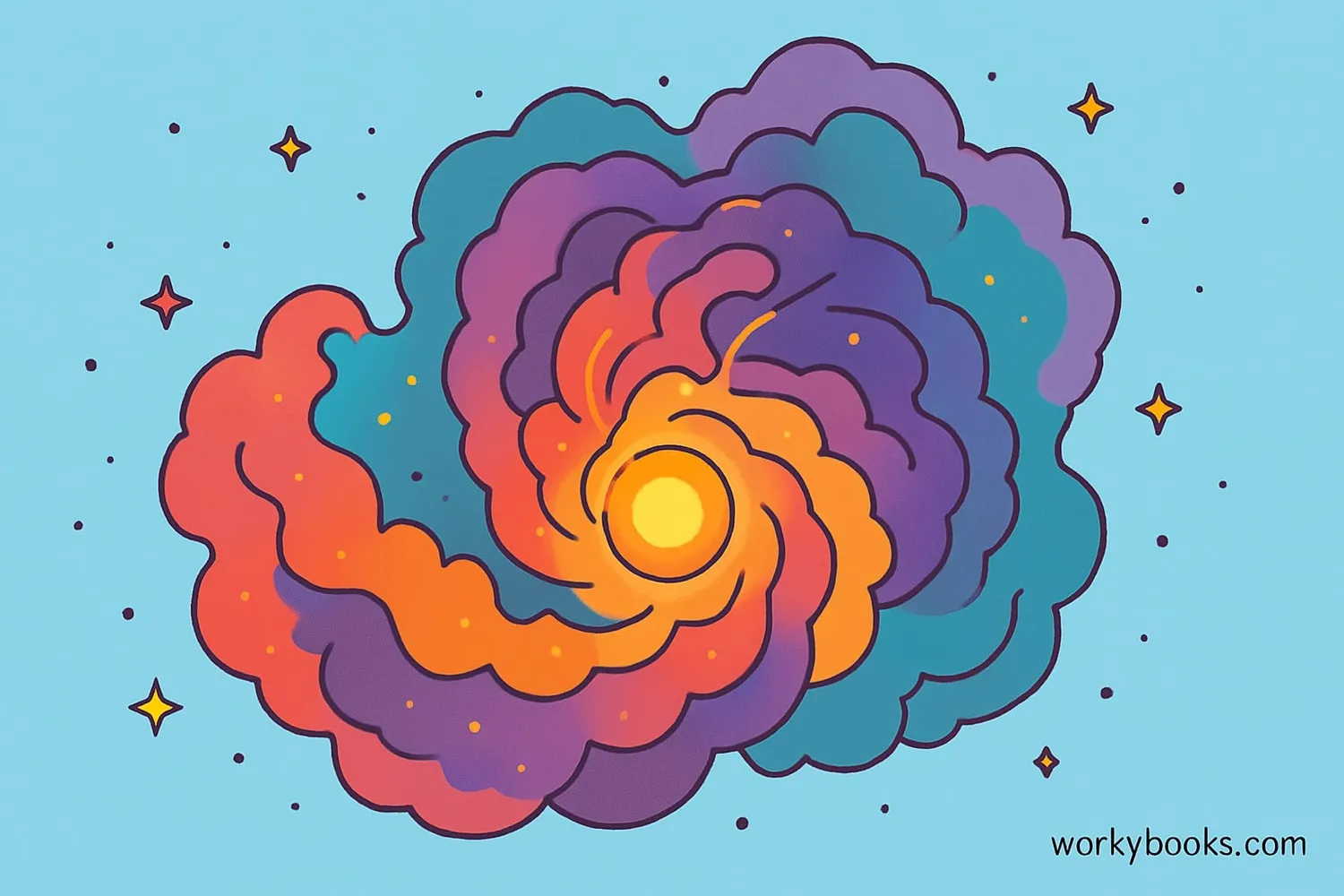
Star formation in the universe begins inside vast clouds of gas and dust known as nebulae. These enormous regions, sometimes called stellar nurseries, contain the raw materials for creating new stars. The Orion Nebula is one of the brightest and most studied examples, observable even with the naked eye from Earth. Understanding how stars are born in these nurseries helps scientists explain the life cycle of stars, the origins of planets, and the evolution of galaxies.
Gravity and the Birth of Stars Within a nebula, certain areas become denser than others due to small disturbances or the death of previous stars. The force of gravity pulls the gas and dust in these dense regions closer together. As the material collapses, it spins faster because of the conservation of angular momentum, a physical principle that keeps spinning objects rotating as they shrink. The spinning causes the cloud to flatten into a disk with a bulging center. The central region, known as a protostar, heats up as the material compresses. Temperatures rise dramatically, sometimes reaching millions of degrees Kelvin. During this phase, the protostar glows from internal heat but does not yet create energy by nuclear fusion.
From Protostar to Main Sequence Star The next key stage is the T Tauri phase, when the young star is still gathering mass and is very active. When the core temperature of the protostar approaches about 10 million Kelvin, a process called nuclear fusion begins. Here, hydrogen atoms in the core fuse to form helium, releasing vast amounts of energy as light and heat. This nuclear reaction creates an outward pressure that balances the inward pull of gravity. At this moment, the star becomes a main sequence star—like our Sun—and is considered truly "born." The leftover material in the disk can clump together, forming planets, asteroids, and comets in a structure called a protoplanetary disk.
Variety in Star Formation and Its Importance The timeline for star formation depends on the mass of the collapsing region. For stars similar to our Sun, it takes about 50 million years to reach the main sequence. More massive stars form much faster, while smaller stars can take hundreds of millions of years. Astronomers use telescopes to observe nebulae and protostars at various stages, confirming theories about star birth through direct evidence and computer models. Understanding star formation also reveals how elements are distributed across the universe and how planetary systems, including our own solar system, come into existence.
Studying stellar nurseries shows how interconnected the universe is—each star formed enriches space with new elements, paving the way for future generations of stars and planets. The birth of stars is a key process in galactic evolution and helps explain the diversity of worlds we observe.
Interesting Fact: The Orion Nebula is about 1,344 light-years from Earth and contains thousands of young stars forming right now!
What is a nebula?
A large cloud of gas and dust in space where stars are born.A planet that orbits a star.A type of asteroid.A black hole.
What causes the material in a nebula to start collapsing?
Gravity pulling the gas and dust together.The light from other stars.Winds from comets.Magnetic fields.
Which stage comes right before a star becomes a main sequence star?
What is the main process that powers a main sequence star?
Nuclear fusionChemical burningSolar windRotation
What does the term 'stellar nurseries' mean in the passage?
Regions where many new stars are being formed.A place where planets are destroyed.A special kind of asteroid belt.A dust ring around black holes.
What happens to leftover material in the protoplanetary disk?
It may form planets, asteroids, and comets.It disappears into space.It becomes another star immediately.It cools and turns into ice.
Which of the following best explains why the collapsing gas spins faster?
Conservation of angular momentum causes it to spin faster as it shrinks.Gravity slows down its spin.Heat from the protostar increases the speed.The light from nearby stars pushes it.
True or False: All stars take the same amount of time to form.
TrueFalse
True or False: The Orion Nebula can be seen without a telescope from Earth.
TrueFalse
Why is studying stellar nurseries important to science?
It helps scientists understand how stars and planets form and how the universe evolves.It shows how black holes are made.It explains the creation of asteroids only.It helps us predict solar flares on Earth.
Perfect For:
👩🏫 Teachers
• Reading comprehension practice
• Auto-graded assessments
• Literacy skill development
👨👩👧👦 Parents
• Reading practice at home
• Comprehension improvement
• Educational reading time
🏠 Homeschoolers
• Reading curriculum support
• Independent reading practice
• Progress monitoring
Reading Features:
📖
Reading Passage
Engaging fiction or nonfiction text
❓
Comprehension Quiz
Auto-graded questions
📊
Instant Feedback
Immediate results and scoring
📄
Printable Version
Download for offline reading
🔊
Read Aloud
Voice-over with word highlighting
Reviews & Ratings
No reviews yet. Be the first to share your experience!
Related Content
What is Solar Radiation
This NGSS-aligned science reading passage for middle school students explores the concept of solar radiation. Solar radi...
MS-ESS1-1
How Incoming Solar Radiation Changes with Latitude
This NGSS-aligned science reading passage helps middle school students understand how solar radiation, or insolation, ch...
MS-ESS1-1
Tides and Tidal Forces
This middle school science passage explores the mechanisms of tides and tidal forces, aligning with NGSS standards MS-ES...
MS-ESS1-1MS-ESS1-2
The Night Sky
This comprehensive science reading passage for grades 6-8 aligns with NGSS standard MS-ESS1-1 and explores the systems a...
MS-ESS1-1
Ancient Astronomy
This engaging passage for grades 6-8 explores the history of astronomy through the lens of ancient observations. Student...
MS-ESS1-1
Tools of Modern Astronomy
This passage introduces middle school students to modern astronomy, aligning with NGSS standard MS-ESS1-1. It explains h...
MS-ESS1-1
How Astronomy Became a Science
This passage explores the transformative period known as the Scientific Revolution, with a special focus on the history ...
MS-ESS1-1
Earth's Rotation
This middle school science passage, aligned with NGSS standard MS-ESS1-1, focuses on Earth's rotation—how Earth spins on...
MS-ESS1-1
Earth's Revolution
This middle school science passage explores the science behind Earth's revolution around the Sun, closely aligned with N...
MS-ESS1-1
Why We Have Seasons
This comprehensive middle school science reading passage explains the mechanisms behind Earth's seasons, directly addres...
MS-ESS1-1
Earth's Seasons
This comprehensive reading passage for grades 6-8 explains why Earth has seasons, revealing the scientific mechanisms be...
MS-ESS1-1
Phases of the Moon
This comprehensive middle school science passage explains the phases of the Moon, focusing on the mechanisms behind the ...
MS-ESS1-1
Tides
This comprehensive middle school science reading passage explores the phenomenon of ocean tides, aligned to NGSS standar...
MS-ESS1-1MS-ESS1-2
Eclipses
This comprehensive passage for grades 6-8 explores the science behind eclipses, including solar and lunar eclipses, thei...
MS-ESS1-1
The Moon's Characteristics
This comprehensive science reading passage for grades 6-8 examines the Moon's physical characteristics, including its si...
MS-ESS1-1MS-ESS1-2
Lunar Eclipses
This passage introduces middle school students to the phenomenon of lunar eclipses, connecting observable events to the ...
MS-ESS1-1
The Sun's Characteristics
This engaging science passage introduces middle school students to the Sun’s key characteristics, such as its classifica...
MS-ESS1-1MS-ESS1-2
What Is a Galaxy?
This comprehensive middle school science passage answers the question: What is a galaxy? Aligned to NGSS standard MS-ESS...
MS-ESS1-1
The Milky Way: Our Home Galaxy
This comprehensive science passage introduces middle school students to the Milky Way, the barred spiral galaxy that is ...
MS-ESS1-1
Types of Galaxies
This comprehensive middle school science passage introduces students to the classification and characteristics of galaxi...