This 400-500 word reading passage explores how Galileo Galilei changed astronomy through his telescope observations in 1609-1610. Students learn how Galileo discovered moons orbiting Jupiter, which provided evidence that not everything orbits Earth, challenging the geocentric model. The passage explains how the phases of Venus only make sense if Venus orbits the Sun, supporting the heliocentric model. Students also learn about Galileo's house arrest by the Catholic Church and how new tools enable new scientific discoveries. Aligned to NGSS MS-ESS1-2 and MS-ESS1.B, this passage helps students understand the nature of science and how technology drives scientific revolution. The content includes audio integration, vocabulary support, and differentiated versions for diverse learners. Activities reinforce understanding of observational evidence and the scientific process.
Written by Workybooks TeamPublished by Workybooks
Preview
Sample passage and quiz content
CONTENT PREVIEW
Expand content preview
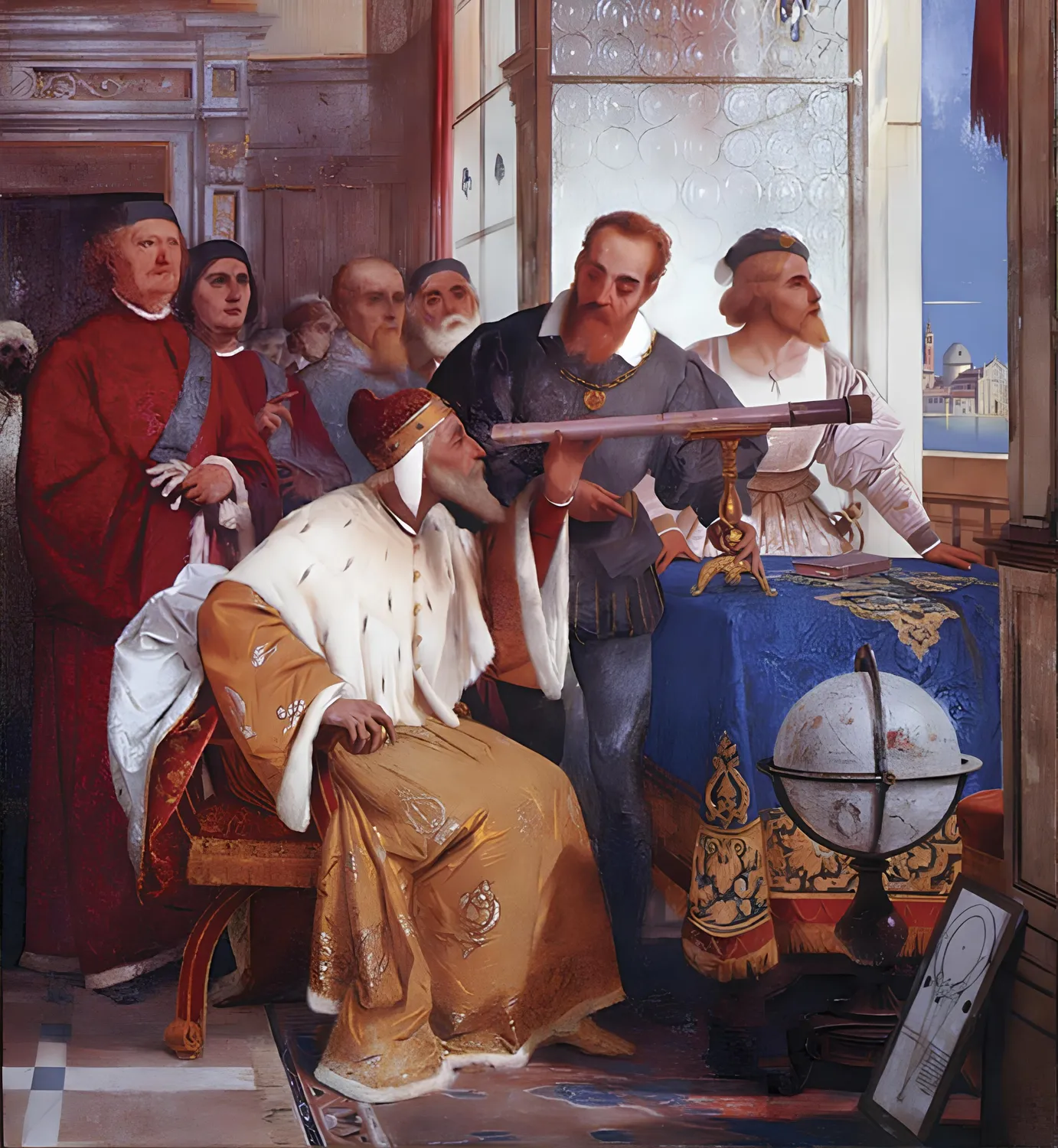
"Bertini fresco of Galileo Galilei and Doge of Venice Upscaled" by Giuseppe Bertini / Wikimedia Commons
Galileo Galilei changed astronomy by using a telescope to make observations that challenged ancient beliefs about the universe. In 1609, he built his own telescope and pointed it at the night sky. What he saw transformed how scientists understood Earth's place in space.
Before Galileo, most people believed Earth was the center of the universe. This idea was called the geocentric model. Ancient astronomers thought all objects in space orbited around Earth. Galileo's observations provided evidence for a different explanation. The heliocentric model suggested that Earth and other planets orbit the Sun instead.
Galileo made several important discoveries with his telescope. He observed mountains and craters on the Moon's surface. This showed that the Moon was not a perfect, smooth sphere as people once believed. He also discovered four moons orbiting the planet Jupiter. These moons proved that not everything in space orbits Earth. Scientists now call these four moons the Galilean moons in his honor.
Perhaps his most important observation involved the planet Venus. Galileo saw that Venus goes through phases similar to our Moon. Venus appeared to change from a thin crescent to a full circle over time. This pattern only makes sense if Venus orbits the Sun, not Earth. Evidence from these observations supported the heliocentric model proposed earlier by astronomer Nicolaus Copernicus.
Galileo's discoveries created conflict with the Catholic Church. Church leaders believed Earth was the center of God's creation. They ordered Galileo to stop teaching the heliocentric model. In 1633, Church officials put him on trial for supporting ideas that contradicted religious teachings. Galileo spent his final years under house arrest.
Despite this opposition, Galileo's work reshaped science forever. His method of using instruments to make careful observations became a foundation of modern astronomy. Scientists today still use telescopes to study distant objects in space. Galileo showed that direct observation and evidence can reveal truths about nature. His discoveries helped establish that Earth is one planet among many in our solar system.
Interesting Fact: Galileo was not the first person to invent the telescope, but he improved its design to magnify objects up to 30 times. This made his observations far more detailed than anyone had achieved before.
What instrument did Galileo use to make his astronomical discoveries in 1609?
A telescopeA microscopeA compassA thermometer
According to the passage, what did the geocentric model propose?
The Sun is the center of the universeEarth is the center of the universeJupiter is the center of the universeThe Moon is the center of the universe
What does the term 'heliocentric model' mean in the context of this passage?
A model showing Earth at the center with other objects orbiting itA model showing the Moon at the center of the solar systemA model showing the Sun at the center with planets orbiting itA model showing all planets moving in straight lines
How many moons did Galileo discover orbiting Jupiter?
Two moonsThree moonsFour moonsFive moons
Why was Galileo's observation of Venus's phases important evidence for the heliocentric model?
It showed Venus was larger than EarthIt proved Venus had its own moonIt demonstrated that Venus orbits the Sun, not EarthIt revealed that Venus was made of rock
Based on the passage, what can you infer about the relationship between scientific observations and accepted beliefs?
Scientific observations always match what people already believeObservations can challenge and change long-held beliefsReligious beliefs are more important than scientific evidenceAncient beliefs are always more accurate than new discoveries
What consequence did Galileo face for supporting the heliocentric model?
He received an award from the ChurchHe was given a new telescopeHe was put on trial and placed under house arrestHe was asked to teach at a university
If you were an astronomer in 1609 and observed Jupiter's moons through a telescope, how would this observation challenge the geocentric model?
It would prove Earth is flatIt would show that some objects orbit something other than EarthIt would demonstrate that Jupiter is larger than the SunIt would confirm that all objects orbit Earth
True or False: Galileo invented the first telescope.
TrueFalse
True or False: Galileo's discoveries showed that the Moon had a smooth, perfect surface.
TrueFalse
Who it's for
Perfect for the way you teach
Teachers
Build comprehension skills
Auto-graded quiz
Differentiated reading
Parents
Read together at home
Improve fluency
Quiet reading time
Homeschoolers
Reading curriculum support
Independent practice
Track Lexile growth
Topics
Galileotelescopeheliocentric modelgeocentric modelJupiter moonsphases of VenusastronomyNGSS MS-ESS1-2scientific revolutionobservational evidence
Reviews & Ratings
No reviews yet. Be the first to share your experience!
More reading you might love
20 more
Comets
This middle school science passage explores the fascinating world of comets, commonly known as 'dirty snowballs.' Studen...
MS-ESS1-2
Mercury: Closest to the Sun
This comprehensive, standards-aligned passage explores Mercury—the smallest and closest planet to the Sun. Students in g...
MS-ESS1-2MS-ESS1-3
Venus: Earth's Twin?
This comprehensive science passage for grades 6-8 examines Venus—often called Earth's twin—by exploring its similarities...
MS-ESS1-2MS-ESS1-3
Earth: Our Home Planet
This comprehensive science passage for grades 6-8 explores Earth’s unique characteristics and the interconnected systems...
MS-ESS1-2
Mars: The Red Planet
This middle school science passage explores Mars, the Red Planet, providing students in grades 6-8 with a comprehensive ...
MS-ESS1-2MS-ESS1-3
Kepler's Laws of Planetary Motion
This comprehensive middle school science passage explores Kepler's Laws of Planetary Motion, meeting NGSS Standard MS-ES...
MS-ESS1-2
Tides and Tidal Forces
This middle school science passage explores the mechanisms of tides and tidal forces, aligning with NGSS standards MS-ES...
MS-ESS1-1MS-ESS1-2
Escape Velocity and Space Travel
This middle school science passage introduces students to the concept of escape velocity—the minimum speed required to b...
MS-ESS1-2MS-PS2-4
Weightlessness and Microgravity
This science reading passage for middle school students explores the phenomenon of weightlessness and microgravity. Alig...
MS-PS2-4MS-ESS1-2
Orbits and Orbital Motion
This middle school science passage, aligned with NGSS MS-ESS1-2 and MS-PS2-4, explores the science of orbits and orbital...
MS-ESS1-2MS-PS2-4
What Is the Solar System?
This passage provides a comprehensive overview of the solar system for grades 6-8, aligned with NGSS standards MS-ESS1-2...
MS-ESS1-2MS-ESS1-3
Structure of the Solar System
This comprehensive science reading passage introduces middle school students (grades 6-8) to the structure of the solar ...
MS-ESS1-2MS-ESS1-3
Moons of the Solar System
This comprehensive passage, designed for grades 6-8 and aligned to NGSS standard MS-ESS1-2, delves into the fascinating ...
MS-ESS1-2
Defining Life: What Are We Looking For?
This informational science passage for middle school students explores the question: What is life, and how do we define ...
MS-LS1-1MS-ESS1-2
Astronomy
This comprehensive reading passage introduces middle school students to the science of astronomy, which is the study of ...
MS-ESS1-2MS-ESS1-3MS-PS4-2MS-ETS1-1
The Solar System
This middle school science passage introduces students to the solar system, aligning with NGSS standards MS-ESS1-2 and M...
MS-ESS1-2MS-ESS1-3
Gravity and Orbits
This comprehensive passage for grades 6-8 explains the science of gravity and orbits, aligning with NGSS standard MS-ESS...
MS-ESS1-2
The Inner Planets
This comprehensive science passage for grades 6-8 explores the inner (terrestrial) planets of our solar system—Mercury, ...
MS-ESS1-2MS-ESS1-3
The Outer Planets
This engaging science passage for grades 6-8 introduces students to the outer planets—Jupiter, Saturn, Uranus, and Neptu...
MS-ESS1-2MS-ESS1-3
Tides
This comprehensive middle school science reading passage explores the phenomenon of ocean tides, aligned to NGSS standar...