Kepler's Laws of Planetary Motion
Interactive passage with audio narration, comprehension questions, and printable PDF.
By completing this purchase you agree to our Terms of Use and Privacy Policy. Your subscription renews automatically until you cancel. You can cancel anytime from your account settings. All sales are final and non-refundable. Digital content is available for download in your account immediately upon purchase.
What's included
Kepler's Laws of Planetary Motion preview and details
About this printable Kepler's Laws of Planetary Motion science reading passage, NGSS-aligned (Grades 5-8)
Sample passage and quiz from Kepler's Laws of Planetary Motion
Reading passage and comprehension quiz preview
Kepler's Laws of Planetary Motion
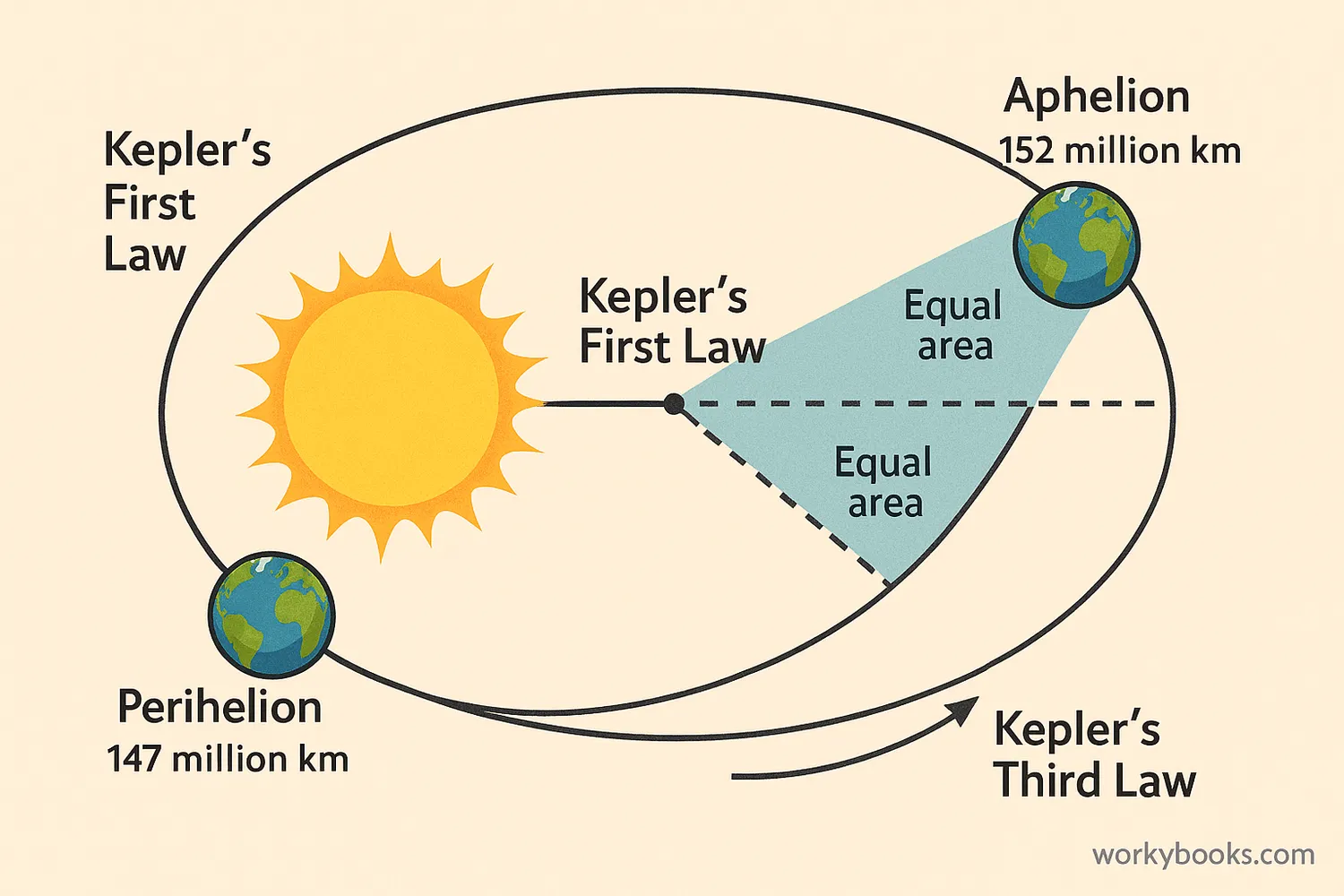
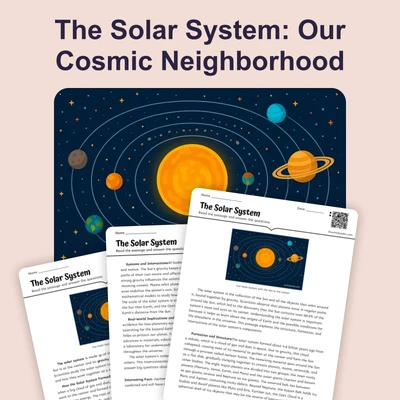
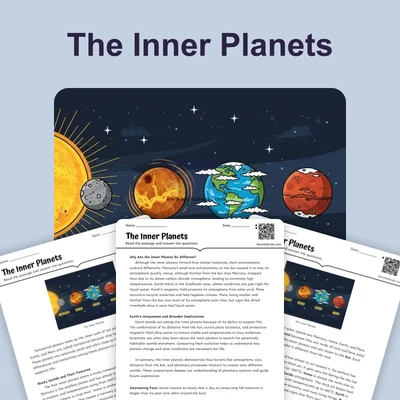
Planetary motion describes how planets travel around the Sun and other stars. For centuries, astronomers tried to understand the rules that govern these movements. In the early 1600s, Johannes Kepler used Tycho Brahe’s accurate records of the planets to discover patterns in their paths. Kepler’s three laws of planetary motion changed how scientists view the solar system and the forces that shape it.
How Planets Move: The Mechanism of Orbits
Kepler’s First Law states that planets orbit the Sun in elliptical paths, not perfect circles. An ellipse is a stretched-out circle with two central points called foci. The Sun sits at one focus of each planet’s ellipse. The shape of the ellipse is measured by its eccentricity, which shows how much it’s stretched. Most planetary orbits are only slightly elliptical, but some, like comets, are much more elongated. This discovery explained why planets sometimes appear closer or farther from the Sun during their journey.
Kepler’s Second and Third Laws: Changing Speeds and Times
Kepler’s Second Law, also called the Law of Equal Areas, reveals that a planet moves faster when it is closer to the Sun (at perihelion) and slower when it is farther away (at aphelion). If you draw a line from the planet to the Sun, the area swept out by that line is always equal for the same length of time. This means the planet’s speed changes as its distance from the Sun changes. Kepler’s Third Law connects a planet’s average distance from the Sun to the time it takes to complete one orbit (its orbital period). The farther a planet is from the Sun, the longer its orbital period. For example, Neptune takes about 165 years to orbit the Sun, while Mercury takes only 88 days.
Applications and Connections to Other Scientific Ideas
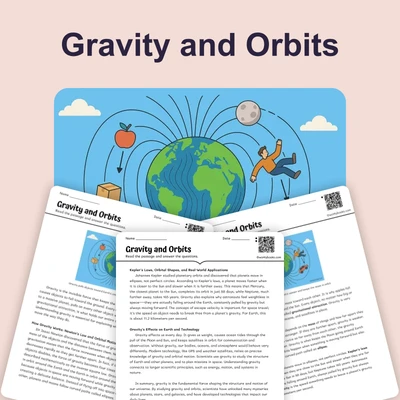
Kepler’s laws apply to all objects in orbit, not just planets. Moons, satellites, and even artificial spacecraft follow these same rules. Scientists use Kepler’s Third Law to calculate the masses of planets and stars by observing their orbiting objects. Later, Isaac Newton explained why Kepler’s laws work by showing that gravity is the force that causes orbits. These discoveries are fundamental for modern astronomy and for missions that send spacecraft to other planets. Understanding orbital motion helps us predict eclipses, launch satellites, and explore the universe beyond our solar system.
Kepler’s careful analysis of Brahe’s data showed the power of scientific observation and mathematical reasoning. Today, Kepler’s Laws of Planetary Motion connect what we see in the sky to the invisible forces that govern the cosmos, forming a foundation for physics and space science.
Interesting Fact:
Kepler’s Laws are so accurate that they are still used to guide spacecraft to distant planets and to predict the orbits of exoplanets around other stars!
Comprehension quiz (10 questions)
1. What did Johannes Kepler use to discover the laws of planetary motion?
2. According to Kepler’s First Law, what shape are planetary orbits?
3. What happens to a planet’s speed as it gets closer to the Sun?
4. What does the term 'eccentricity' mean in the context of orbits?
5. Which of the following best describes 'orbital period'?
6. What is the main force that causes planets to follow Kepler’s laws?
7. Which planet takes the longest time to orbit the Sun according to the passage?
8. Kepler’s Second Law is also known as the Law of Equal Areas.
9. The Sun is at the center of every planet’s orbit.
10. Why are Kepler’s laws still important today?
Perfect for the way you teach
- Build comprehension skills
- Auto-graded quiz
- Differentiated reading
- Read together at home
- Improve fluency
- Quiet reading time
- Reading curriculum support
- Independent practice
- Track Lexile growth