This learning resource is available in interactive and printable formats. The interactive worksheet can be played online and assigned to students. The Printable PDF version can be downloaded and printed for completion by hand.
This comprehensive passage, designed for grades 6-8 and aligned to NGSS standard MS-ESS1-2, delves into the fascinating world of the moons in our solar system. Students will learn about the diversity of over 200 confirmed moons, including unique examples like Earth's large moon, Mars' small captured moons, and the complex systems of Jupiter and Saturn. The passage explains mechanisms of moon formation—such as co-formation, capture, and impact debris—and highlights remarkable moons like Ganymede, Titan, and Europa. Scientific vocabulary is clearly embedded and supported by a glossary. Students will also explore how scientific discoveries about moons are made, the role of tidal locking, and the potential for life beyond Earth. Multiple activities—including quizzes, writing prompts, and visual graphic organizers—support comprehension and critical thinking. Audio integration is available for all content, making this resource accessible and engaging for all learners.
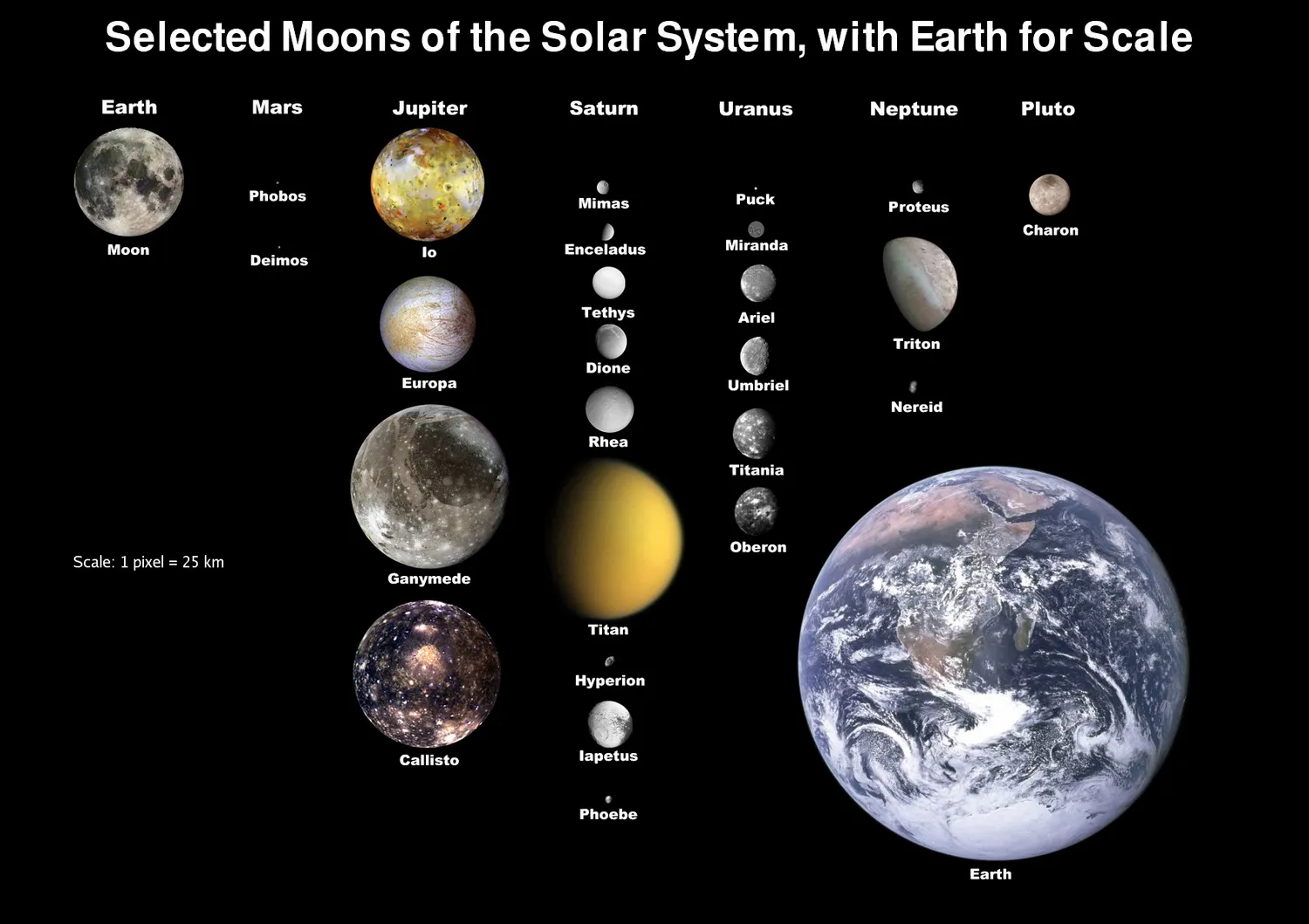
Moons, also known as natural satellites, are objects that orbit planets throughout our solar system. Over 200 confirmed moons have been discovered so far, and new moons are found regularly as technology improves. These satellites vary greatly in size, composition, and origin. Studying moons helps scientists understand both the history of our solar system and the processes that shape planetary systems.
Formation and Diversity of Moons Moons form in several ways. Some, like Jupiter’s four largest moons, formed from the same disk of gas and dust that created their planet—a process called co-formation. Others, such as Mars’ tiny moons Phobos and Deimos, are likely captured asteroids. Earth's moon is thought to have formed when a large object collided with Earth, and debris from this impact coalesced into a satellite. This diversity leads to a wide range of moon sizes, from Ganymede—Jupiter’s largest moon, which is even bigger than Mercury—down to moons less than 1 kilometer across. Most moons are much smaller than their planets, but Earth’s Moon is unusually large compared to Earth, making it an interesting case for scientists.
Systems and Interactions Moons interact with their planets and each other in complex ways. Many moons are tidally locked, meaning the same side always faces their planet due to gravitational forces. For example, our Moon is tidally locked to Earth, which is why we always see the same side. Some moons, like Jupiter’s Io, experience intense tidal forces that create volcanic activity, making Io the most volcanically active body in the solar system. Others, like Europa and Saturn’s Enceladus, have subsurface oceans beneath icy crusts. These oceans may harbor the conditions needed for life. Saturn’s Titan stands out for its thick atmosphere and lakes of liquid methane, making it one of the most Earth-like places in the solar system, even though its chemistry is very different.
Scientific Discoveries and Future Exploration Advances in telescopes and spacecraft have allowed scientists to discover new moons and study their features in detail. For instance, Ganymede’s magnetic field was detected by spacecraft, and geysers erupting from Enceladus were observed by NASA’s Cassini mission. The number of moons can change as new satellites are found; for example, Jupiter is now known to have over 95 moons, while Saturn has more than 140. Future missions aim to explore ocean worlds like Europa and Enceladus to search for signs of life and better understand how moons form and evolve. The study of moons helps scientists answer broader questions about planetary systems, habitability, and the origins of the solar system itself.
Interesting Fact: Some moons, like Neptune’s Triton, orbit in the opposite direction of their planet’s rotation. This retrograde motion suggests they were captured from elsewhere in the solar system.
How many confirmed moons are there in our solar system according to the passage?
Over 200About 50Exactly 100Less than 20
Which moon is the largest in the solar system?
TitanGanymedeEuropaEarth's Moon
What does 'tidally locked' mean as used in the passage?
A moon that moves very fastA moon that always shows the same side to its planetA moon made of iceA moon that was formed from impact debris
Which planet’s moon has lakes of liquid methane?
MarsNeptuneSaturnJupiter
What is the likely origin of Mars’ moons Phobos and Deimos?
Formed with Mars in co-formationCaptured asteroidsImpact debrisCreated by volcanic activity
What is 'retrograde motion' as described in the passage?
When a moon orbits faster than its planet spinsWhen a moon orbits in the opposite direction of the planet's rotationWhen a moon is made of iceWhen a moon has a thick atmosphere
Why are moons like Europa and Enceladus important for scientists searching for life?
They are close to the SunThey have subsurface oceans that might have lifeThey are the largest moonsThey have strong magnetic fields
Which of the following is TRUE based on the passage?
All moons are smaller than MercuryMoons can form in multiple ways, including from impact debrisAll moons have thick atmospheresOnly Jupiter has more than 50 moons
Most moons are tidally locked to their planet. (True/False)
TrueFalse
Earth’s Moon is unusually large compared to its planet. (True/False)
TrueFalse
Perfect For:
👩🏫 Teachers
• Reading comprehension practice
• Auto-graded assessments
• Literacy skill development
👨👩👧👦 Parents
• Reading practice at home
• Comprehension improvement
• Educational reading time
🏠 Homeschoolers
• Reading curriculum support
• Independent reading practice
• Progress monitoring
Reading Features:
📖
Reading Passage
Engaging fiction or nonfiction text
❓
Comprehension Quiz
Auto-graded questions
📊
Instant Feedback
Immediate results and scoring
📄
Printable Version
Download for offline reading
🔊
Read Aloud
Voice-over with word highlighting
Reviews & Ratings
No reviews yet. Be the first to share your experience!
Related Content
Comets
This middle school science passage explores the fascinating world of comets, commonly known as 'dirty snowballs.' Studen...
MS-ESS1-2
Mercury: Closest to the Sun
This comprehensive, standards-aligned passage explores Mercury—the smallest and closest planet to the Sun. Students in g...
MS-ESS1-2MS-ESS1-3
Venus: Earth's Twin?
This comprehensive science passage for grades 6-8 examines Venus—often called Earth's twin—by exploring its similarities...
MS-ESS1-2MS-ESS1-3
Earth: Our Home Planet
This comprehensive science passage for grades 6-8 explores Earth’s unique characteristics and the interconnected systems...
MS-ESS1-2
Mars: The Red Planet
This middle school science passage explores Mars, the Red Planet, providing students in grades 6-8 with a comprehensive ...
MS-ESS1-2MS-ESS1-3
What Is Gravity?
This comprehensive middle school science reading passage explores the concept of gravity, aligning with NGSS standards M...
MS-ESS1-2MS-PS2-4
Kepler's Laws of Planetary Motion
This comprehensive middle school science passage explores Kepler's Laws of Planetary Motion, meeting NGSS Standard MS-ES...
MS-ESS1-2
Tides and Tidal Forces
This middle school science passage explores the mechanisms of tides and tidal forces, aligning with NGSS standards MS-ES...
MS-ESS1-1MS-ESS1-2
Escape Velocity and Space Travel
This middle school science passage introduces students to the concept of escape velocity—the minimum speed required to b...
MS-ESS1-2MS-PS2-4
Weightlessness and Microgravity
This science reading passage for middle school students explores the phenomenon of weightlessness and microgravity. Alig...
MS-PS2-4MS-ESS1-2
Orbits and Orbital Motion
This middle school science passage, aligned with NGSS MS-ESS1-2 and MS-PS2-4, explores the science of orbits and orbital...
MS-ESS1-2MS-PS2-4
What Is the Solar System?
This passage provides a comprehensive overview of the solar system for grades 6-8, aligned with NGSS standards MS-ESS1-2...
MS-ESS1-2MS-ESS1-3
Structure of the Solar System
This comprehensive science reading passage introduces middle school students (grades 6-8) to the structure of the solar ...
MS-ESS1-2MS-ESS1-3
Defining Life: What Are We Looking For?
This informational science passage for middle school students explores the question: What is life, and how do we define ...
MS-LS1-1MS-ESS1-2
Astronomy
This comprehensive reading passage introduces middle school students to the science of astronomy, which is the study of ...
MS-ESS1-2MS-ESS1-3MS-PS4-2MS-ETS1-1
The Solar System
This middle school science passage introduces students to the solar system, aligning with NGSS standards MS-ESS1-2 and M...
MS-ESS1-2MS-ESS1-3
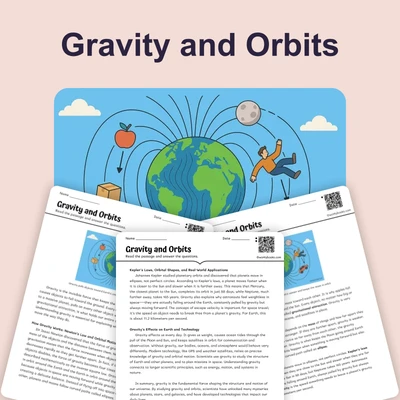
Gravity and Orbits
This comprehensive passage for grades 6-8 explains the science of gravity and orbits, aligning with NGSS standard MS-ESS...
MS-ESS1-2
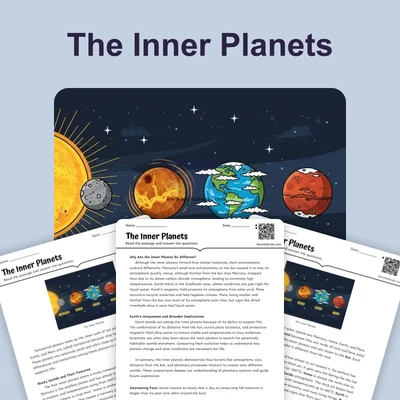
The Inner Planets
This comprehensive science passage for grades 6-8 explores the inner (terrestrial) planets of our solar system—Mercury, ...
MS-ESS1-2MS-ESS1-3
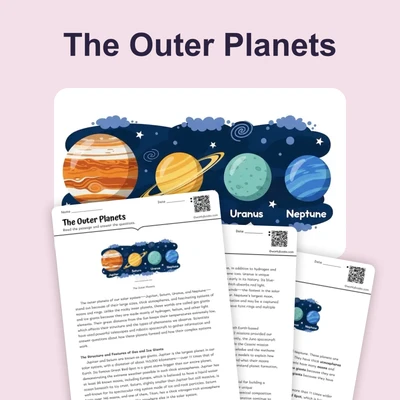
The Outer Planets
This engaging science passage for grades 6-8 introduces students to the outer planets—Jupiter, Saturn, Uranus, and Neptu...