Comets
Interactive passage with audio narration, comprehension questions, and printable PDF.
By completing this purchase you agree to our Terms of Use and Privacy Policy. Your subscription renews automatically until you cancel. You can cancel anytime from your account settings. All sales are final and non-refundable. Digital content is available for download in your account immediately upon purchase.
What's included
Comets preview and details
About this printable Comets science reading passage, NGSS-aligned (Grades 5-8)
Sample passage and quiz from Comets
Reading passage and comprehension quiz preview
Comets: Dirty Snowballs
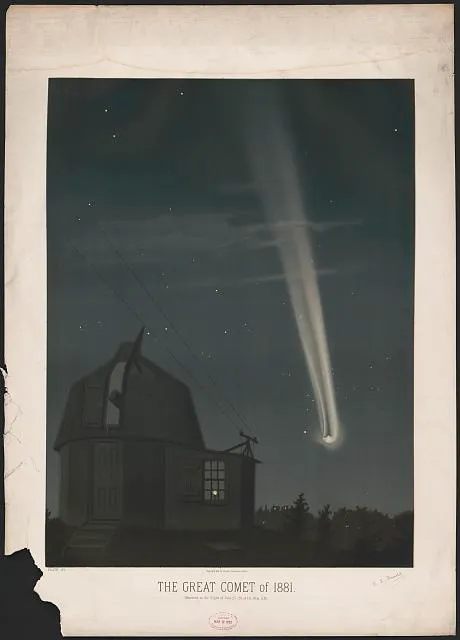
"The great comet of 1881, observed on the night of June 25-26, at 1h. 20m. A.M." / Library of Congress.
Comets are among the most dynamic and spectacular objects in our solar system. These icy wanderers are sometimes visible from Earth as brilliant streaks of light with glowing tails stretching across the night sky. Scientists study comets to understand the early history of our solar system and the processes that shaped it. Comets help answer questions about the origins of water and organic molecules on planets.
The Structure and Origins of Comets
Comets are often described as "dirty snowballs" or "icy dirtballs" due to their unique composition. Their solid center, called the nucleus, is made mainly of ice—such as water, carbon dioxide, methane, and ammonia—mixed with dust and rock. Most comet nuclei are only a few kilometers across, much smaller than planets. Comets come from two main regions: the Kuiper Belt, which is just beyond Neptune and produces short-period comets, and the distant Oort Cloud, the source of long-period comets. These regions act as reservoirs, storing icy bodies that occasionally get nudged toward the Sun by gravitational forces.
Comet Orbits and Their Dramatic Display
Comets travel around the Sun in highly elliptical orbits. This means they spend most of their time far from the Sun, moving slowly through deep space. When a comet’s path brings it closer to the Sun, solar heat causes the comet’s ice to undergo sublimation, transforming from a solid directly into a gas. The gas and dust released form a vast, glowing cloud around the nucleus called the coma. The coma can be larger than Jupiter itself. Solar radiation and wind then push this material away from the Sun, creating two distinct tails: a yellowish, curved dust tail and a bluish, straight ion tail. The dust tail is shaped by sunlight, while the ion tail is formed by charged solar particles and always points directly away from the Sun.
Types of Comets and Space Exploration
Comets are classified by the length of their orbits. Short-period comets take less than 200 years to orbit the Sun. For example, Halley’s Comet, which has a 76-year orbit, will next return in 2061. Long-period comets can take thousands or even millions of years to complete one orbit and may only visit the inner solar system once in recorded history. Scientific missions, like the European Space Agency’s Rosetta mission, have landed spacecraft on comets to study their surface and composition up close. In 2014, Rosetta’s lander Philae touched down on comet 67P/Churyumov-Gerasimenko, sending back valuable data about its makeup and behavior.
Studying comets gives scientists clues about the conditions that existed when the solar system formed. Because comets are made of ancient material, they act as time capsules preserving information about the distant past. Research on comets could also help us understand how water and organic molecules were delivered to Earth, possibly influencing the development of life. The interactions between comets and the Sun showcase the dynamic processes that shape our solar system.
Interesting Fact:
Some comet tails can stretch for millions of kilometers—long enough to span the distance from the Earth to the Moon and far beyond!
Comprehension quiz (10 questions)
1. What is the main component of a comet's nucleus?
2. Where do most short-period comets originate?
3. What happens when a comet gets close to the Sun?
4. What is the term for the cloud of gas and dust around a comet's nucleus?
5. In the passage, what does the word 'sublimation' mean?
6. What does the word 'elliptical' describe in relation to comets?
7. Why are comets considered important to study?
8. How does the ion tail of a comet behave as it approaches the Sun?
9. True or False: All comets return to the inner solar system every 76 years.
10. True or False: The Rosetta mission landed on a comet to study it up close.
Perfect for the way you teach
- Build comprehension skills
- Auto-graded quiz
- Differentiated reading
- Read together at home
- Improve fluency
- Quiet reading time
- Reading curriculum support
- Independent practice
- Track Lexile growth