This 400-500 word reading passage for grades 6-8 explains rocket propulsion through the lens of Newton's third law of motion, aligned with NGSS standard MS-PS2-2 and disciplinary core idea MS-PS2.A. Students explore how rockets generate thrust by expelling hot gases downward from their engines, creating an equal and opposite force that pushes the rocket upward. The passage includes real-world examples, such as the Saturn V rocket used in the Apollo 11 mission, and introduces key vocabulary terms including propulsion, thrust, combustion, exhaust, momentum, and action-reaction forces. Audio-integrated content supports diverse learners through multiple modalities. The passage emphasizes the force pair relationship central to Newton's third law without focusing on space travel details. Students engage with scientific practices through evidence-based language and real-world applications. Accompanying activities include comprehension questions, writing prompts, and graphic organizers that reinforce understanding of cause-effect relationships and the scientific concepts presented.
Written by Workybooks TeamPublished by Workybooks
Preview
Sample passage and quiz content
CONTENT PREVIEW
Expand content preview
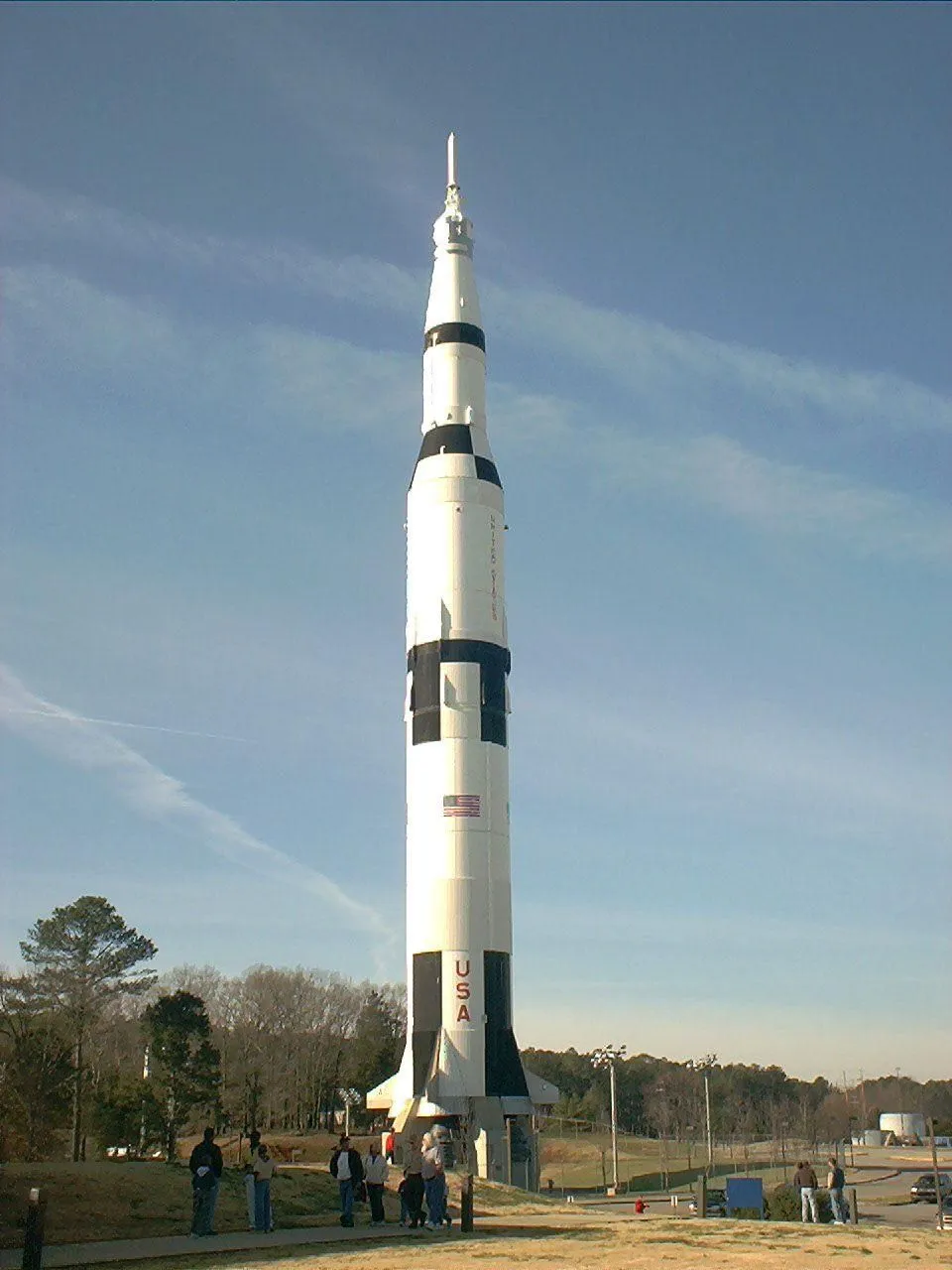
"Saturn v space rocket at us space and rocket center" by Steve Karg / Wikimedia Commons
Rockets work by using Newton's third law of motion, which states that for every action, there is an equal and opposite reaction. When a rocket engine burns fuel, it creates hot gases that shoot downward at high speed. This downward action creates an upward reaction that pushes the rocket in the opposite direction. Scientists explain this interaction as an action-reaction force pair.
Inside a rocket engine, combustion occurs when fuel and oxygen mix and burn. This chemical reaction produces extremely hot gases that expand rapidly. The engine directs these gases downward through a nozzle, creating a powerful stream of exhaust. As millions of gas molecules rush out of the engine, they push against the rocket with equal force in the opposite direction. This upward push is called thrust. The rocket does not push against the ground or air to move. Instead, the expelled gases provide the force needed for movement.
The amount of thrust depends on two factors: the mass of the expelled gases and their speed. Evidence shows that faster-moving gases or larger amounts of gas can produce more thrust. Engineers design rocket engines to maximize both factors. The momentum of the gases moving downward equals the momentum of the rocket moving upward. This relationship demonstrates the conservation of momentum, a fundamental principle in physics.
The Saturn V rocket that launched Apollo 11 to the Moon in 1969 demonstrates this principle on a massive scale. Its first-stage engines burned over 2,000 tons of fuel in just two and a half minutes. The engines expelled gases at speeds exceeding 8,000 miles per hour. This created enough thrust to lift the 6.2-million-pound rocket off the launch pad. Scientists observe that the same physics principles apply to all rockets, from small model rockets to massive space vehicles.
Understanding rocket propulsion matters because it explains how objects can move without pushing against anything. This knowledge helps engineers design better rockets for satellite launches, space exploration, and scientific research. The action-reaction force pairs that power rockets demonstrate fundamental physics laws that govern motion throughout the universe.
Interesting Fact: A rocket can work in the vacuum of space because it carries its own oxygen supply and does not need air to push against. The expelled gases alone provide all the force needed for movement.
According to the passage, what law of physics explains how rockets work?
Newton's first law of motionNewton's third law of motionThe law of gravityThe law of conservation of energy
What happens inside a rocket engine during combustion?
Fuel and oxygen mix and burn to create hot gasesWater turns into steamAir is compressed and cooledElectricity powers a motor
What does the term 'thrust' mean in the context of rocket propulsion?
The weight of the rocketThe downward force of expelled gasesThe upward push created by expelled gasesThe speed of the rocket
What two factors determine the amount of thrust a rocket produces?
The size of the rocket and the color of the flamesThe mass of expelled gases and their speedThe temperature outside and the rocket's weightThe type of metal used and the launch location
Based on the passage, why can rockets work in the vacuum of space?
They push against nearby planetsThey use solar powerThey carry their own oxygen and do not need air to push againstThey rely on magnetic forces
How does the momentum of expelled gases relate to the momentum of the rocket?
The gas momentum is greater than the rocket momentumThe gas momentum equals the rocket momentumThe gas momentum is less than the rocket momentumThere is no relationship between them
What real-world example does the passage use to demonstrate rocket propulsion?
The Space ShuttleA fireworkThe Saturn V rocket that launched Apollo 11A jet airplane
According to the passage, what creates the action-reaction force pair in a rocket?
Gravity pulling down and air pushing upHot gases shooting down and an equal force pushing the rocket upThe rocket pushing against the launch padWind resistance and forward motion
True or False: A rocket needs to push against the ground or air to move upward.
TrueFalse
True or False: The Saturn V rocket's first-stage engines burned over 2,000 tons of fuel in about two and a half minutes.
TrueFalse
Who it's for
Perfect for the way you teach
Teachers
Build comprehension skills
Auto-graded quiz
Differentiated reading
Parents
Read together at home
Improve fluency
Quiet reading time
Homeschoolers
Reading curriculum support
Independent practice
Track Lexile growth
Topics
rocketsNewton's third lawpropulsionthrustaction-reaction forcescombustionmomentumMS-PS2-2middle school physics
Reviews & Ratings
No reviews yet. Be the first to share your experience!
More reading you might love
20 more
What Is Force?
This passage, aligned to NGSS standards MS-PS2-1 and MS-PS2-2, provides a clear and age-appropriate explanation of force...
MS-PS2-1MS-PS2-2
Isaac Newton
This middle school science reading passage introduces students to Isaac Newton, one of the most influential scientists i...
MS-PS2-2
Newton's First Law
This middle school science passage introduces students to Newton's First Law of Motion, also called the Law of Inertia. ...
MS-PS2-1MS-PS2-2
Newton's Laws in Sports
This engaging science passage is designed for grades 6-8 and aligns with NGSS standards MS-PS2-1 and MS-PS2-2. It explor...
MS-PS2-1MS-PS2-2
Reference Points
This passage for grades 6-8 explores the critical role of reference points in measuring and describing motion, aligning ...
MS-PS2-2
Balanced and Unbalanced Forces
This informational science passage explores the core concepts of balanced and unbalanced forces as aligned with NGSS sta...
MS-PS2-1MS-PS2-2
Distance vs. Displacement
This informational science passage for grades 6-8 explores the key differences between distance and displacement, aligni...
MS-PS2-2
Speed
This comprehensive science passage for grades 6-8 introduces students to the concept of speed, aligned with NGSS standar...
MS-PS2-2
Velocity
This middle school science passage explores the concept of velocity as a vector quantity, meaning it includes both speed...
MS-PS2-2
Acceleration
This comprehensive passage introduces middle school students to the concept of acceleration, aligned with NGSS standard ...
MS-PS2-2
Graphing Motion
This passage introduces middle school students to the fundamental concepts of graphing motion, focusing on distance-time...
MS-PS2-2
Understanding Inertia
This comprehensive science passage introduces middle school students to the concept of inertia, a key property of matter...
MS-PS2-1MS-PS2-2
Newton's Second Law
This comprehensive passage introduces middle school students to Newton's Second Law of Motion, focusing on the core rela...
MS-PS2-1MS-PS2-2
Newton's Laws in Everyday Life
This comprehensive reading passage introduces middle school students to Newton's three laws of motion using relatable, e...
MS-PS2-1MS-PS2-2
What Are Fluids?
This comprehensive middle school science reading passage introduces the concept of fluids, focusing on the scientific de...
MS-PS2-2
Fluid Pressure
This engaging middle school science passage explores the concept of fluid pressure, aligned to NGSS standard MS-PS2-2. S...
MS-PS2-2
Why Things Float or Sink
This comprehensive science passage for grades 6-8 explains the fundamental principles behind why objects float or sink. ...
MS-PS2-2
Buoyancy and Archimedes' Principle
This comprehensive middle school science passage explores the principles of buoyancy and Archimedes' Principle, aligning...
MS-PS2-2
Pascal's Principle
This comprehensive passage introduces middle school students to Pascal's Principle, a key concept in physical science th...
MS-PS2-2
Air Pressure and the Atmosphere
This passage for grades 6-8 explores the concept of air pressure in the atmosphere, directly aligning with NGSS MS-PS2-2...