This learning resource is available in interactive and printable formats. The interactive worksheet can be played online and assigned to students. The Printable PDF version can be downloaded and printed for completion by hand.
This comprehensive science passage for grades 6-8 explains the fundamental principles behind why objects float or sink. Aligned with NGSS standard MS-PS2-2, it introduces students to the concepts of density and buoyancy, demonstrating how these forces interact in real-world systems like ships, submarines, and hot air balloons. The passage provides mechanistic explanations, cause-and-effect relationships, and quantitative reasoning, making it perfect for middle school learners. Glossary support, differentiated reading levels, and Spanish translations ensure accessibility for all students. Multiple choice questions, writing prompts, and graphic organizers encourage critical thinking and engagement. Audio integration is included for enhanced learning and accessibility. This resource is ideal for science teachers seeking rigorous, standards-based instructional materials.
CONTENT PREVIEW
Expand content preview
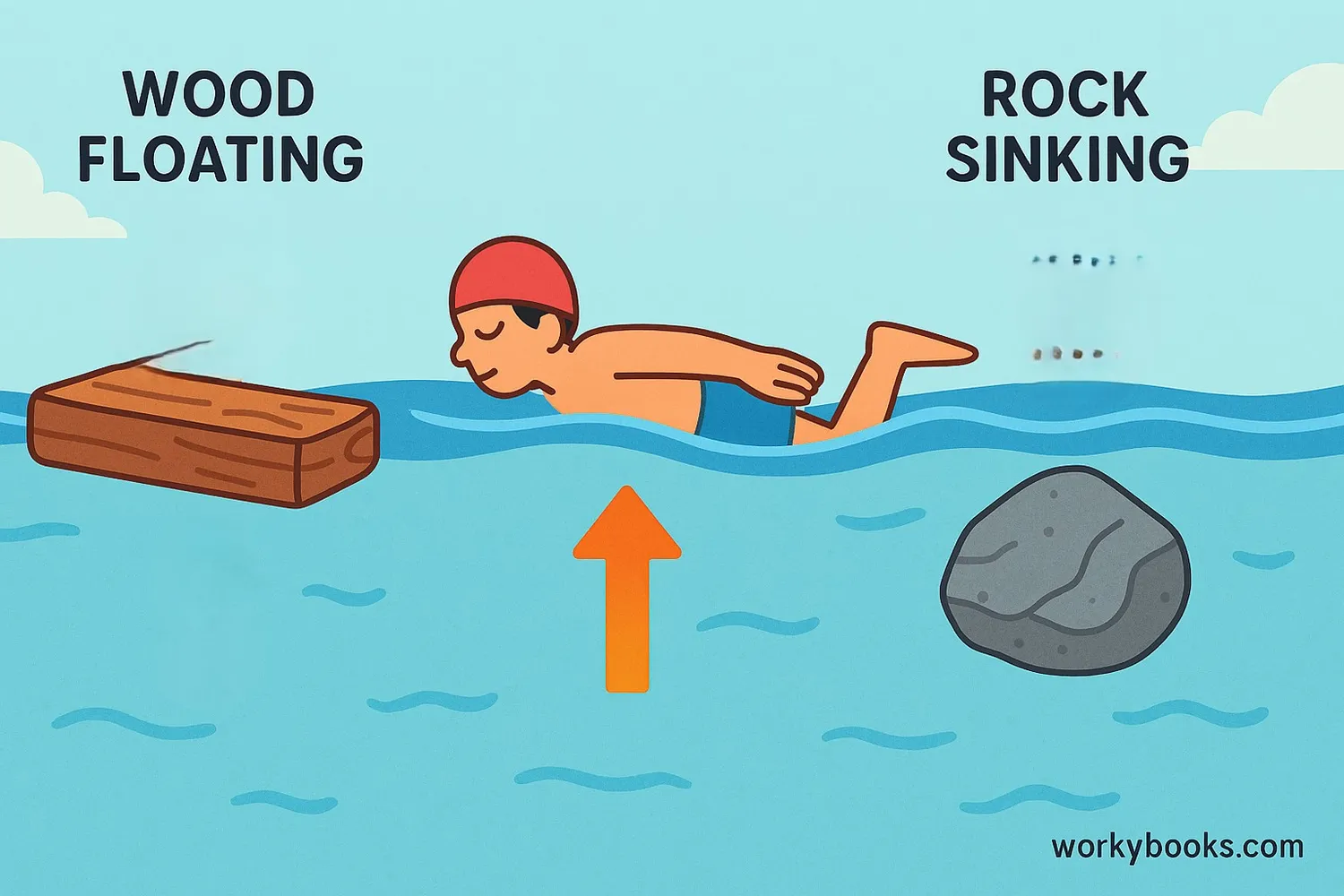
Illustration showing floating and sinking objects
Buoyancy helps explain why some objects float while others sink in a fluid, like water or air. This phenomenon is essential for understanding how ships travel across oceans, how submarines dive and resurface, and why hot air balloons rise into the sky. The main factor behind floating or sinking is the relationship between an object's density and the buoyant force acting upon it. Exploring these ideas helps us see how science shapes technology and daily life.
The Science of Buoyancy and Density
Every object placed in a fluid experiences an upward force called buoyant force. This force is equal to the weight of the fluid the object displaces. If the object's weight is less than or equal to this upward force, the object will float. If the weight is greater, it will sink. The key property that determines this balance is density, which is mass divided by volume. Objects with lower density than the fluid will float, while objects with higher density will sink. For example, a solid steel block sinks in water because its density is much higher than water. However, a large steel ship floats because its shape includes air-filled spaces, reducing its overall density below that of water.
Real-World Applications: Ships, Submarines, and Balloons
Understanding buoyancy and density has enabled humans to design remarkable machines. Ships are constructed with hulls that displace a large volume of water, creating enough buoyant force to support thousands of tons of cargo. Submarines use ballast tanks to control their density. By taking in water, submarines increase their density and sink. To rise, they expel water from the tanks, filling them with air and decreasing their density. Hot air balloons operate on a similar principle but use air instead of water. When air inside the balloon is heated, it becomes less dense than the cooler air around it, causing the balloon to rise due to the upward buoyant force.
Interacting Forces and Broader Implications
Buoyancy interacts with other forces, such as gravity, in every example. Designers must carefully calculate the volume and mass of ships and submarines to ensure safety and efficiency. The principle of displacement, described by Archimedes more than 2,000 years ago, is still fundamental to engineering today. Research continues to explore how these concepts affect ocean pollution, oil spills, and the development of new materials. The ability to control buoyancy and density has transformed transportation, exploration, and even recreation.
In summary, whether an object floats or sinks depends on the balance between its weight and the upward buoyant force from the fluid it displaces. By understanding and manipulating density and buoyant force, we have built ships, submarines, and balloons that shape our world. These concepts connect to the broader scientific principle of forces and motion, illustrating the power of science to solve real problems.
Interesting Fact: The largest ships today can carry over 20,000 containers, each weighing several tons, all thanks to the science of buoyancy and density!
What is the main reason an object floats or sinks in a fluid?
The relationship between its density and the buoyant force.Its color.Its temperature.Its shape only.
Which of the following best describes density?
Weight divided by volumeMass divided by volumeVolume divided by massHeight times width
If an object sinks in water, what does that mean about its density?
Its density is less than water.Its density is equal to water.Its density is greater than water.It has no density.
What is the purpose of ballast tanks in submarines?
To help control the submarine's density so it can rise or sink.To store food for the crew.To keep the submarine warm.To create energy for the engines.
What happens when a hot air balloon's air is heated?
The balloon becomes denser and sinks.The air inside becomes less dense and the balloon rises.The air inside becomes more dense and the balloon sinks.Nothing happens.
What does 'displace' mean in the context of buoyancy?
To move fluid out of the way when an object is placed in it.To change the color of an object.To heat up the air.To make something lighter.
Why does a steel ship float while a steel block sinks?
The ship's shape includes air spaces, lowering its overall density.The steel in ships is less dense than in blocks.Ships are lighter than steel blocks.Ships are painted a special color.
True or False: The buoyant force is always equal to the weight of fluid displaced.
TrueFalse
True or False: Objects always float if they are heavy.
TrueFalse
What scientific principle explains why things float or sink?
The principle of displacement described by Archimedes.Newton's law of motion.The theory of relativity.The law of conservation of energy.
Perfect For:
👩🏫 Teachers
• Reading comprehension practice
• Auto-graded assessments
• Literacy skill development
👨👩👧👦 Parents
• Reading practice at home
• Comprehension improvement
• Educational reading time
🏠 Homeschoolers
• Reading curriculum support
• Independent reading practice
• Progress monitoring
Reading Features:
📖
Reading Passage
Engaging fiction or nonfiction text
❓
Comprehension Quiz
Auto-graded questions
📊
Instant Feedback
Immediate results and scoring
📄
Printable Version
Download for offline reading
🔊
Read Aloud
Voice-over with word highlighting
Reviews & Ratings
No reviews yet. Be the first to share your experience!
Related Content
What Is Force?
This passage, aligned to NGSS standards MS-PS2-1 and MS-PS2-2, provides a clear and age-appropriate explanation of force...
MS-PS2-1MS-PS2-2
Isaac Newton
This middle school science reading passage introduces students to Isaac Newton, one of the most influential scientists i...
MS-PS2-2
Newton's First Law
This middle school science passage introduces students to Newton's First Law of Motion, also called the Law of Inertia. ...
MS-PS2-1MS-PS2-2
Newton's Laws in Sports
This engaging science passage is designed for grades 6-8 and aligns with NGSS standards MS-PS2-1 and MS-PS2-2. It explor...
MS-PS2-1MS-PS2-2
Reference Points
This passage for grades 6-8 explores the critical role of reference points in measuring and describing motion, aligning ...
MS-PS2-2
Balanced and Unbalanced Forces
This informational science passage explores the core concepts of balanced and unbalanced forces as aligned with NGSS sta...
MS-PS2-1MS-PS2-2
Distance vs. Displacement
This informational science passage for grades 6-8 explores the key differences between distance and displacement, aligni...
MS-PS2-2
Speed
This comprehensive science passage for grades 6-8 introduces students to the concept of speed, aligned with NGSS standar...
MS-PS2-2
Velocity
This middle school science passage explores the concept of velocity as a vector quantity, meaning it includes both speed...
MS-PS2-2
Acceleration
This comprehensive passage introduces middle school students to the concept of acceleration, aligned with NGSS standard ...
MS-PS2-2
Graphing Motion
This passage introduces middle school students to the fundamental concepts of graphing motion, focusing on distance-time...
MS-PS2-2
Understanding Inertia
This comprehensive science passage introduces middle school students to the concept of inertia, a key property of matter...
MS-PS2-1MS-PS2-2
Newton's Second Law
This comprehensive passage introduces middle school students to Newton's Second Law of Motion, focusing on the core rela...
MS-PS2-1MS-PS2-2
Newton's Laws in Everyday Life
This comprehensive reading passage introduces middle school students to Newton's three laws of motion using relatable, e...
MS-PS2-1MS-PS2-2
What Are Fluids?
This comprehensive middle school science reading passage introduces the concept of fluids, focusing on the scientific de...
MS-PS2-2
Fluid Pressure
This engaging middle school science passage explores the concept of fluid pressure, aligned to NGSS standard MS-PS2-2. S...
MS-PS2-2
Buoyancy and Archimedes' Principle
This comprehensive middle school science passage explores the principles of buoyancy and Archimedes' Principle, aligning...
MS-PS2-2
Pascal's Principle
This comprehensive passage introduces middle school students to Pascal's Principle, a key concept in physical science th...
MS-PS2-2
Air Pressure and the Atmosphere
This passage for grades 6-8 explores the concept of air pressure in the atmosphere, directly aligning with NGSS MS-PS2-2...