Buoyancy and Archimedes' Principle
Interactive passage with audio narration, comprehension questions, and printable PDF.
By completing this purchase you agree to our Terms of Use and Privacy Policy. Your subscription renews automatically until you cancel. You can cancel anytime from your account settings. All sales are final and non-refundable. Digital content is available for download in your account immediately upon purchase.
What's included
Buoyancy and Archimedes' Principle preview and details
About this printable Buoyancy and Archimedes' Principle science reading passage, NGSS-aligned (Grades 5-8)
Sample passage and quiz from Buoyancy and Archimedes' Principle
Reading passage and comprehension quiz preview
Buoyancy and Archimedes' Principle

Buoyancy determines whether objects float or sink when placed in liquids like water. This property is essential for understanding the behavior of boats, icebergs, and even human bodies in a swimming pool. The explanation for buoyancy lies in the upward force that fluids exert on objects, which can counteract the force of gravity. The principle that describes this phenomenon was first understood over two thousand years ago and remains a foundation of modern science and engineering.
How Buoyancy Works: The Mechanism Behind Floating
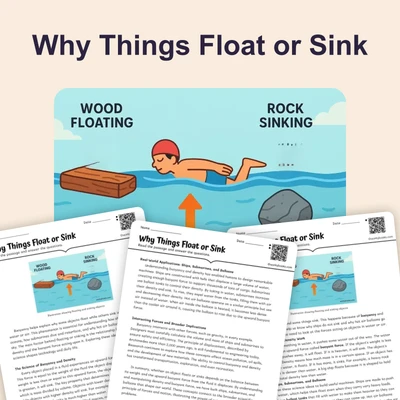
When an object is submerged in a fluid, such as water or air, it experiences an upward force called buoyant force. This force pushes against the object, opposing the downward pull of gravity. According to Archimedes' Principle, the buoyant force on an object is equal to the weight of the fluid the object displaces. For example, if a block displaces 500 grams of water, the upward force equals the weight of those 500 grams. This principle explains why objects often feel lighter in water: the water supports part of their weight.
The amount of fluid displaced depends on the volume of the object submerged. If the weight of the displaced fluid is greater than or equal to the object's weight, the object floats. If it is less, the object sinks. This cause-and-effect relationship is observed in daily life, such as when a steel ship floats despite steel being denser than water overall. The ship’s shape causes it to displace enough water to support its weight.
Density, Floating, and Sinking: Interacting Concepts
Density is a key factor in buoyancy. It describes how much mass is packed into a given volume. If an object’s density is less than the fluid’s, it will float. For example, wood floats in water because its density is lower than water’s density of about 1 gram per cubic centimeter. Rocks, with higher density, sink. Submarines adjust their ballast tanks to change overall density and control depth in the ocean. Icebergs float in the sea because solid ice is less dense than liquid water, causing only part of the iceberg to be visible above the surface while the rest remains underwater.
Understanding the relationship between density and buoyancy has led to advances in shipbuilding, the design of floating platforms, and safe water recreation equipment. Experiments show that objects with the same weight but different volumes can float or sink depending on how much fluid they displace. The interaction of these variables demonstrates the importance of scientific reasoning in real-world problem solving.
Applications and Broader Implications
Buoyancy is not only important in engineering and transportation, but also in environmental science and biology. Fish use swim bladders to regulate their position in water. Oil spills create layers on water because oil is less dense, which affects ecosystems. Scientists also use the principles of buoyancy to study ocean currents and climate patterns. These concepts all illustrate the interconnectedness of physical science and the natural world, showing how simple principles can explain complex phenomena.
In summary, buoyancy and Archimedes' Principle reveal how objects interact with fluids based on density, volume, and the forces involved. Recognizing these patterns helps us design better technology, protect the environment, and understand the world around us.
Interesting Fact: Archimedes reportedly discovered his principle while taking a bath, noticing that the water level rose as he got in. He famously ran through the streets shouting “Eureka!” which means “I have found it!” in Greek.
Comprehension quiz (10 questions)
1. What is the main idea of Archimedes' Principle?
2. Why do steel ships float even though steel is denser than water?
3. What does the term 'density' mean in the passage?
4. According to the passage, why do objects feel lighter in water?
5. Which example shows the use of ballast tanks?
6. Based on the passage, what will happen if an object’s density is less than water?
7. Which statement best explains why oil floats on water?
8. True or False: The buoyant force always equals the weight of the object.
9. True or False: Archimedes discovered his principle while swimming in the ocean.
10. What is one real-world application of buoyancy described in the passage?
Perfect for the way you teach
- Build comprehension skills
- Auto-graded quiz
- Differentiated reading
- Read together at home
- Improve fluency
- Quiet reading time
- Reading curriculum support
- Independent practice
- Track Lexile growth