This learning resource is available in interactive and printable formats. The interactive worksheet can be played online and assigned to students. The Printable PDF version can be downloaded and printed for completion by hand.
This comprehensive science passage for grades 6-8 introduces students to the concept of speed, aligned with NGSS standard MS-PS2-2. Students will learn how speed is defined as the distance traveled per unit of time, the formula for calculating speed, and the differences between average and instantaneous speed. The passage uses real-life examples, such as car speedometers, animal comparisons, and running races, to illustrate concepts and demonstrate how speed is measured and applied in daily life and scientific research. It integrates academic vocabulary, provides a glossary, and includes Spanish translations and differentiated versions for accessibility. Activities include comprehension questions, writing prompts, and graphic organizers. All content is audio integrated for diverse learners. This resource is ideal for building foundational physics knowledge and supporting science literacy in the middle grades.
CONTENT PREVIEW
Expand content preview
Speed
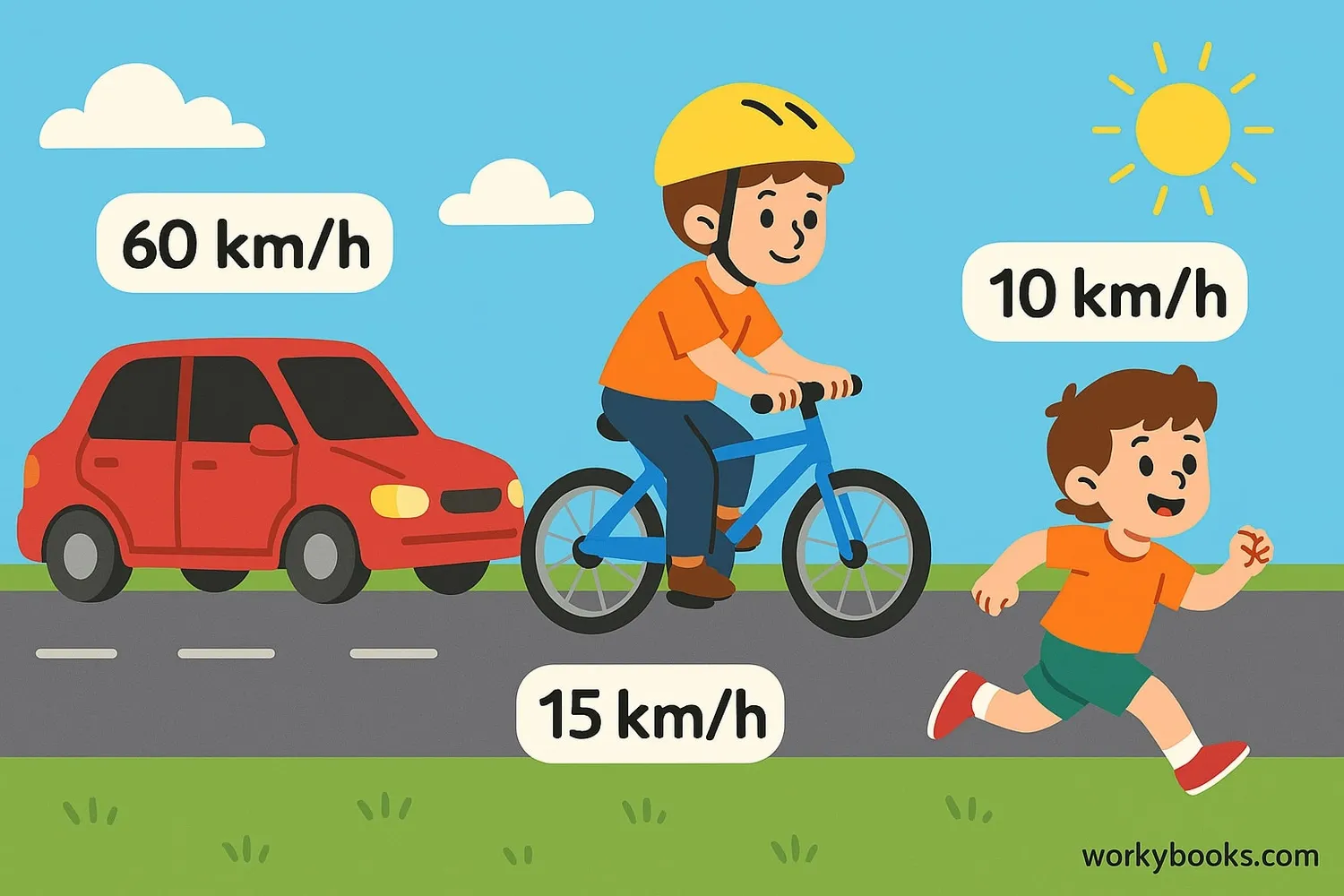
Speed is a key concept in physics that describes how quickly something moves from one place to another. When a car travels down a highway, its speed tells us how many miles it covers in a certain amount of time. Scientists use speed to analyze motion in everything from running athletes to orbiting planets. Understanding speed is essential for solving problems in transportation, engineering, and even biology.
The main idea behind speed is that it measures the distance an object travels divided by the time it takes to travel that distance. The formula for speed is: speed = distance ÷ time. Common units for speed include meters per second (m/s), kilometers per hour (km/h), and miles per hour (mph). For example, if a runner covers 100 meters in 20 seconds, the speed is 5 m/s. Speed is considered a scalar quantity, which means it only has magnitude and not direction, unlike velocity.
Types of Speed: Instantaneous and Average
There are two main ways to describe speed: instantaneous speed and average speed. Instantaneous speed is the speed of an object at a specific moment, like what a car's speedometer shows at any given second. Average speed, on the other hand, is calculated over the total journey, dividing the total distance by the total time. For example, if a cyclist rides 30 kilometers in 2 hours, the average speed is 15 km/h, even if the cyclist went faster or slower at different points. Scientists use both types to understand patterns and changes in motion.
Applications and Examples of Speed
Speed is measured and compared in many ways. In sports, athletes aim to increase their speed to win races. The fastest human, Usain Bolt, reached a top speed of about 27.8 mph during a 100-meter race. Animals like cheetahs can sprint up to 70 mph for short distances. Cars, planes, and trains are all designed with speed in mind, and engineers must understand how speed interacts with friction and air resistance. Speed is also important for safety—knowing how fast vehicles travel helps set speed limits and prevent accidents.
Speed in the Bigger Picture
Speed does not act alone; it is connected to other scientific concepts like acceleration and force. For example, increasing speed means an object is accelerating, which requires a force to be applied. In nature, animals have evolved different speeds to survive, hunt, or escape danger. Scientists study these adaptations to learn more about ecosystems and evolution. Understanding speed helps us design better technology, improve transportation systems, and make informed decisions about safety and the environment.
Speed is more than just a number; it reveals how things move and interact in our world. By measuring and comparing speed, we gain insights into everything from sports performance to natural phenomena and technological innovations.
Interesting Fact: The fastest land animal is the cheetah, which can reach speeds of up to 70 miles per hour—but only for about 20 seconds!
What is the basic formula for calculating speed?
Speed = distance ÷ timeSpeed = time ÷ distanceSpeed = distance × timeSpeed = time × velocity
Which unit is NOT commonly used to measure speed?
Meters per second (m/s)Kilometers per hour (km/h)Miles per hour (mph)Liters per minute (L/min)
What does a speedometer show?
The instantaneous speed of a vehicleThe average speed of a vehicleThe direction of a vehicleThe friction acting on a vehicle
According to the passage, why do engineers care about speed when designing vehicles?
To make vehicles heavierTo improve safety and performanceTo increase air resistanceTo reduce the distance traveled
How is 'velocity' different from 'speed'?
Velocity has direction, speed does notSpeed has direction, velocity does notBoth measure direction onlyThey are exactly the same
What is one real-world example of using speed for safety mentioned in the passage?
Setting speed limits on roadsMeasuring the weight of a carCounting the number of carsPainting cars different colors
Which animal is mentioned as the fastest land animal?
LionCheetahHorseKangaroo
True or False: Average speed is calculated by dividing total distance by total time.
TrueFalse
True or False: Speed is a vector quantity.
TrueFalse
If a runner covers 200 meters in 40 seconds, what is their speed?
5 m/s8 m/s10 m/s20 m/s
Perfect For:
👩🏫 Teachers
• Reading comprehension practice
• Auto-graded assessments
• Literacy skill development
👨👩👧👦 Parents
• Reading practice at home
• Comprehension improvement
• Educational reading time
🏠 Homeschoolers
• Reading curriculum support
• Independent reading practice
• Progress monitoring
Reading Features:
📖
Reading Passage
Engaging fiction or nonfiction text
❓
Comprehension Quiz
Auto-graded questions
📊
Instant Feedback
Immediate results and scoring
📄
Printable Version
Download for offline reading
🔊
Read Aloud
Voice-over with word highlighting
Reviews & Ratings
No reviews yet. Be the first to share your experience!
Related Content
What Is Force?
This passage, aligned to NGSS standards MS-PS2-1 and MS-PS2-2, provides a clear and age-appropriate explanation of force...
MS-PS2-1MS-PS2-2
Isaac Newton
This middle school science reading passage introduces students to Isaac Newton, one of the most influential scientists i...
MS-PS2-2
Newton's First Law
This middle school science passage introduces students to Newton's First Law of Motion, also called the Law of Inertia. ...
MS-PS2-1MS-PS2-2
Newton's Laws in Sports
This engaging science passage is designed for grades 6-8 and aligns with NGSS standards MS-PS2-1 and MS-PS2-2. It explor...
MS-PS2-1MS-PS2-2
Reference Points
This passage for grades 6-8 explores the critical role of reference points in measuring and describing motion, aligning ...
MS-PS2-2
Balanced and Unbalanced Forces
This informational science passage explores the core concepts of balanced and unbalanced forces as aligned with NGSS sta...
MS-PS2-1MS-PS2-2
Distance vs. Displacement
This informational science passage for grades 6-8 explores the key differences between distance and displacement, aligni...
MS-PS2-2
Velocity
This middle school science passage explores the concept of velocity as a vector quantity, meaning it includes both speed...
MS-PS2-2
Acceleration
This comprehensive passage introduces middle school students to the concept of acceleration, aligned with NGSS standard ...
MS-PS2-2
Graphing Motion
This passage introduces middle school students to the fundamental concepts of graphing motion, focusing on distance-time...
MS-PS2-2
Understanding Inertia
This comprehensive science passage introduces middle school students to the concept of inertia, a key property of matter...
MS-PS2-1MS-PS2-2
Newton's Second Law
This comprehensive passage introduces middle school students to Newton's Second Law of Motion, focusing on the core rela...
MS-PS2-1MS-PS2-2
Newton's Laws in Everyday Life
This comprehensive reading passage introduces middle school students to Newton's three laws of motion using relatable, e...
MS-PS2-1MS-PS2-2
What Are Fluids?
This comprehensive middle school science reading passage introduces the concept of fluids, focusing on the scientific de...
MS-PS2-2
Fluid Pressure
This engaging middle school science passage explores the concept of fluid pressure, aligned to NGSS standard MS-PS2-2. S...
MS-PS2-2
Why Things Float or Sink
This comprehensive science passage for grades 6-8 explains the fundamental principles behind why objects float or sink. ...
MS-PS2-2
Buoyancy and Archimedes' Principle
This comprehensive middle school science passage explores the principles of buoyancy and Archimedes' Principle, aligning...
MS-PS2-2
Pascal's Principle
This comprehensive passage introduces middle school students to Pascal's Principle, a key concept in physical science th...
MS-PS2-2
Air Pressure and the Atmosphere
This passage for grades 6-8 explores the concept of air pressure in the atmosphere, directly aligning with NGSS MS-PS2-2...