This learning resource is available in interactive and printable formats. The interactive worksheet can be played online and assigned to students. The Printable PDF version can be downloaded and printed for completion by hand.
This comprehensive passage introduces middle school students to the concept of acceleration, aligned with NGSS standard MS-PS2-2. Students will learn that acceleration is the change in velocity over time, including both speeding up, slowing down (deceleration), and changes in direction. The passage explains the acceleration formula (a = (final velocity - initial velocity) ÷ time), provides real-world examples like cars, roller coasters, and braking, and discusses how acceleration is measured. Academic vocabulary is embedded and supported by a glossary. The passage encourages scientific thinking by explaining how scientists observe and measure acceleration in various contexts. Additionally, the resource includes differentiated versions for accessibility, Spanish translations, interactive activities, quizzes, and graphic organizers. This makes it ideal for classroom use, homework, or independent study. Audio integration supports diverse learners, enhancing comprehension and engagement.
CONTENT PREVIEW
Expand content preview
Acceleration
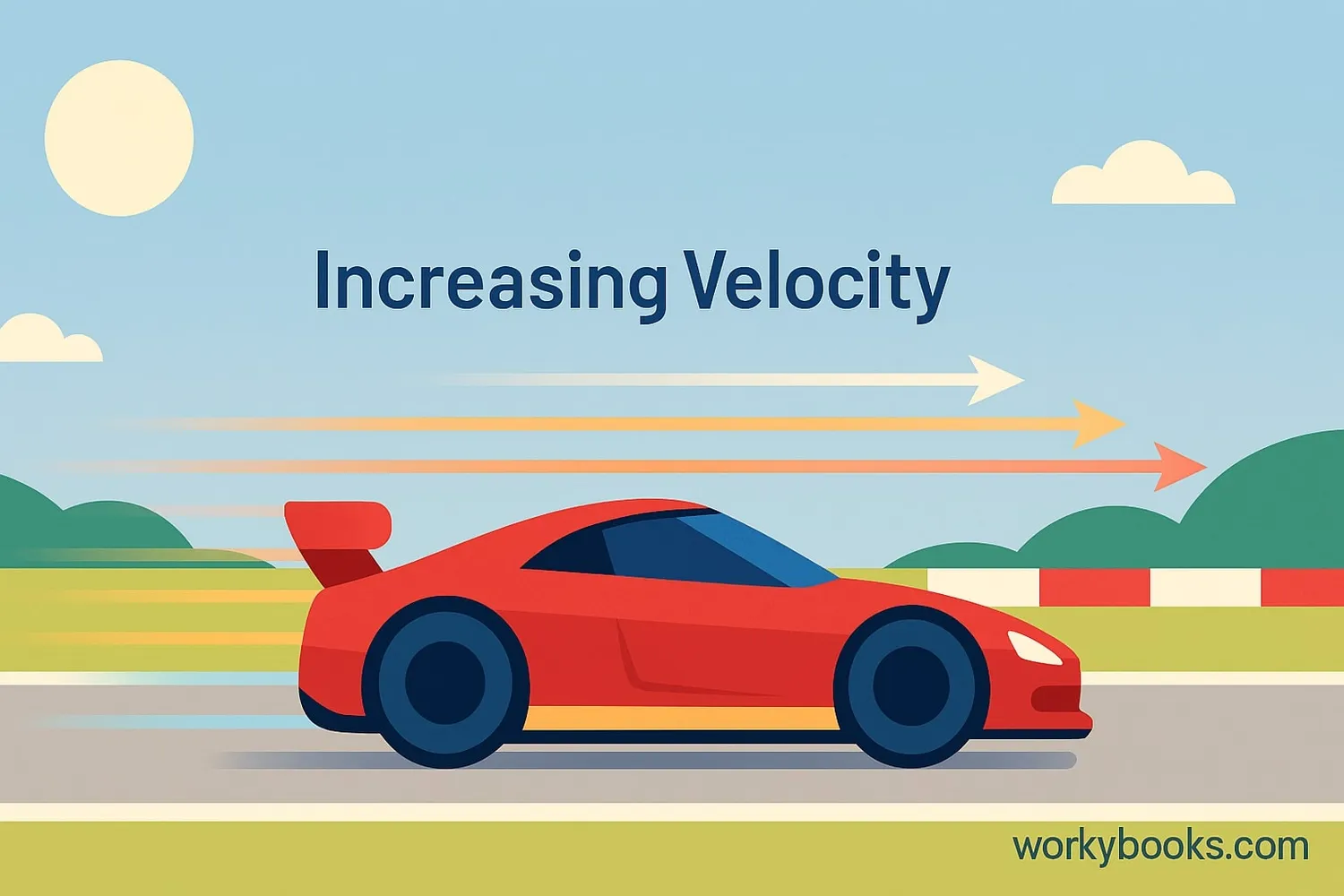
Acceleration is a key concept in physical science, describing how an object’s velocity changes over time. In the world around us, acceleration is observed whenever something speeds up, slows down, or changes direction. For example, a car leaving a stoplight, a roller coaster racing down a track, and a soccer ball curving during a kick all experience acceleration. Understanding acceleration helps scientists and engineers design safer vehicles, predict motion, and explore the forces that shape our world.
How Acceleration Works
Acceleration happens when the velocity of an object changes. Velocity means both the speed and the direction of motion. If the speed increases, it is called positive acceleration. If the speed decreases, it is called negative acceleration or deceleration. Acceleration can also occur if the direction changes, even if the speed stays the same. The formula for acceleration is: a = (final velocity - initial velocity) ÷ time. This means you subtract the starting velocity from the final velocity and then divide by the amount of time the change took. For instance, if a car goes from 0 to 20 meters per second in 4 seconds, its acceleration is (20 - 0) ÷ 4 = 5 meters per second squared (m/s²).
Types and Examples of Acceleration
There are several ways objects accelerate. When a roller coaster speeds up going down a hill, that is positive acceleration. When it slows at the end of the ride, that is negative acceleration or deceleration. Turning a corner at constant speed is also acceleration because the direction of motion changes. Scientists use tools like speedometers and motion sensors to measure acceleration in real time. Engineers use this information to design safer cars that can stop quickly or to build amusement park rides that thrill but protect riders. Athletes also rely on understanding acceleration to improve performance in sports.
Acceleration in the Real World
Acceleration is connected to the larger idea of force. According to Newton’s Second Law of Motion, acceleration happens when a force acts on a mass. The greater the force, the greater the acceleration, if the mass remains the same. For example, when you brake a bicycle, the force of the brakes causes negative acceleration, slowing the bike down. In space, rockets accelerate by expelling gas at high speed, demonstrating how force changes velocity over time. Scientists observe acceleration in natural events too, like the motion of asteroids or the changes in wind direction during storms.
Understanding acceleration helps us predict motion, design technology, and stay safe. Whether driving, playing sports, or studying the universe, acceleration shows how things move and change. It connects to core principles of physics and helps us make sense of both everyday life and extraordinary phenomena.
Interesting Fact: Some roller coasters accelerate riders from 0 to 60 miles per hour in under three seconds using powerful magnetic forces!
What does acceleration describe in science?
How velocity changes over timeOnly how fast something movesThe weight of an objectThe color of an object
Which of these is NOT an example of acceleration?
A runner staying at the same speed and directionA car speeding up after a stoplight turns greenA roller coaster slowing down at the end of the rideA soccer ball curving through the air
What does it mean if an object has negative acceleration?
It is slowing downIt is speeding upIt is moving backwardIt is not moving
What does the formula a = (final velocity - initial velocity) ÷ time calculate?
AccelerationForceDistanceWeight
What tool do scientists use to measure how fast an object is moving?
SpeedometerThermometerBarometerMicroscope
According to Newton’s Second Law, what causes acceleration?
A force acting on a massOnly gravityTemperature changeLight energy
If a roller coaster turns a corner at constant speed, is it accelerating?
Yes, because its direction changesNo, because its speed is constant
True or False: Deceleration is another word for negative acceleration.
TrueFalse
True or False: Acceleration only occurs when something speeds up.
FalseTrue
Which statement best connects acceleration to real-world technology?
Engineers use knowledge of acceleration to make safer carsAcceleration is not important for engineersCars never accelerateAcceleration only happens in space
Perfect For:
👩🏫 Teachers
• Reading comprehension practice
• Auto-graded assessments
• Literacy skill development
👨👩👧👦 Parents
• Reading practice at home
• Comprehension improvement
• Educational reading time
🏠 Homeschoolers
• Reading curriculum support
• Independent reading practice
• Progress monitoring
Reading Features:
📖
Reading Passage
Engaging fiction or nonfiction text
❓
Comprehension Quiz
Auto-graded questions
📊
Instant Feedback
Immediate results and scoring
📄
Printable Version
Download for offline reading
🔊
Read Aloud
Voice-over with word highlighting
Reviews & Ratings
No reviews yet. Be the first to share your experience!
Related Content
What Is Force?
This passage, aligned to NGSS standards MS-PS2-1 and MS-PS2-2, provides a clear and age-appropriate explanation of force...
MS-PS2-1MS-PS2-2
Isaac Newton
This middle school science reading passage introduces students to Isaac Newton, one of the most influential scientists i...
MS-PS2-2
Newton's First Law
This middle school science passage introduces students to Newton's First Law of Motion, also called the Law of Inertia. ...
MS-PS2-1MS-PS2-2
Newton's Laws in Sports
This engaging science passage is designed for grades 6-8 and aligns with NGSS standards MS-PS2-1 and MS-PS2-2. It explor...
MS-PS2-1MS-PS2-2
Reference Points
This passage for grades 6-8 explores the critical role of reference points in measuring and describing motion, aligning ...
MS-PS2-2
Balanced and Unbalanced Forces
This informational science passage explores the core concepts of balanced and unbalanced forces as aligned with NGSS sta...
MS-PS2-1MS-PS2-2
Distance vs. Displacement
This informational science passage for grades 6-8 explores the key differences between distance and displacement, aligni...
MS-PS2-2
Speed
This comprehensive science passage for grades 6-8 introduces students to the concept of speed, aligned with NGSS standar...
MS-PS2-2
Velocity
This middle school science passage explores the concept of velocity as a vector quantity, meaning it includes both speed...
MS-PS2-2
Graphing Motion
This passage introduces middle school students to the fundamental concepts of graphing motion, focusing on distance-time...
MS-PS2-2
Understanding Inertia
This comprehensive science passage introduces middle school students to the concept of inertia, a key property of matter...
MS-PS2-1MS-PS2-2
Newton's Second Law
This comprehensive passage introduces middle school students to Newton's Second Law of Motion, focusing on the core rela...
MS-PS2-1MS-PS2-2
Newton's Laws in Everyday Life
This comprehensive reading passage introduces middle school students to Newton's three laws of motion using relatable, e...
MS-PS2-1MS-PS2-2
What Are Fluids?
This comprehensive middle school science reading passage introduces the concept of fluids, focusing on the scientific de...
MS-PS2-2
Fluid Pressure
This engaging middle school science passage explores the concept of fluid pressure, aligned to NGSS standard MS-PS2-2. S...
MS-PS2-2
Why Things Float or Sink
This comprehensive science passage for grades 6-8 explains the fundamental principles behind why objects float or sink. ...
MS-PS2-2
Buoyancy and Archimedes' Principle
This comprehensive middle school science passage explores the principles of buoyancy and Archimedes' Principle, aligning...
MS-PS2-2
Pascal's Principle
This comprehensive passage introduces middle school students to Pascal's Principle, a key concept in physical science th...
MS-PS2-2
Air Pressure and the Atmosphere
This passage for grades 6-8 explores the concept of air pressure in the atmosphere, directly aligning with NGSS MS-PS2-2...