This learning resource is available in interactive and printable formats. The interactive worksheet can be played online and assigned to students. The Printable PDF version can be downloaded and printed for completion by hand.
This middle school science reading passage introduces students to Isaac Newton, one of the most influential scientists in history. Aligned to NGSS MS-PS2-2, the passage explores Newton's life, the historical context of his discoveries, and his groundbreaking work on motion, gravity, light, and mathematics. Students learn how Newton built upon Galileo's observations and developed the laws of motion and universal gravitation, changing the way we understand how objects interact. The passage also addresses the famous apple story, separating myth from fact, and highlights Newton’s curiosity and persistence as qualities that drive scientific discovery. Real-world applications and connections to modern science are included. Activities such as a glossary, multiple-choice quiz, writing prompts, and graphic organizers help students engage deeply with the content. The resources are designed for grades 6-8 and feature audio integration options for accessibility. This comprehensive package provides everything teachers need to inspire students and support standards-based science instruction.
CONTENT PREVIEW
Expand content preview
Isaac Newton: The Scientist Who Changed How We See the World
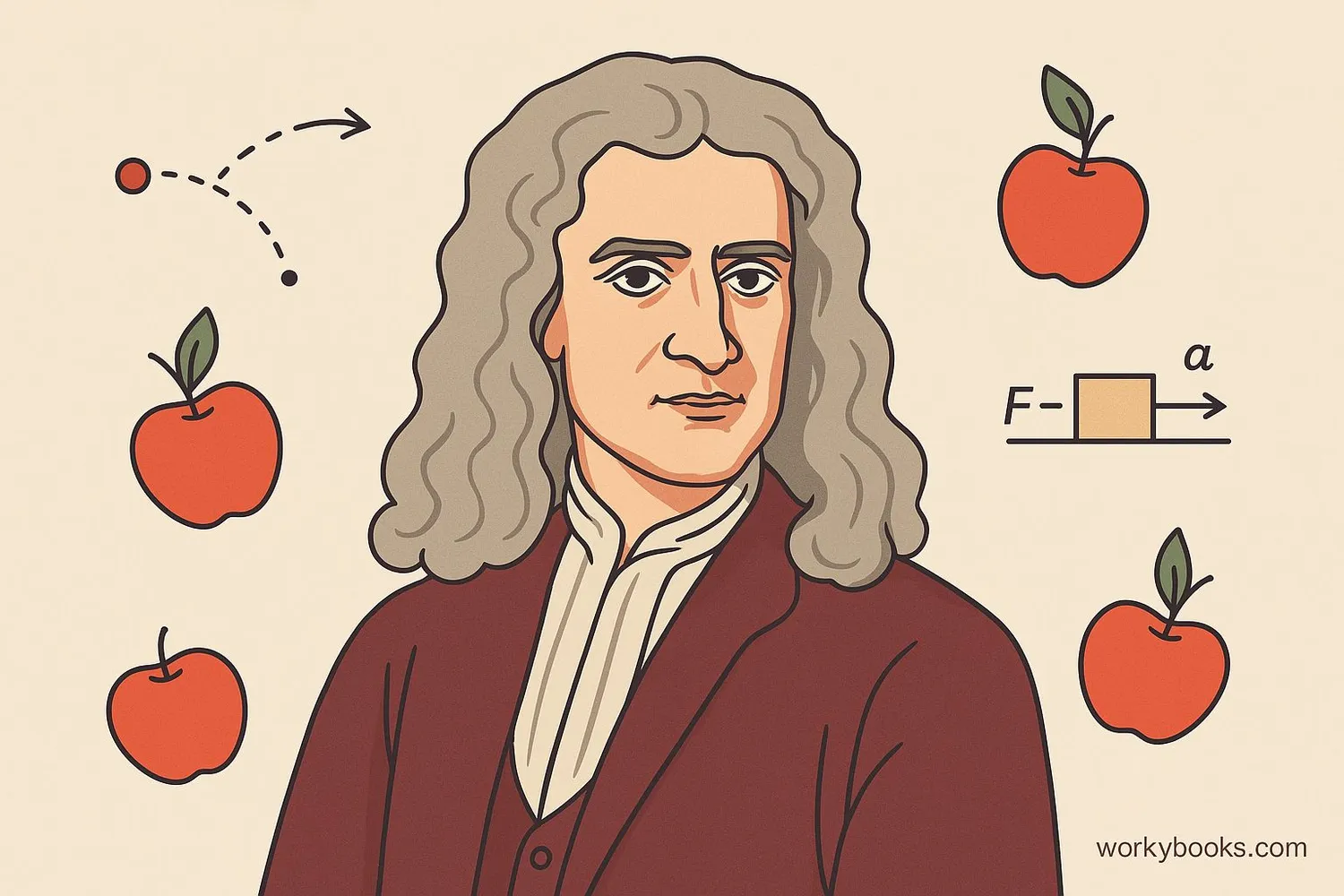
Isaac Newton is considered one of the most influential scientists of all time. In the 1600s, many people were trying to understand why objects move and how forces work. Newton’s discoveries answered important questions about the natural world. Today, his ideas help us explain everything from falling apples to the motion of planets. Newton’s curiosity and persistence led to discoveries that still shape science and technology.
The Laws of Motion and Gravity Newton’s most famous work focused on motion and gravity. He developed three laws of motion that describe how objects move when forces act on them. For example, the first law says that an object will stay at rest or keep moving in a straight line unless a force changes its motion. The second law connects force, mass, and acceleration with the formula F = ma. The third law states that for every action, there is an equal and opposite reaction. Newton also discovered universal gravitation. He explained that gravity is a force that pulls objects together. The strength of gravity depends on the masses of the objects and the distance between them. Newton realized that the force pulling an apple to the ground is the same force that keeps the Moon orbiting Earth. This idea connected observations on Earth with the motion of planets in space.
Light, Mathematics, and Building on Galileo Newton’s curiosity extended beyond gravity. He studied light and discovered that white light is made up of many colors. Using a prism, he showed how light can be split into a spectrum of colors, changing how people thought about light. Newton was also a brilliant mathematician. He invented a type of mathematics called calculus, which helps scientists describe and predict changing systems. Newton built on the work of earlier scientists like Galileo. Galileo’s experiments with falling objects inspired Newton to ask deeper questions about how and why things move. By connecting ideas from different fields, Newton created a new way to understand the universe.
Myth vs. Reality: The Apple Story The story of Newton discovering gravity when an apple fell on his head is mostly a myth. Historical records show that Newton did see an apple fall, which made him wonder why things always fall straight down. He used careful observation, experiments, and mathematical reasoning to explain gravity. Newton’s process shows how scientific discoveries often start with simple questions and observations, but require years of thought, testing, and evidence to understand fully.
Newton’s discoveries changed science forever. His laws of motion and gravity are used in engineering, space exploration, and everyday life. By combining curiosity, careful observation, and mathematics, Newton helped create modern science. His work reminds us that asking questions and seeking evidence can lead to new knowledge and understanding.
Interesting Fact: Newton wrote more about alchemy and religion than about science, but it was his scientific work that changed the world!
Who is Isaac Newton?
A scientist who studied motion, gravity, and lightA famous artist from ItalyA mathematician from ancient GreeceA king of England
What does Newton's second law of motion describe?
The relationship between force, mass, and accelerationHow light is separated into colorsHow gravity keeps planets in orbitWhy objects keep moving unless stopped
What real-world example did Newton use to explain gravity?
The falling of an appleThe boiling of waterThe shining of the sunThe growth of plants
What is the 'spectrum' according to Newton’s research?
The range of colors in white lightA list of scientific lawsThe orbit of a planetA type of force
Which scientist inspired Newton’s questions about falling objects?
GalileoEinsteinDarwinCopernicus
In the passage, what does the word 'persistence' mean?
Never giving up, even when things are difficultBeing very fast at solving problemsMaking many mistakesIgnoring questions
What does 'universal gravitation' mean?
Gravity works everywhere and affects all objects with massGravity only affects applesGravity only works on EarthGravity is a type of light
How did Newton change the way people understand the universe?
He connected ideas from different fields and explained the laws of motion and gravityHe invented the telescopeHe discovered electricityHe was the first person to write about math
Newton’s scientific discoveries are still used in engineering and space exploration. (True/False)
TrueFalse
The story of the apple falling on Newton’s head is completely true. (True/False)
FalseTrue
Perfect For:
👩🏫 Teachers
• Reading comprehension practice
• Auto-graded assessments
• Literacy skill development
👨👩👧👦 Parents
• Reading practice at home
• Comprehension improvement
• Educational reading time
🏠 Homeschoolers
• Reading curriculum support
• Independent reading practice
• Progress monitoring
Reading Features:
📖
Reading Passage
Engaging fiction or nonfiction text
❓
Comprehension Quiz
Auto-graded questions
📊
Instant Feedback
Immediate results and scoring
📄
Printable Version
Download for offline reading
🔊
Read Aloud
Voice-over with word highlighting
Reviews & Ratings
No reviews yet. Be the first to share your experience!
Related Content
What Is Force?
This passage, aligned to NGSS standards MS-PS2-1 and MS-PS2-2, provides a clear and age-appropriate explanation of force...
MS-PS2-1MS-PS2-2
Newton's First Law
This middle school science passage introduces students to Newton's First Law of Motion, also called the Law of Inertia. ...
MS-PS2-1MS-PS2-2
Newton's Laws in Sports
This engaging science passage is designed for grades 6-8 and aligns with NGSS standards MS-PS2-1 and MS-PS2-2. It explor...
MS-PS2-1MS-PS2-2
Reference Points
This passage for grades 6-8 explores the critical role of reference points in measuring and describing motion, aligning ...
MS-PS2-2
Balanced and Unbalanced Forces
This informational science passage explores the core concepts of balanced and unbalanced forces as aligned with NGSS sta...
MS-PS2-1MS-PS2-2
Distance vs. Displacement
This informational science passage for grades 6-8 explores the key differences between distance and displacement, aligni...
MS-PS2-2
Speed
This comprehensive science passage for grades 6-8 introduces students to the concept of speed, aligned with NGSS standar...
MS-PS2-2
Velocity
This middle school science passage explores the concept of velocity as a vector quantity, meaning it includes both speed...
MS-PS2-2
Acceleration
This comprehensive passage introduces middle school students to the concept of acceleration, aligned with NGSS standard ...
MS-PS2-2
Graphing Motion
This passage introduces middle school students to the fundamental concepts of graphing motion, focusing on distance-time...
MS-PS2-2
Understanding Inertia
This comprehensive science passage introduces middle school students to the concept of inertia, a key property of matter...
MS-PS2-1MS-PS2-2
Newton's Second Law
This comprehensive passage introduces middle school students to Newton's Second Law of Motion, focusing on the core rela...
MS-PS2-1MS-PS2-2
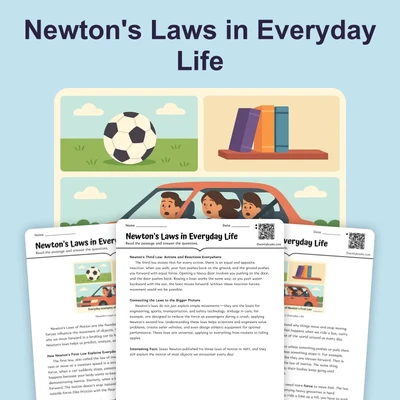
Newton's Laws in Everyday Life
This comprehensive reading passage introduces middle school students to Newton's three laws of motion using relatable, e...
MS-PS2-1MS-PS2-2
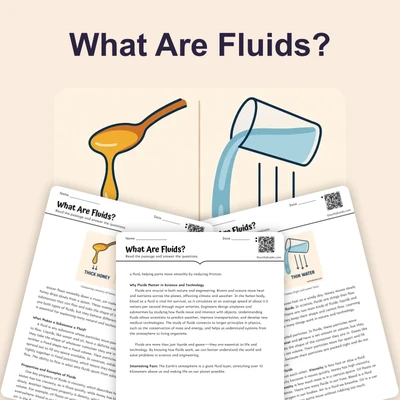
What Are Fluids?
This comprehensive middle school science reading passage introduces the concept of fluids, focusing on the scientific de...
MS-PS2-2
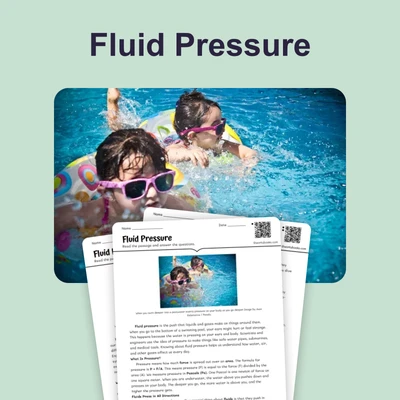
Fluid Pressure
This engaging middle school science passage explores the concept of fluid pressure, aligned to NGSS standard MS-PS2-2. S...
MS-PS2-2
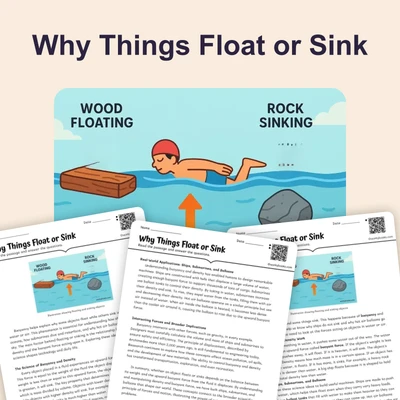
Why Things Float or Sink
This comprehensive science passage for grades 6-8 explains the fundamental principles behind why objects float or sink. ...
MS-PS2-2
Buoyancy and Archimedes' Principle
This comprehensive middle school science passage explores the principles of buoyancy and Archimedes' Principle, aligning...
MS-PS2-2
Pascal's Principle
This comprehensive passage introduces middle school students to Pascal's Principle, a key concept in physical science th...
MS-PS2-2
Air Pressure and the Atmosphere
This passage for grades 6-8 explores the concept of air pressure in the atmosphere, directly aligning with NGSS MS-PS2-2...