This learning resource is available in interactive and printable formats. The interactive worksheet can be played online and assigned to students. The Printable PDF version can be downloaded and printed for completion by hand.
This passage for grades 6-8 explores the critical role of reference points in measuring and describing motion, aligning with NGSS standard MS-PS2-2. Students learn how scientists use frames of reference to observe and quantify movement, and why the same motion can appear different depending on the observer’s position. Real-life examples, such as standing versus walking on an escalator and observing car motion from different viewpoints, help students connect the concept to everyday experiences. The passage integrates cause-and-effect reasoning to show how reference points influence our perception of speed and direction. Vocabulary terms are highlighted and defined, and activities include a multiple-choice quiz, writing prompts, and graphic organizers to deepen understanding. Spanish translations and a differentiated version ensure accessibility for all learners. Audio integration supports diverse student needs. This comprehensive lesson helps students build a strong foundation in physics and scientific thinking, preparing them for advanced topics in force and motion.
CONTENT PREVIEW
Expand content preview
Understanding motion requires a fixed reference point for clear communication and measurement.
Motion is a fundamental concept in science, but describing it accurately requires more than just observing objects as they move. To measure and explain motion, scientists always use a reference point. A reference point is a fixed place or object used to determine if something else is moving. The importance of reference points can be seen in everyday life, from riding escalators in shopping malls to watching cars on the road. Understanding reference points helps us communicate, calculate, and predict how objects move in the world around us.
What is a Frame of Reference? A frame of reference is a set of objects, distances, and directions used to describe the position and motion of something. For example, if you are standing still on an escalator, the escalator itself might be your reference point. However, if you are walking on that moving escalator, your motion could be described differently depending on who is observing you and what they consider stationary. An observer standing on the floor sees you moving faster than someone who is also on the escalator. The velocity and direction you experience change based on the chosen frame of reference. This is why scientists always specify their reference points when measuring motion. It allows for clear and precise communication.
Examples of Reference Points in Action Consider two situations. First, imagine a car moving at 60 kilometers per hour. To someone standing on the sidewalk (using the ground as the reference point), the car is moving quickly. But if another car is traveling alongside at the same speed and direction, the drivers appear still to each other. This difference happens because each observer uses a different frame of reference. In the second example, think about riding a train. If you walk toward the front of the train at 5 km/h while the train moves at 80 km/h, an observer standing outside sees you moving at 85 km/h. However, someone sitting inside the train only sees you walking at 5 km/h. The observer's position changes how motion is measured.
Choosing Useful Reference Points Selecting a useful reference point depends on the situation and what information is needed. Stationary objects, like the ground, buildings, or trees, are often chosen because they make it easier to detect movement. Sometimes, scientists use moving reference points, such as a moving vehicle, to simplify complex problems. The key is consistency—using the same reference point throughout an experiment or description. In engineering and navigation, choosing the right frame of reference is crucial for safety and accuracy. For example, pilots and ship captains must carefully define their reference points to avoid accidents and ensure correct navigation data.
In summary, understanding reference points and frames of reference is essential for measuring and describing motion. The way we observe motion depends on our position and what we consider stationary. This concept is a basic part of physics that helps scientists, engineers, and even athletes make sense of movement in our world.
Interesting Fact: The idea of reference points is so important that even astronauts use them in space, where there is no fixed ground. They use stars or parts of spacecraft as reference points to navigate!
What is a reference point?
A fixed place or object used to determine if something else is movingA type of motionA moving objectA scientific experiment
How does a frame of reference help describe motion?
It provides a system to describe position and movementIt makes objects move fasterIt stops objects from movingIt changes the color of objects
According to the passage, why do two people see the same car's motion differently?
They use different frames of referenceThey have different eyesightThe car changes colorOne is moving faster than light
What is most often chosen as a reference point?
Stationary objects like the ground or buildingsOther moving carsRandom peopleColors
Why is consistency important when choosing a reference point?
It allows clear and accurate measurement of motionIt makes experiments fasterIt changes the speed of objectsIt helps objects become stationary
What does velocity mean, as used in the passage?
Speed in a particular directionA type of reference pointBeing stationaryA kind of observer
Which of the following is NOT a reason why reference points are useful?
They help us communicate about motionThey allow us to measure movementThey make objects move fasterThey help predict how things move
True/False: An observer inside a train will always see passengers moving at the same speed as someone outside the train.
TrueFalse
True/False: Astronauts can use stars as reference points in space.
TrueFalse
If a person is walking on a moving escalator, who will see them moving the fastest?
Someone standing on the floor next to the escalatorSomeone riding the escalator beside themThe person walkingA person on another escalator far away
Perfect For:
👩🏫 Teachers
• Reading comprehension practice
• Auto-graded assessments
• Literacy skill development
👨👩👧👦 Parents
• Reading practice at home
• Comprehension improvement
• Educational reading time
🏠 Homeschoolers
• Reading curriculum support
• Independent reading practice
• Progress monitoring
Reading Features:
📖
Reading Passage
Engaging fiction or nonfiction text
❓
Comprehension Quiz
Auto-graded questions
📊
Instant Feedback
Immediate results and scoring
📄
Printable Version
Download for offline reading
🔊
Read Aloud
Voice-over with word highlighting
Reviews & Ratings
No reviews yet. Be the first to share your experience!
Related Content
What Is Force?
This passage, aligned to NGSS standards MS-PS2-1 and MS-PS2-2, provides a clear and age-appropriate explanation of force...
MS-PS2-1MS-PS2-2
Isaac Newton
This middle school science reading passage introduces students to Isaac Newton, one of the most influential scientists i...
MS-PS2-2
Newton's First Law
This middle school science passage introduces students to Newton's First Law of Motion, also called the Law of Inertia. ...
MS-PS2-1MS-PS2-2
Newton's Laws in Sports
This engaging science passage is designed for grades 6-8 and aligns with NGSS standards MS-PS2-1 and MS-PS2-2. It explor...
MS-PS2-1MS-PS2-2
Balanced and Unbalanced Forces
This informational science passage explores the core concepts of balanced and unbalanced forces as aligned with NGSS sta...
MS-PS2-1MS-PS2-2
Distance vs. Displacement
This informational science passage for grades 6-8 explores the key differences between distance and displacement, aligni...
MS-PS2-2
Speed
This comprehensive science passage for grades 6-8 introduces students to the concept of speed, aligned with NGSS standar...
MS-PS2-2
Velocity
This middle school science passage explores the concept of velocity as a vector quantity, meaning it includes both speed...
MS-PS2-2
Acceleration
This comprehensive passage introduces middle school students to the concept of acceleration, aligned with NGSS standard ...
MS-PS2-2
Graphing Motion
This passage introduces middle school students to the fundamental concepts of graphing motion, focusing on distance-time...
MS-PS2-2
Understanding Inertia
This comprehensive science passage introduces middle school students to the concept of inertia, a key property of matter...
MS-PS2-1MS-PS2-2
Newton's Second Law
This comprehensive passage introduces middle school students to Newton's Second Law of Motion, focusing on the core rela...
MS-PS2-1MS-PS2-2
Newton's Laws in Everyday Life
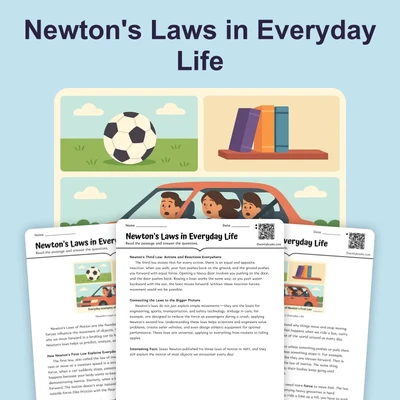
This comprehensive reading passage introduces middle school students to Newton's three laws of motion using relatable, e...
MS-PS2-1MS-PS2-2
What Are Fluids?
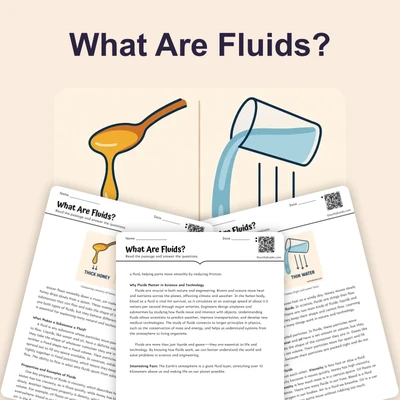
This comprehensive middle school science reading passage introduces the concept of fluids, focusing on the scientific de...
MS-PS2-2
Fluid Pressure
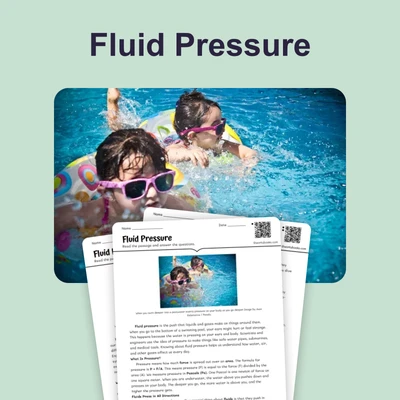
This engaging middle school science passage explores the concept of fluid pressure, aligned to NGSS standard MS-PS2-2. S...
MS-PS2-2
Why Things Float or Sink
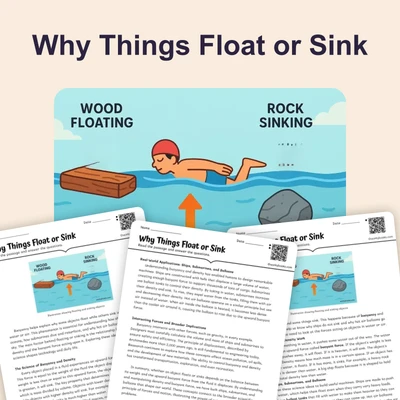
This comprehensive science passage for grades 6-8 explains the fundamental principles behind why objects float or sink. ...
MS-PS2-2
Buoyancy and Archimedes' Principle
This comprehensive middle school science passage explores the principles of buoyancy and Archimedes' Principle, aligning...
MS-PS2-2
Pascal's Principle
This comprehensive passage introduces middle school students to Pascal's Principle, a key concept in physical science th...
MS-PS2-2
Air Pressure and the Atmosphere
This passage for grades 6-8 explores the concept of air pressure in the atmosphere, directly aligning with NGSS MS-PS2-2...