This learning resource is available in interactive and printable formats. The interactive worksheet can be played online and assigned to students. The Printable PDF version can be downloaded and printed for completion by hand.
This informational science passage for grades 6-8 explores the key differences between distance and displacement, aligning with NGSS standard MS-PS2-2. Students learn how total distance traveled (a scalar quantity) differs from displacement (a vector representing the shortest path from start to end), using familiar examples like walking around a track or driving around a block. The passage explains the scientific mechanisms behind these concepts and connects them to related ideas such as speed and velocity. Real-world applications and cause-and-effect relationships are highlighted, helping students understand why these ideas matter in science and technology. The resource includes a glossary, Spanish translation, differentiated version, multiple-choice quiz, writing activities, and graphic organizers, making it accessible to diverse learners. Audio integration is available to support all students.
CONTENT PREVIEW
Expand content preview
Distance VS. Displacement
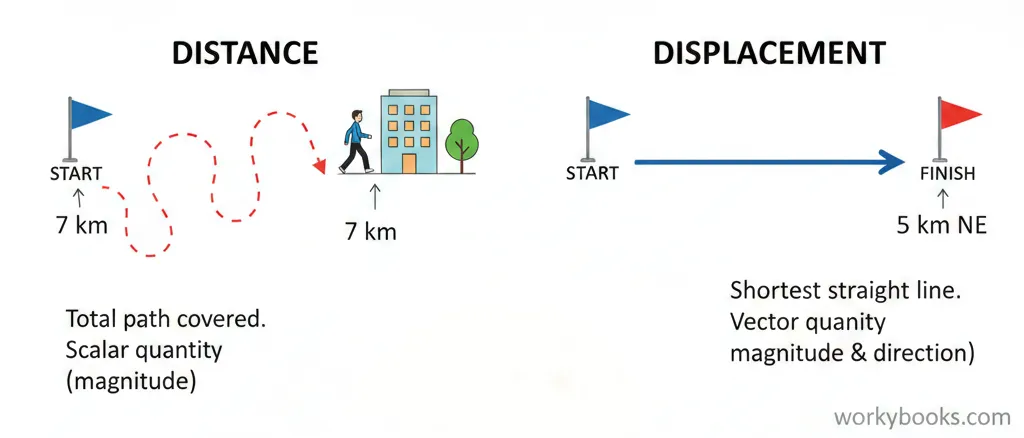
Distance and displacement are two ways scientists describe how far something moves from one place to another. For example, when a runner completes a lap around a 400-meter track and ends where they started, they have traveled a distance of 400 meters. However, their displacement is zero, because displacement only measures the straight-line path from the start point to the end point. Understanding the difference between these two measurements is essential for studying how objects move, which scientists call motion.
Scalar vs. Vector Quantities
Distance is a scalar quantity, which means it has only size (magnitude) but no direction. It adds up all the ground covered, no matter which way you travel. In contrast, displacement is a vector quantity. This means it has both size and direction. Displacement is the shortest straight line from your starting position to your ending position, along with the direction you traveled. For example, if you walk 3 km east and then 4 km north, your total distance is 7 km, but your displacement is 5 km northeast, found using the Pythagorean theorem. Scientists often use diagrams and arrows to represent displacement, showing both its length and the direction.
Examples and Applications
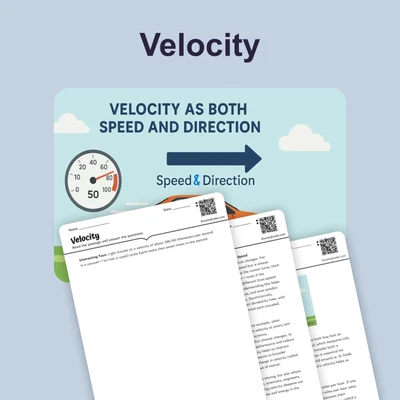
Consider driving around a city block. If you return to the place you started, your distance is the total length of all four sides, but your displacement is zero, since you end where you began. In another example, if you walk from your house to school in a zigzag path, your distance increases with every twist and turn, but your displacement is only the straight line from home to school. These differences are important in science and engineering because they affect how we calculate speed and velocity. Speed is based on total distance divided by time, while velocity uses displacement divided by time and includes direction. This distinction helps engineers design efficient routes, pilots plan flights, and scientists predict how objects move in space or on Earth.
Complex Situations and Broader Connections
Sometimes, distance and displacement can be the same, such as when you move in a straight line without turning. But when paths curve or loop, distance is always greater than or equal to displacement. The concepts of scalar and vector quantities also help scientists study forces, acceleration, and energy. Understanding distance and displacement leads to deeper ideas in physics, like conservation of energy and predicting the motion of planets or satellites. These principles are used in GPS technology, robotics, and even sports science to analyze performance and improve safety.
In summary, distance measures the total ground covered, while displacement points directly from start to finish. Learning to distinguish between them helps us better understand motion, solve real-world problems, and connect to broader scientific ideas about how things move and interact.
Interesting Fact: The longest possible distance and the shortest displacement between two points on Earth are rarely the same, except when you travel in a perfectly straight line!
What is the main difference between distance and displacement?
Distance is the total path traveled, while displacement is the shortest straight line from start to end.Displacement is always greater than distance.Distance includes direction, displacement does not.Distance is only used by scientists, not in real life.
If a runner goes all the way around a 400-meter track and ends where they started, what is their displacement?
400 metersZero200 meters800 meters
Which of the following is a scalar quantity?
DistanceDisplacementVelocityForce
Which of these is a vector quantity?
DistanceSpeedDisplacementTime
How is speed different from velocity according to the passage?
Speed uses displacement, velocity uses distance.Speed includes direction, velocity does not.Speed is distance divided by time, velocity is displacement divided by time and includes direction.There is no difference.
Why do engineers and pilots need to understand the difference between distance and displacement?
To choose the fastest and most efficient routes.To make sure they always travel in circles.To avoid measuring speed.So they can ignore direction.
What is always true about distance and displacement when the path is curved or loops?
Distance is always less than displacement.Distance and displacement are always equal.Distance is always greater than or equal to displacement.Displacement is always zero.
Which of the following best describes the Pythagorean theorem's use in the passage?
It helps find the total distance traveled.It is used to calculate the straight-line displacement.It is only used for circles.It measures time.
True or False: Displacement can never be zero.
TrueFalse
True or False: Distance always includes direction.
TrueFalse
Perfect For:
👩🏫 Teachers
• Reading comprehension practice
• Auto-graded assessments
• Literacy skill development
👨👩👧👦 Parents
• Reading practice at home
• Comprehension improvement
• Educational reading time
🏠 Homeschoolers
• Reading curriculum support
• Independent reading practice
• Progress monitoring
Reading Features:
📖
Reading Passage
Engaging fiction or nonfiction text
❓
Comprehension Quiz
Auto-graded questions
📊
Instant Feedback
Immediate results and scoring
📄
Printable Version
Download for offline reading
🔊
Read Aloud
Voice-over with word highlighting
Reviews & Ratings
No reviews yet. Be the first to share your experience!
Related Content
What Is Force?
This passage, aligned to NGSS standards MS-PS2-1 and MS-PS2-2, provides a clear and age-appropriate explanation of force...
MS-PS2-1MS-PS2-2
Isaac Newton
This middle school science reading passage introduces students to Isaac Newton, one of the most influential scientists i...
MS-PS2-2
Newton's First Law
This middle school science passage introduces students to Newton's First Law of Motion, also called the Law of Inertia. ...
MS-PS2-1MS-PS2-2
Newton's Laws in Sports
This engaging science passage is designed for grades 6-8 and aligns with NGSS standards MS-PS2-1 and MS-PS2-2. It explor...
MS-PS2-1MS-PS2-2
Reference Points
This passage for grades 6-8 explores the critical role of reference points in measuring and describing motion, aligning ...
MS-PS2-2
Balanced and Unbalanced Forces
This informational science passage explores the core concepts of balanced and unbalanced forces as aligned with NGSS sta...
MS-PS2-1MS-PS2-2
Speed
This comprehensive science passage for grades 6-8 introduces students to the concept of speed, aligned with NGSS standar...
MS-PS2-2
Velocity
This middle school science passage explores the concept of velocity as a vector quantity, meaning it includes both speed...
MS-PS2-2
Acceleration
This comprehensive passage introduces middle school students to the concept of acceleration, aligned with NGSS standard ...
MS-PS2-2
Graphing Motion
This passage introduces middle school students to the fundamental concepts of graphing motion, focusing on distance-time...
MS-PS2-2
Understanding Inertia
This comprehensive science passage introduces middle school students to the concept of inertia, a key property of matter...
MS-PS2-1MS-PS2-2
Newton's Second Law
This comprehensive passage introduces middle school students to Newton's Second Law of Motion, focusing on the core rela...
MS-PS2-1MS-PS2-2
Newton's Laws in Everyday Life
This comprehensive reading passage introduces middle school students to Newton's three laws of motion using relatable, e...
MS-PS2-1MS-PS2-2
What Are Fluids?
This comprehensive middle school science reading passage introduces the concept of fluids, focusing on the scientific de...
MS-PS2-2
Fluid Pressure
This engaging middle school science passage explores the concept of fluid pressure, aligned to NGSS standard MS-PS2-2. S...
MS-PS2-2
Why Things Float or Sink
This comprehensive science passage for grades 6-8 explains the fundamental principles behind why objects float or sink. ...
MS-PS2-2
Buoyancy and Archimedes' Principle
This comprehensive middle school science passage explores the principles of buoyancy and Archimedes' Principle, aligning...
MS-PS2-2
Pascal's Principle
This comprehensive passage introduces middle school students to Pascal's Principle, a key concept in physical science th...
MS-PS2-2
Air Pressure and the Atmosphere
This passage for grades 6-8 explores the concept of air pressure in the atmosphere, directly aligning with NGSS MS-PS2-2...