Velocity
Interactive passage with audio narration, comprehension questions, and printable PDF.
By completing this purchase you agree to our Terms of Use and Privacy Policy. Your subscription renews automatically until you cancel. You can cancel anytime from your account settings. All sales are final and non-refundable. Digital content is available for download in your account immediately upon purchase.
What's included
Velocity preview and details
About this printable Velocity science reading passage, NGSS-aligned (Grades 5-8)
Sample passage and quiz from Velocity
Reading passage and comprehension quiz preview
Velocity
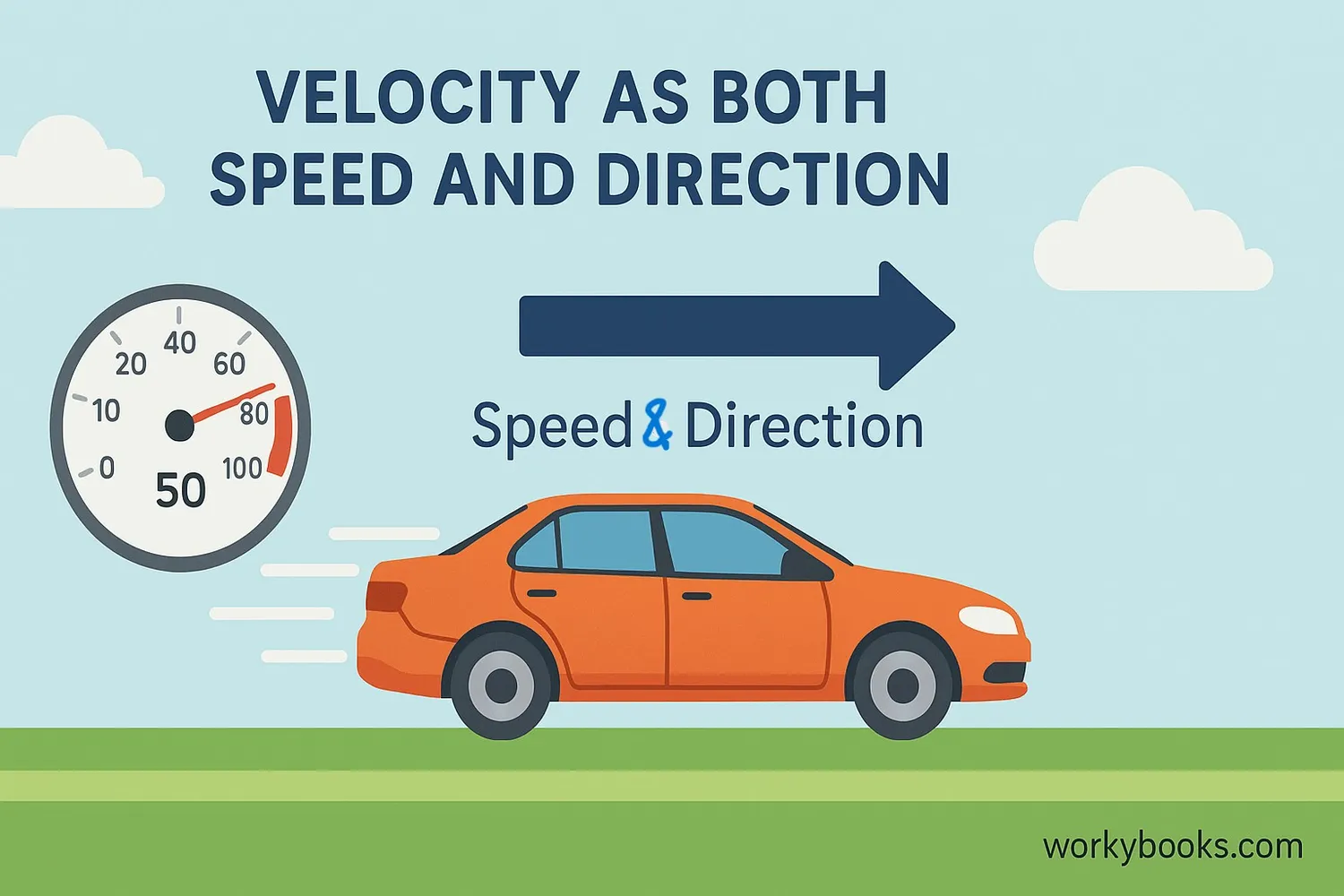
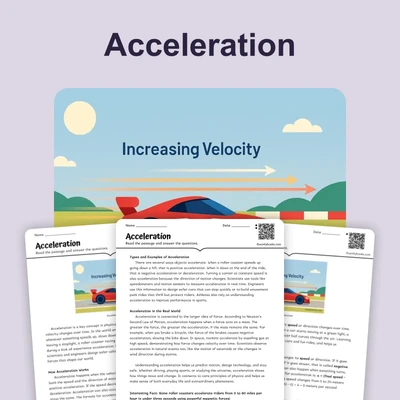
Velocity is a fundamental concept in physics that describes both how fast an object moves and the direction in which it moves. Unlike speed, which measures only the rate of motion, velocity is a vector quantity—meaning it includes both a magnitude (how fast) and a direction (where to). This distinction is essential for understanding and predicting the motion of objects in the world around us. In fields like transportation, sports, and engineering, knowing an object's velocity helps us analyze and control movement more precisely.
How Velocity Works: More Than Just Speed
To understand velocity, consider an airplane flying at 500 miles per hour. If one plane travels 500 miles per hour east and another travels 500 miles per hour west, their speeds are the same, but their velocities are different because their directions are opposite. This is why velocity is represented by an arrow, called a vector, which points in the direction of motion and has a length proportional to speed. When scientists measure velocity, they use both the size of the speed and the exact direction, such as “20 meters per second north.” Measuring velocity accurately allows us to predict where an object will be in the future. For example, air traffic controllers use velocity to prevent airplane collisions by tracking not just how fast, but also in which direction, planes are moving.
Why Direction Matters: Changing Velocity Without Changing Speed
Velocity changes whenever either the speed or the direction changes. For instance, a runner on a circular track may keep a constant speed but is always changing direction as they curve around the track. Every time the runner turns, their velocity changes because the direction of movement changes—even if the speedometer reads the same number. This is why velocity is different from speed: speed alone cannot describe the full motion of the runner. Understanding this helps scientists and engineers design safer cars, plan space missions, and even predict weather patterns by tracking the velocity of wind and storms. Quantitatively, velocity can be calculated as displacement (change in position) divided by time, with displacement being a straight line from start to end, not the total path traveled.
Applications and Broader Connections
Velocity plays a crucial role in many real-world systems. For example, when designing roller coasters, engineers must calculate changes in velocity at every turn to ensure the ride is safe and comfortable. In environmental science, oceanographers study the velocity of ocean currents to predict climate changes. In sports, coaches analyze the velocity of athletes to improve performance and reduce injury risk. These applications show that understanding velocity helps us interact safely and effectively with technology and nature. It also connects to broader scientific ideas, such as force and acceleration, because a change in velocity (called acceleration) is caused by a force, according to Newton’s laws of motion.
In summary, velocity tells us not just how fast something is moving, but also where it is headed. By paying attention to both speed and direction, scientists, engineers, and athletes can make more informed decisions. Understanding velocity deepens our knowledge of motion and connects to the larger ideas of forces and energy in the physical world.
Interesting Fact: Light travels at a velocity of about 299,792 kilometers per second in a vacuum—so fast it could circle Earth more than seven times in one second.
Comprehension quiz (10 questions)
1. What makes velocity different from speed?
2. According to the passage, what is a vector?
3. How does velocity change for a runner on a circular track, even if speed stays the same?
4. Why do air traffic controllers need to know the velocity of airplanes?
5. What does the term 'displacement' mean in the context of velocity?
6. In the passage, what does 'magnitude' refer to in a vector?
7. What can cause a change in an object's velocity?
8. If two cars travel at 60 mph, one north and one south, what is true about their velocities?
9. Velocity is a vector quantity. (True/False)
10. A change in velocity is called acceleration. (True/False)
Perfect for the way you teach
- Build comprehension skills
- Auto-graded quiz
- Differentiated reading
- Read together at home
- Improve fluency
- Quiet reading time
- Reading curriculum support
- Independent practice
- Track Lexile growth