Air Pressure and the Atmosphere — Reading Comprehension
Rate this|
11
Present
Present in classroom. No work saved
Assign
Classroom with student accounts, Track progress
Quick Play
No student accounts, assign with a link
Grades
5
6
7
8
Standards
MS-PS2-2
PRINT+DIGITAL RESOURCE
This learning resource is available in interactive and printable formats. The interactive worksheet can be played online and assigned to students. The Printable PDF version can be downloaded and printed for completion by hand.
This passage for grades 6-8 explores the concept of air pressure in the atmosphere, directly aligning with NGSS MS-PS2-2 standards. Students will discover how atmospheric pressure results from the weight of air above us, how it is measured with barometers, and why it decreases as altitude increases. The passage examines real-world effects such as breathing at high altitudes, airplane cabin pressure, and the role of air pressure in weather patterns. It provides scientific explanations, data, and examples, and integrates key academic vocabulary in context. Activities include multiple choice questions, writing prompts, and graphic organizers to deepen understanding. Audio integration supports accessibility for all learners. This resource is ideal for middle school classrooms seeking to build scientific literacy on core physical science concepts.
CONTENT PREVIEW
Expand content preview
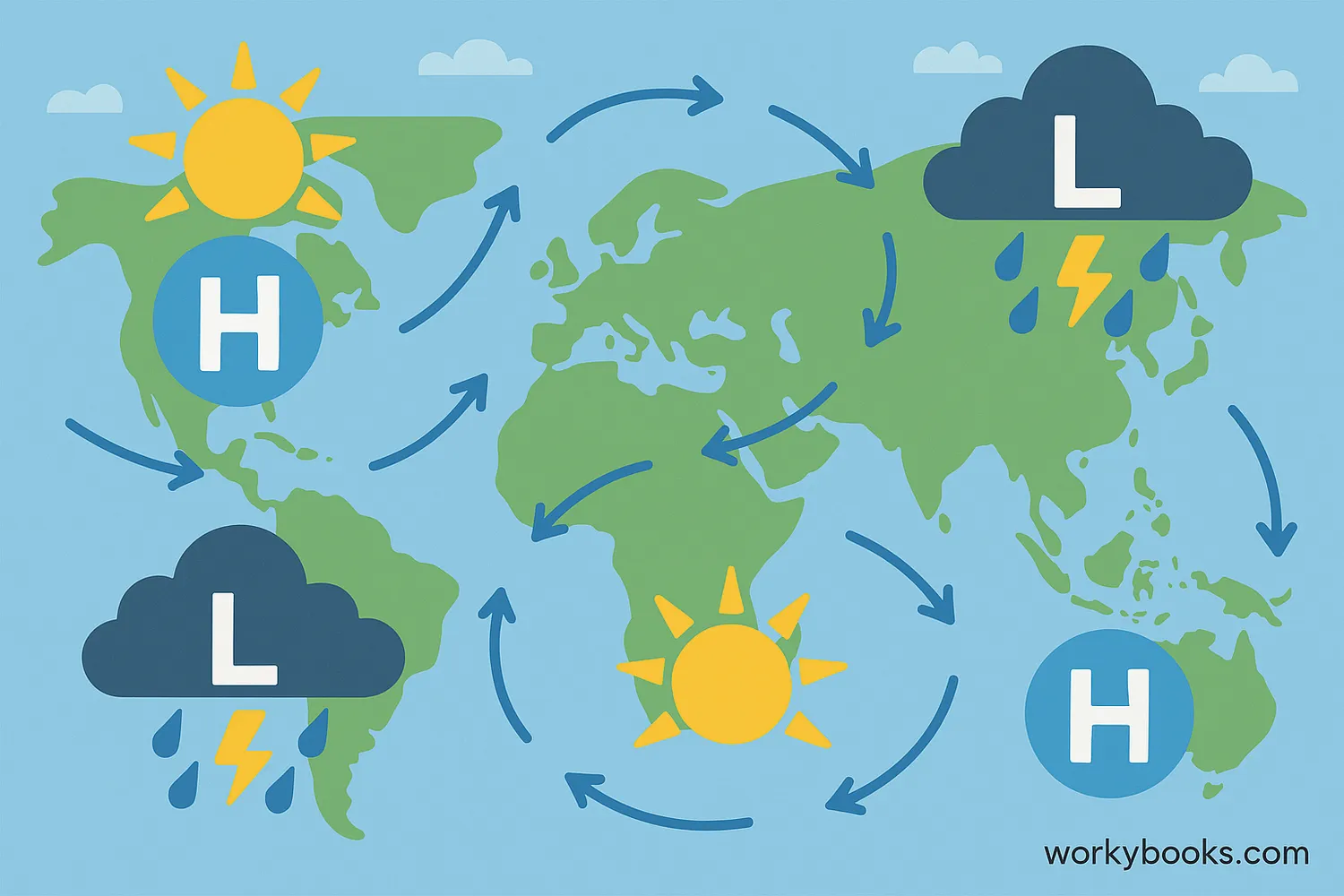
Air pressure's role in weather patterns
Air pressure is a force that affects life on Earth every day. At sea level, the weight of the air above us creates an average pressure of about 101,325 Pascals, or 1 atmosphere (atm). This pressure is strong enough to support a column of mercury about 76 centimeters tall in a barometer. Air pressure is a key factor in weather, breathing, and many technologies. Scientists study atmospheric pressure to understand how our planet's systems operate and interact.
How Does Air Pressure Work? The atmosphere is a layer of gases, mostly nitrogen and oxygen, that surrounds Earth. Gravity pulls these gases toward the planet’s surface, giving them weight. This weight presses down, creating pressure on everything below. As you go higher in altitude, such as climbing a mountain or flying in an airplane, there is less air above you. This means the pressure decreases with altitude. At 5,000 meters above sea level, the air pressure drops to about half of what it is at sea level. The relationship between altitude and pressure is predictable and can be measured using a barometer, a device invented in the 1600s that uses mercury or other fluids to show changes in air pressure.
Applications and Effects of Air Pressure Changes in air pressure have important effects on living things and the environment. For example, at high altitude, lower air pressure means there is less oxygen in each breath, which can make breathing difficult. This is why climbers and athletes sometimes train at high elevations to help their bodies adapt. In airplanes, cabins are pressurized to keep passengers comfortable and safe. Air pressure also plays a big role in weather patterns. When air pressure drops quickly, it often signals that a storm or bad weather is coming. Meteorologists use barometers to track these changes and help predict the weather. The movement of air from areas of high pressure to low pressure creates wind, another important part of Earth’s systems.
Connecting Air Pressure to Broader Science Understanding air pressure helps scientists explain phenomena like weather, wind, and even how our lungs function. Changes in pressure can cause objects to expand or contract, which is why your ears pop during takeoff in an airplane. Pressure differences are also used in many technologies, such as vacuum cleaners and car engines. By studying the patterns and effects of air pressure, scientists can better understand our planet’s climate and help solve real-world problems.
Interesting Fact: The highest recorded air pressure at sea level was 1085.7 millibars in Mongolia in 2001, while the lowest was 870 millibars during Typhoon Tip in 1979.
What creates air pressure on Earth's surface?
The weight of the air above usThe heat from the SunThe Earth's magnetic fieldThe movement of tectonic plates
Which tool do scientists use to measure air pressure?
BarometerThermometerAltimeterSeismograph
What happens to air pressure as altitude increases?
It decreasesIt increasesIt stays the sameIt doubles
What does the word 'barometer' mean in the passage?
A tool for measuring air pressureA tool for measuring temperatureA device for measuring wind speedA machine for making oxygen
What is 'cabin pressure' in the context of the passage?
The air pressure inside an airplaneThe pressure of wind outsideThe force of gravity on the planetThe pressure of the ground
Why do climbers and athletes train at high altitudes?
To help their bodies adapt to lower oxygen levelsTo avoid stormsTo increase air pressureTo measure mercury
How does air pressure relate to weather patterns?
Changes in air pressure can signal storms or changes in weatherAir pressure only affects mountainsWeather does not depend on air pressureHigh air pressure always means rain
True or False: Wind is caused by air moving from high pressure to low pressure.
TrueFalse
True or False: Air pressure increases as you go higher in altitude.
TrueFalse
Perfect For:
👩🏫 Teachers
• Reading comprehension practice
• Auto-graded assessments
• Literacy skill development
👨👩👧👦 Parents
• Reading practice at home
• Comprehension improvement
• Educational reading time
🏠 Homeschoolers
• Reading curriculum support
• Independent reading practice
• Progress monitoring
Reading Features:
📖
Reading Passage
Engaging fiction or nonfiction text
❓
Comprehension Quiz
Auto-graded questions
📊
Instant Feedback
Immediate results and scoring
📄
Printable Version
Download for offline reading
🔊
Read Aloud
Voice-over with word highlighting
Reviews & Ratings
No reviews yet. Be the first to share your experience!
Related Content
What Is Force?
This passage, aligned to NGSS standards MS-PS2-1 and MS-PS2-2, provides a clear and age-appropriate explanation of force...
MS-PS2-1MS-PS2-2
Isaac Newton
This middle school science reading passage introduces students to Isaac Newton, one of the most influential scientists i...
MS-PS2-2
Newton's First Law
This middle school science passage introduces students to Newton's First Law of Motion, also called the Law of Inertia. ...
MS-PS2-1MS-PS2-2
Newton's Laws in Sports
This engaging science passage is designed for grades 6-8 and aligns with NGSS standards MS-PS2-1 and MS-PS2-2. It explor...
MS-PS2-1MS-PS2-2
Reference Points
This passage for grades 6-8 explores the critical role of reference points in measuring and describing motion, aligning ...
MS-PS2-2
Balanced and Unbalanced Forces
This informational science passage explores the core concepts of balanced and unbalanced forces as aligned with NGSS sta...
MS-PS2-1MS-PS2-2
Distance vs. Displacement
This informational science passage for grades 6-8 explores the key differences between distance and displacement, aligni...
MS-PS2-2
Speed
This comprehensive science passage for grades 6-8 introduces students to the concept of speed, aligned with NGSS standar...
MS-PS2-2
Velocity
This middle school science passage explores the concept of velocity as a vector quantity, meaning it includes both speed...
MS-PS2-2
Acceleration
This comprehensive passage introduces middle school students to the concept of acceleration, aligned with NGSS standard ...
MS-PS2-2
Graphing Motion
This passage introduces middle school students to the fundamental concepts of graphing motion, focusing on distance-time...
MS-PS2-2
Understanding Inertia
This comprehensive science passage introduces middle school students to the concept of inertia, a key property of matter...
MS-PS2-1MS-PS2-2
Newton's Second Law
This comprehensive passage introduces middle school students to Newton's Second Law of Motion, focusing on the core rela...
MS-PS2-1MS-PS2-2
Newton's Laws in Everyday Life
This comprehensive reading passage introduces middle school students to Newton's three laws of motion using relatable, e...
MS-PS2-1MS-PS2-2
What Are Fluids?
This comprehensive middle school science reading passage introduces the concept of fluids, focusing on the scientific de...
MS-PS2-2
Fluid Pressure
This engaging middle school science passage explores the concept of fluid pressure, aligned to NGSS standard MS-PS2-2. S...
MS-PS2-2
Why Things Float or Sink
This comprehensive science passage for grades 6-8 explains the fundamental principles behind why objects float or sink. ...
MS-PS2-2
Buoyancy and Archimedes' Principle
This comprehensive middle school science passage explores the principles of buoyancy and Archimedes' Principle, aligning...
MS-PS2-2
Pascal's Principle
This comprehensive passage introduces middle school students to Pascal's Principle, a key concept in physical science th...