Pascal's Principle
Interactive passage with audio narration, comprehension questions, and printable PDF.
What's included
Pascal's Principle preview and details
About this printable Pascal's Principle science reading passage, NGSS-aligned (Grades 5-8)
Sample passage and quiz from Pascal's Principle
Reading passage and comprehension quiz preview
Pascal's Principle
Pascal's Principle is a fundamental concept in physics that describes how pressure behaves in fluids. When a force is applied to a confined fluid, that pressure is transmitted equally in all directions throughout the fluid. For example, when you press the plunger of a syringe filled with water, the water pushes out with the same force at the tip, no matter the shape or direction. This principle helps scientists and engineers solve real-world problems where moving or lifting heavy objects is required.
How Pressure Works in Fluids
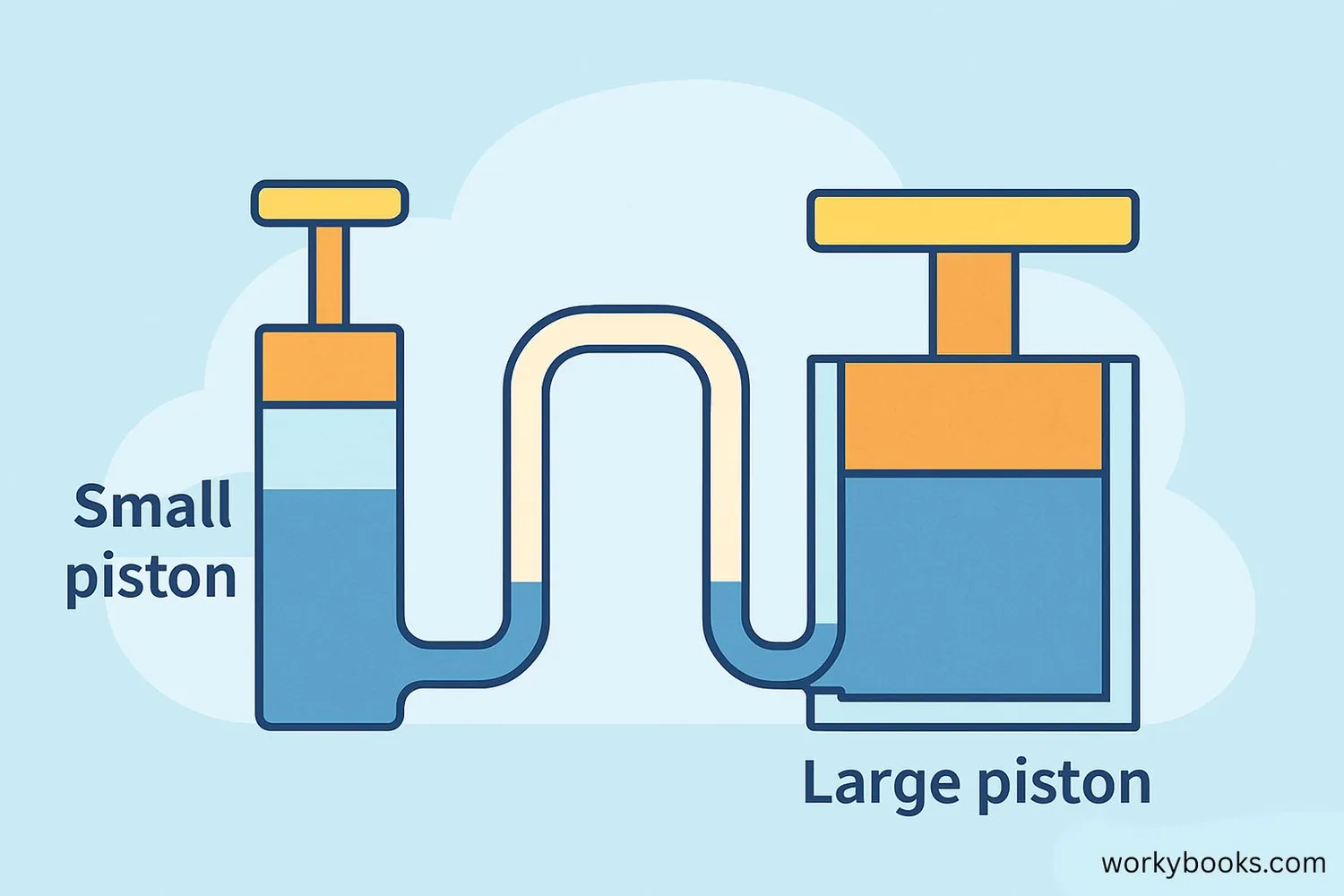
Pressure is defined as the amount of force applied per unit area. In an enclosed fluid, like oil in a hydraulic system, any applied pressure moves through the entire fluid instantly and equally. This is because the molecules in a liquid can move freely and transmit forces efficiently. The French scientist Blaise Pascal discovered this in the 1600s, leading to the creation of many useful machines. When you push down on a small piston in a hydraulic lift, the pressure is transmitted to a larger piston. Since the larger piston has more area, it can lift a much heavier object, even though you only applied a small force. This effect is called mechanical advantage.
Applications: Hydraulic Systems in Our World
The concept of Pascal's Principle is used in many machines. Car brakes are a good example: when you press the brake pedal, pressure is applied to brake fluid, which travels through tubes to press the brake pads against the wheels. This process allows a small force from your foot to stop a heavy car quickly and safely. Dentist chairs and construction lifts use similar hydraulic systems. By changing the size and area of pistons, engineers can control how much force is multiplied and where it is directed. Calculating the mechanical advantage in these systems shows that force can be increased by making the area of the output piston larger than the input piston. For example, if one piston is four times larger in area, it multiplies the input force by four.
Complexities and Interactions
While Pascal's Principle works in all enclosed fluids, there are limits. If there is a leak or air bubbles in the system, the pressure may not be transmitted efficiently. Temperature can also affect how fluids behave, since liquids can expand or contract, changing the pressure. Despite these challenges, hydraulic systems are used worldwide in transportation, medicine, and manufacturing because they make moving heavy objects much easier.
Pascal's Principle connects to the broader concept of force and motion, showing how basic scientific laws can lead to important technological advances. Understanding how pressure moves in fluids helps engineers design safe, efficient systems that improve our daily lives.
Interesting Fact:
Hydraulic presses based on Pascal's Principle can lift objects weighing hundreds of tons, making them essential for building bridges and shaping metals in factories!
Comprehension quiz (10 questions)
1. What does Pascal's Principle state about pressure in an enclosed fluid?
2. Which scientist discovered the principle described in the passage?
3. What is the main function of a hydraulic system?
4. In the context of hydraulics, what does 'mechanical advantage' mean?
5. What does the word 'enclosed' mean as used in the passage?
6. Which word from the passage means 'the act of passing something from one place to another'?
7. Why do hydraulic systems allow a small force to lift heavy objects?
8. What could cause a hydraulic system to fail to transmit pressure efficiently?
9. Hydraulic systems are not used in transportation. True or false?
10. If the area of the output piston is four times greater than the input piston, the force is multiplied by four. True or false?
Perfect for the way you teach
- Build comprehension skills
- Auto-graded quiz
- Differentiated reading
- Read together at home
- Improve fluency
- Quiet reading time
- Reading curriculum support
- Independent practice
- Track Lexile growth