How does Deforestation Contribute to Climate Change? — Reading Comprehension
Rate this
Premium Resource
Present
Present in classroom. No work saved
Assign
Classroom with student accounts, Track progress
Quick Play
No student accounts, assign with a link
Grades
3
4
5
6
7
8
PRINT+DIGITAL RESOURCE
This learning resource is available in interactive and printable formats. The interactive worksheet can be played online and assigned to students. The Printable PDF version can be downloaded and printed for completion by hand.
"This science passage is designed for middle school students, aligning with NGSS standards related to Earth's systems and human impact on the environment. It provides a comprehensive overview of how deforestation exacerbates climate change by disrupting the carbon and water cycles. Key concepts covered include photosynthesis, the greenhouse effect, and the role of forests as carbon sinks. The content is structured to support self-study, featuring a direct, factual tone and relatable examples. The passage aims to build a foundational understanding of this critical environmental issue, emphasizing the interconnectedness of ecological systems and the global climate. It also introduces solutions like reforestation as part of a broader discussion on environmental stewardship."
CONTENT PREVIEW
Expand content preview
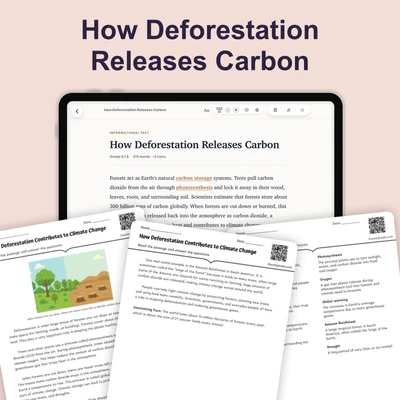
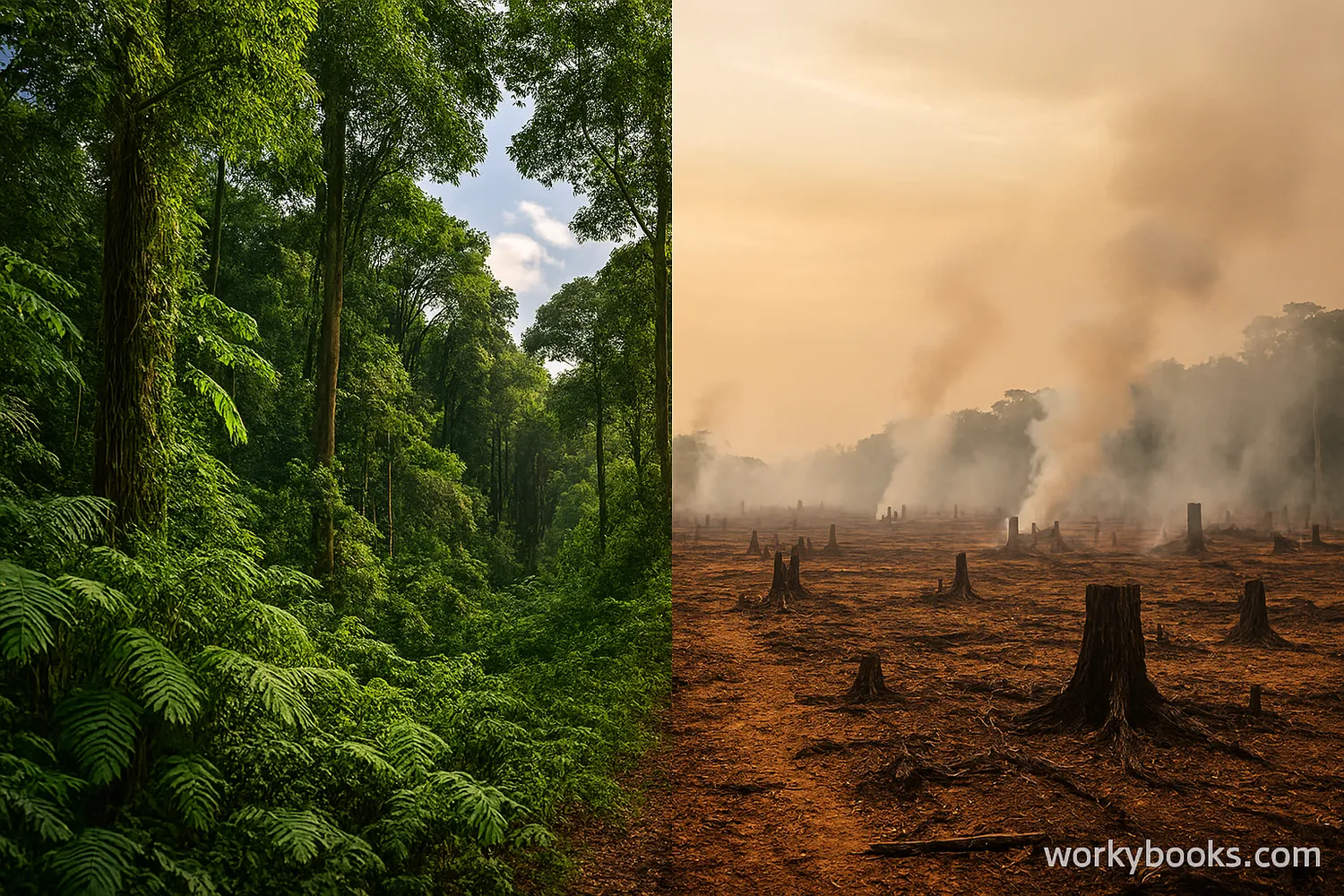
Deforestation, the large-scale clearing of forests for other land uses, is a significant contributor to global climate change. Forests are often referred to as the "lungs of the planet" because of their critical role in the carbon cycle. They absorb carbon dioxide (CO2) from the atmosphere through a process called photosynthesis, converting it into the energy they need to grow. This action helps to regulate Earth's climate by reducing the amount of greenhouse gases that trap heat in the atmosphere. When forests are destroyed, this natural process is disrupted, leading to an increase in atmospheric CO2 levels and a rise in global temperatures.
One of the primary ways deforestation contributes to climate change is by releasing stored carbon. Trees and other plants store vast amounts of carbon in their wood, leaves, and roots. When forests are cut down or burned, this stored carbon is released back into the atmosphere as CO2. Large-scale burning, a common method for clearing land for agriculture, is particularly harmful because it releases this carbon very quickly, along with other greenhouse gases like methane (CH4). This rapid release of stored carbon significantly intensifies the greenhouse effect, which is the process by which gases in Earth’s atmosphere trap heat, warming the planet.
Another critical effect of deforestation is the loss of a natural cooling system. Forests are an essential part of the water cycle; they release water vapor into the air through a process called transpiration. This water vapor forms clouds, which reflect sunlight and help to cool the planet's surface. Without forests, there is less cloud cover, leading to more sunlight reaching the ground and warmer local temperatures. This not only affects regional weather patterns but also contributes to the overall global temperature increase. Protecting existing forests and engaging in reforestation—the process of replanting trees—are crucial steps in mitigating climate change.
Fun Fact: A single mature tree can absorb approximately 48 pounds of carbon dioxide per year, which is equivalent to the amount of CO2 produced by driving a car 11,000 miles.
What is the primary process by which trees absorb carbon dioxide from the atmosphere?
How do forests contribute to a natural cooling system?
They release oxygen, which cools the air.They trap heat, which prevents cold snaps.They release water vapor that forms clouds.They absorb solar energy, which cools the ground.
According to the passage, what is a major consequence of burning forests for land clearing?
It stops the carbon cycle.It releases stored carbon quickly.It causes an immediate decrease in rainfall.It increases local cloud cover.
Which of the following is an example of reforestation?
Clearing land for a new farm.Replanting trees in a previously logged area.Converting a forest into a city park.Cutting down old trees to plant new ones.
Which of the following best describes the main idea of the passage?
Deforestation is a problem in tropical regions.Trees are the only living things that use photosynthesis.Deforestation is a primary cause of climate change.Trees are important for the water cycle and weather.
What happens to the carbon stored in trees when they are cut down and burned?
It is absorbed by the soil.It is released back into the atmosphere.It is converted into oxygen.It becomes part of the soil's nutrients.
Based on the passage, what would be a likely effect of a large area of forest being replaced by a parking lot?
Increased cloud formation.A decrease in local air temperature.An increase in atmospheric CO2.A new natural cooling system.
The "greenhouse effect" is a process where:
Trees trap sunlight for photosynthesis.Gases in the atmosphere trap heat.Forests reflect sunlight back into space.Water vapor is released into the air.
Perfect For:
👩🏫 Teachers
• Reading comprehension practice
• Auto-graded assessments
• Literacy skill development
👨👩👧👦 Parents
• Reading practice at home
• Comprehension improvement
• Educational reading time
🏠 Homeschoolers
• Reading curriculum support
• Independent reading practice
• Progress monitoring
Reading Features:
📖
Reading Passage
Engaging fiction or nonfiction text
❓
Comprehension Quiz
Auto-graded questions
📊
Instant Feedback
Immediate results and scoring
📄
Printable Version
Download for offline reading
🔊
Read Aloud
Voice-over with word highlighting
Reviews & Ratings
No reviews yet. Be the first to share your experience!
Related Content
What Is Earth Science?
This engaging middle school science passage introduces students to the field of Earth science, aligning with NGSS standa...
MS-ESS1MS-ESS2MS-ESS3SEP
Transportation and Climate Change
This engaging science passage for grades 6-8 explores the vital role that transportation plays in climate change. Studen...
Tools and Technology in Earth Science
This middle school science reading passage explores the wide range of tools and technologies used in Earth science, from...
MS-ESS2-2MS-ESS3-2MS-ETS1-1MS-PS4-3
Climate Change: Solutions and Mitigation
This passage explores scientific solutions and mitigation strategies for climate change, designed for middle school scie...
MS-ESS3-4MS-ESS3-5
Extreme Weather and Climate Change
This Grade 6-8 science passage, aligned to NGSS standards, explores the impact of climate change on extreme weather even...
Climate Change: Causes
This comprehensive middle school science passage explores the causes of climate change by examining both natural and hum...
MS-ESS3-5MS-LS2-4
Effects of Climate Change
This comprehensive middle school science passage explores the effects of climate change on Earth's systems and life, ali...
MS-ESS3-5MS-LS4-4
Climate Change Bird Migration
This educational passage, audio integrated, explores how climate change affects bird migration patterns. Students will l...
MS-LS2-4: CONSTRUCT AN ARGUMENT SUPPORTED BY EMPIRICAL EVIDENCE THAT CHANGES TO PHYSICAL OR BIOLOGICAL COMPONENTS OF AN ECOSYSTEM AFFECT POPULATIONS.
Climate Through Earth's History
This engaging passage for grades 6-8 explores how Earth's climate has naturally changed over millions of years, highligh...
MS-ESS1-4MS-ESS2-6
Climate Change: Vulnerable Ecosystems
This middle school science passage, aligned with NGSS standards MS-ESS3-5 and MS-LS2-4, helps students understand how cl...
MS-ESS3-5MS-LS2-4
How Deforestation Contributes to Climate Change
This engaging science passage, aligned with NGSS standards, explains how deforestation contributes to climate change for...
Permafrost and Climate Change
This engaging, NGSS-aligned science passage for grades 6-8 explores how melting permafrost releases greenhouse gases, im...
Scientific Inquiry in Earth Science
This passage explores scientific inquiry in Earth science for grades 6-8, aligned with NGSS standards MS-ESS1-4, MS-ESS2...
MS-ESS1-4MS-ESS2-1MS-ESS3-5SEP
Impact of Climate Change on Water Resources
This engaging science passage for grades 6-8 explores the impact of climate change on water resources, aligning with NGS...
Heatwaves and Climate Change
This educational resource features an engaging, audio-integrated reading passage titled 'Heatwaves and Climate Change,' ...
How Climate Change Affects Food Security
This grade 6-8 science passage, aligned with the NGSS standards, explores how climate change affects food security aroun...
Addressing Climate Change
This middle school science passage, aligned with NGSS standards MS-ESS3-4 and MS-ESS3-5, explores the mechanisms and sol...
MS-ESS3-4MS-ESS3-5
What Is The Difference Between Global Warming And Climate Change?
This educational content, audio integrated, explores the crucial differences between global warming and climate change. ...
Climate Change: Species Responses
This middle school science passage explores how species respond to climate change, aligning with NGSS standards MS-LS4-4...
MS-LS4-4MS-LS4-6
Climate Refugees
This engaging science passage for grades 6-8 introduces students to the topic of climate refugees and human migration. A...