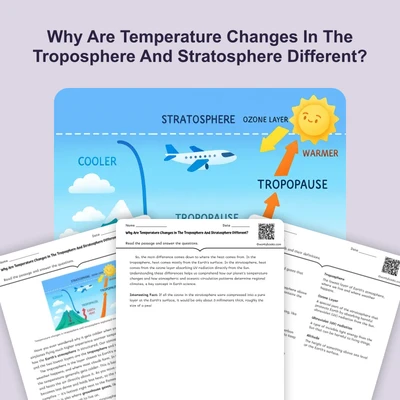
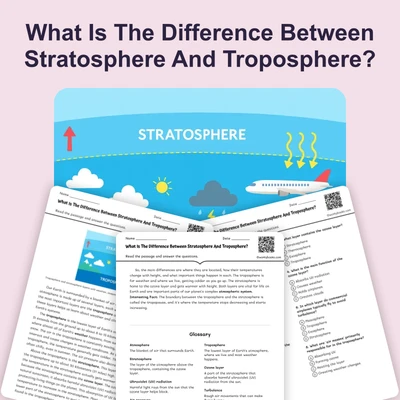
How Does The Stratosphere Affect Climate
Interactive passage with audio narration, comprehension questions, and printable PDF.
By completing this purchase you agree to our Terms of Use and Privacy Policy. Your subscription renews automatically until you cancel. You can cancel anytime from your account settings. All sales are final and non-refundable. Digital content is available for download in your account immediately upon purchase.
What's included
How Does The Stratosphere Affect Climate preview and details
About this printable How Does The Stratosphere Affect Climate science reading passage, NGSS-aligned (Grade 6)
Sample passage and quiz from How Does The Stratosphere Affect Climate
Reading passage and comprehension quiz preview
Aphelion and Perihelion: Earth's Journey Around the Sun
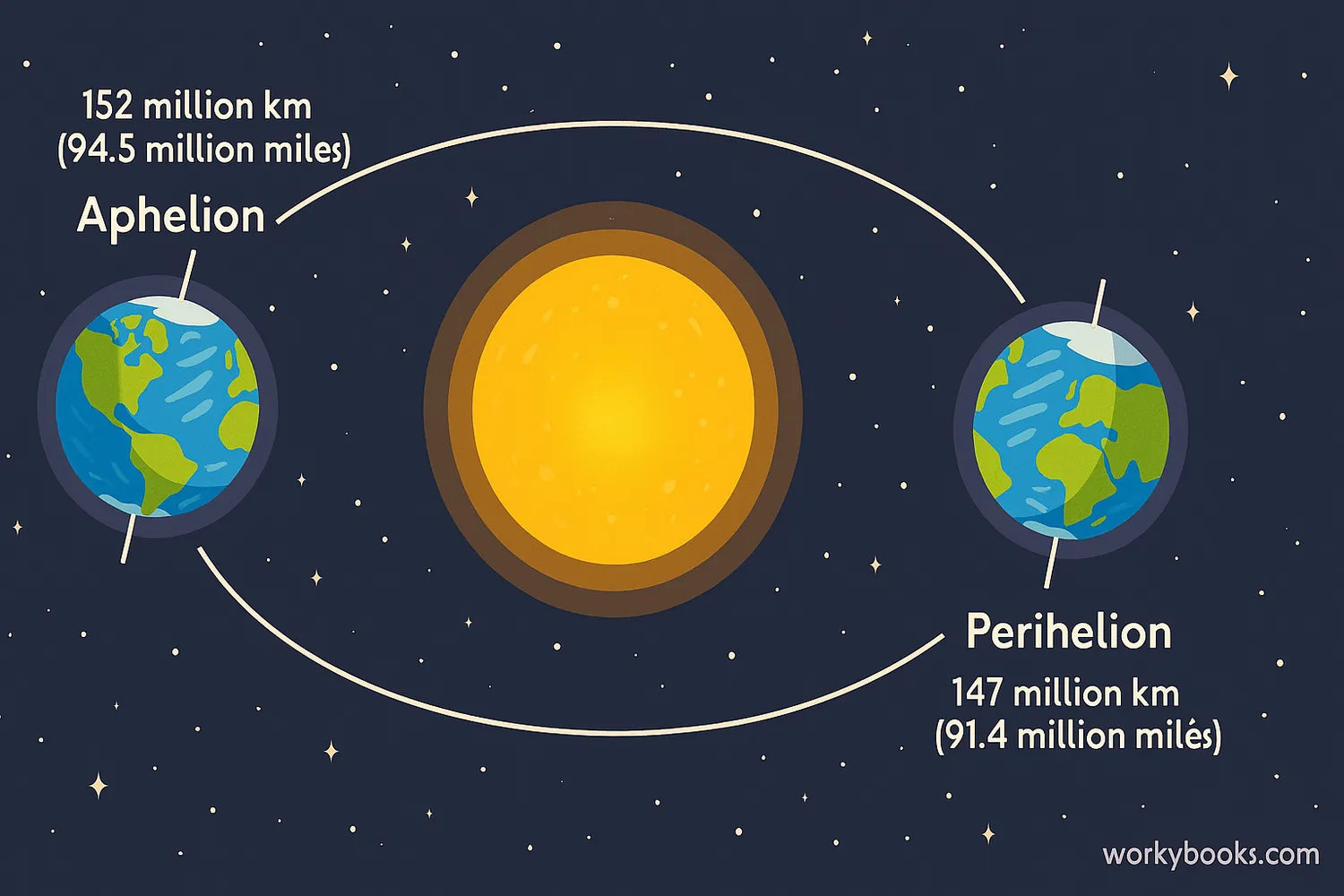
Have you ever wondered why we have seasons? Many people think it's because Earth is closer to the Sun in summer and farther away in winter. While the Earth's distance from the Sun does change throughout the year, this actually isn't why we have seasons! The real reason for seasons is the tilt of Earth's axis. However, Earth's changing distance from the Sun is a fascinating part of its journey through space.
Our planet, Earth, does not orbit the Sun in a perfect circle. Instead, it follows an elliptical orbit, which means it's shaped more like an oval or a stretched circle. Because of this oval shape, there are times when Earth is closer to the Sun and times when it is farther away. These two important points in Earth's orbit have special names: Aphelion and Perihelion.
Let's start with Aphelion. This word comes from Greek words meaning 'away from the Sun.' Aphelion is the point in Earth's orbit when it is farthest away from the Sun. This usually happens around July 4th each year. During Aphelion, the distance between the Earth and the Sun is about 152 million kilometers (about 94.5 million miles). Think of it like being at the widest part of the oval, making the longest possible distance from the center.
Now for Perihelion. This word also comes from Greek, meaning 'near the Sun.' Perihelion is the point in Earth's orbit when it is closest to the Sun. This usually happens around January 3rd each year. At Perihelion, the Earth is approximately 147 million kilometers (about 91.4 million miles) away from the Sun. This is like being at the narrowest part of the oval, making the shortest possible distance from the center.
It might seem strange that Earth is closest to the Sun in January (Perihelion) when many parts of the Northern Hemisphere are experiencing winter, and farthest from the Sun in July (Aphelion) during summer. This fact strongly supports that the distance from the Sun is not the primary cause of seasons. The tilt of Earth's axis is what truly creates the seasons because it changes how directly the sunlight hits different parts of the Earth throughout the year.
So, while Aphelion and Perihelion represent significant changes in Earth's distance from the Sun, they have very little impact on our daily temperatures or the changing of the seasons. These terms are important for understanding the mechanics of our solar system and the beautiful, complex path our planet takes as it journeys around its star. Studying Earth's elliptical orbit helps scientists and astronomers predict its position and understand the gravitational forces at play.
Fun Fact: The word 'Aphelion' specifically refers to the point farthest from the Sun, while the general term for the farthest point in any object's orbit around a star is 'apoapsis.'
Comprehension quiz (10 questions)
1. What is Aphelion?
2. When does Perihelion usually occur?
3. What shape is Earth's orbit?
4. What is the main reason for seasons?
5. If Earth's orbit were a perfect circle, what would be true?
6. How does Aphelion affect seasons?
7. Why is Perihelion in January counterintuitive for seasons?
8. What would happen without an elliptical orbit?
9. Imagine Earth's tilt was 0 degrees. How would this affect seasons?
10. A planet with a very stretched elliptical orbit would likely experience:
Perfect for the way you teach
- Build comprehension skills
- Auto-graded quiz
- Differentiated reading
- Read together at home
- Improve fluency
- Quiet reading time
- Reading curriculum support
- Independent practice
- Track Lexile growth