How Many Greenhouse Gases Are There
Interactive passage with audio narration, comprehension questions, and printable PDF.
By completing this purchase you agree to our Terms of Use and Privacy Policy. Your subscription renews automatically until you cancel. You can cancel anytime from your account settings. All sales are final and non-refundable. Digital content is available for download in your account immediately upon purchase.
What's included
How Many Greenhouse Gases Are There preview and details
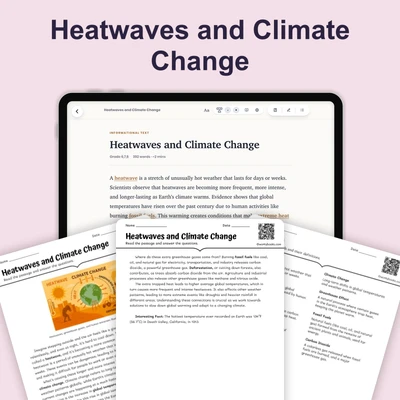
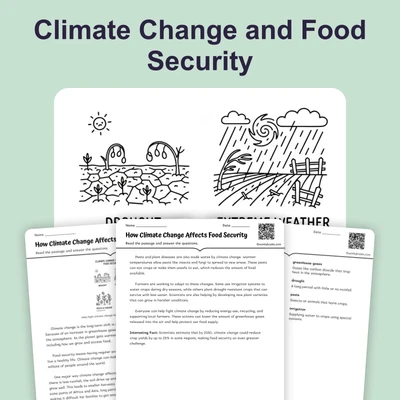
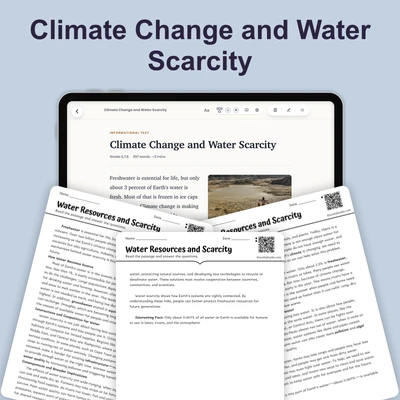
About this printable How Many Greenhouse Gases Are There science reading passage, NGSS-aligned (Grades 5-8)
Sample passage and quiz from How Many Greenhouse Gases Are There
Reading passage and comprehension quiz preview
How Many Greenhouse Gases Are There
When people discuss climate change, carbon dioxide often gets mentioned first. However, Earth's atmosphere contains several different greenhouse gases that trap heat. Scientists have identified four main greenhouse gases: water vapor, carbon dioxide, methane, and nitrous oxide. A few other gases also trap heat, but these four play the biggest roles.
These gases do not all work the same way. Each gas differs in two important ways: strength and lifespan. Scientists measure strength by comparing how much heat one molecule of each gas can trap. Evidence shows that methane traps about 28 times more heat than carbon dioxide over a century. Nitrous oxide can trap nearly 300 times more heat than CO2. Water vapor also traps significant heat, but its amount in the air changes constantly with weather patterns.
The gases also stay in the atmosphere for different lengths of time. Water vapor may remain airborne for only days before falling as rain or snow. Methane breaks down after about 12 years. Carbon dioxide, however, can persist for centuries. Some CO2 molecules released today will still be trapping heat 200 years from now. This long lifespan makes CO2 particularly important for long-term climate patterns.
Scientists explain that CO2 matters most not because it traps the most heat per molecule, but because humans release enormous quantities of it. Burning fossil fuels for energy, transportation, and manufacturing adds about 37 billion tons of CO2 to the atmosphere each year. This massive volume overwhelms the stronger but less abundant gases. In 2020, atmospheric CO2 concentrations reached 412 parts per million, the highest level in at least 800,000 years based on ice core evidence.
Understanding all greenhouse gases helps scientists predict climate changes more accurately. Each gas contributes differently to warming. Methane from agriculture and natural gas systems causes rapid warming but fades relatively quickly. CO2 from power plants and vehicles builds up slowly but persists for generations. Nitrous oxide from fertilizers adds a smaller but very long-lasting warming effect. Together, these gases create the greenhouse effect that keeps Earth warm enough for life but can cause problems when concentrations rise too high.
Interesting Fact: If you could see greenhouse gases, the sky would look slightly different each day because water vapor concentrations change constantly, while CO2 and methane remain more stable in the short term.
Comprehension quiz (10 questions)
1. What are the four main greenhouse gases mentioned in the passage?
2. How much more heat does methane trap compared to carbon dioxide over a century?
3. What does the term 'molecule' mean in this passage?
4. Based on the passage, why does carbon dioxide matter most for climate change?
5. How long can carbon dioxide remain in the atmosphere?
6. What can scientists infer from the fact that different greenhouse gases have different lifespans?
7. If a country wanted to reduce warming quickly, which gas would be most important to reduce based on the passage?
8. According to the passage, approximately how many tons of CO2 do humans add to the atmosphere each year?
9. True or False: Water vapor stays in the atmosphere longer than methane.
10. True or False: The passage states that all greenhouse gases trap heat with equal strength.
Perfect for the way you teach
- Build comprehension skills
- Auto-graded quiz
- Differentiated reading
- Read together at home
- Improve fluency
- Quiet reading time
- Reading curriculum support
- Independent practice
- Track Lexile growth