This engaging 400-500 word reading passage for grades 6-8 explores how artificial satellites orbit Earth using the fundamental physics of gravity and inertia. Aligned to NGSS MS-ESS1-2 and MS-ESS1.B, students discover how rockets provide satellites with the necessary sideways speed, and how Earth's gravity continuously bends their path into stable orbits. The passage uses clear, accessible language at an 800-1050 Lexile level to explain the same mechanism that keeps the Moon orbiting Earth. Students explore real-world examples like the International Space Station and learn why understanding satellite orbits matters for GPS, weather forecasting, and communication. The content includes audio integration for enhanced accessibility, a simplified differentiated version for struggling readers, Spanish translations, vocabulary glossary, comprehension questions, writing activities, and graphic organizers. This comprehensive resource helps students apply scientific principles to engineered systems in space.
Written by Workybooks TeamPublished by Workybooks
Preview
Sample passage and quiz content
CONTENT PREVIEW
Expand content preview
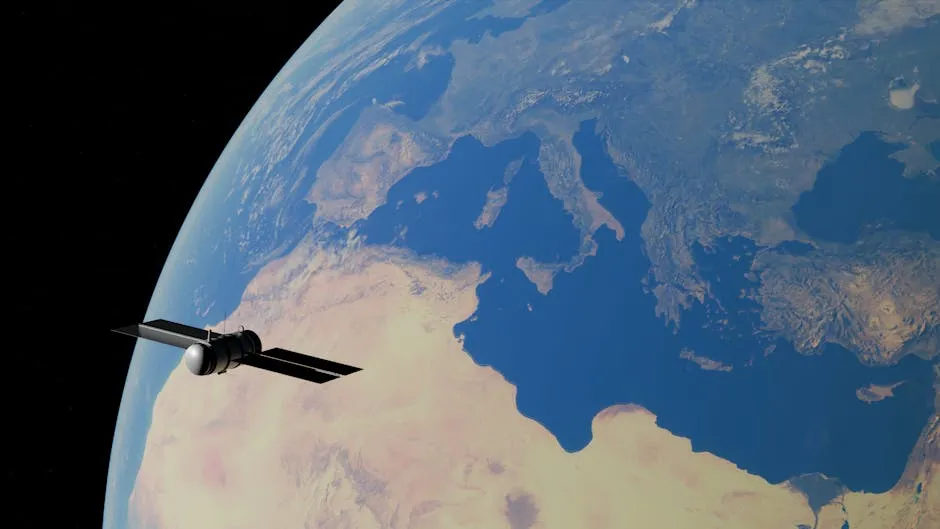
"A satellite orbiting Earth, showcasing the Mediterranean Sea and surrounding continents." by Zelch Csaba / Pexels.
Artificial satellites orbit Earth because of two forces working together: gravity and inertia. Rockets launch satellites into space and give them tremendous sideways speed. Once in space, Earth's gravity pulls the satellite downward toward the planet. However, the satellite's fast sideways motion keeps it from falling straight down. Instead, gravity bends the satellite's path into a continuous curve around Earth.
This mechanism is the same physics that keeps the Moon orbiting our planet. Scientists explain that an object in orbit is constantly falling toward Earth but also moving sideways fast enough to keep missing it. The satellite's velocity, or speed in a specific direction, must be precisely calculated. If the satellite moves too slowly, gravity pulls it down to Earth. If it moves too fast, it escapes into space. The balance between these two forces creates a stable orbit.
Different satellites orbit at different heights depending on their purpose. The International Space Station orbits about 250 miles above Earth's surface. At this altitude, it travels at approximately 17,500 miles per hour to maintain its orbit. Weather satellites often orbit much higher, around 22,000 miles up. Evidence shows that satellites closer to Earth must move faster because gravity's pull is stronger at lower altitudes.
Understanding satellite orbits matters because these objects provide essential services. GPS satellites help people navigate accurately on Earth's surface. Communication satellites transmit television signals and internet data across continents. Weather satellites monitor storms and help scientists predict dangerous conditions. All of these technologies depend on engineers applying the gravity and inertia mechanism to keep satellites in stable orbits.
Interesting Fact: There are more than 8,000 satellites currently orbiting Earth, but only about half of them still function. The rest are space debris that continues orbiting because there is no air resistance in space to slow them down.
What two forces work together to keep satellites in orbit around Earth?
Gravity and inertiaMagnetism and frictionWind and air pressureHeat and light
What happens if a satellite moves too slowly in orbit?
It escapes into deep spaceGravity pulls it down to EarthIt speeds up automaticallyIt stops moving completely
According to the passage, what does the term 'velocity' mean?
The weight of an objectThe size of an objectSpeed in a specific directionThe distance from Earth
How fast does the International Space Station travel to maintain its orbit?
About 5,000 miles per hourAbout 10,000 miles per hourAbout 17,500 miles per hourAbout 25,000 miles per hour
Why must satellites closer to Earth move faster than those farther away?
Because there is more air resistance closer to EarthBecause gravity's pull is stronger at lower altitudesBecause they need to avoid other satellitesBecause they carry heavier equipment
What mechanism keeps the Moon orbiting Earth?
Magnetic attraction between Earth and MoonAir currents pushing the Moon around EarthThe same gravity and inertia mechanism as satellitesRocket engines on the Moon
Based on the passage, what can you infer about why space debris continues to orbit Earth?
Rockets continue to push it around EarthThere is no air resistance in space to slow it downScientists control it from EarthIt is magnetic and attracted to Earth
If engineers wanted to place a new satellite in a very high orbit, what would they need to consider about its velocity?
It would need to move faster than low-orbit satellitesIt would need to move slower than low-orbit satellitesIts velocity would not matter at high altitudesIt would need to stop moving periodically
True or False: A satellite in orbit is constantly falling toward Earth but moving sideways fast enough to keep missing it.
TrueFalse
True or False: All satellites orbiting Earth are still functioning and providing services.
TrueFalse
Who it's for
Perfect for the way you teach
Teachers
Build comprehension skills
Auto-graded quiz
Differentiated reading
Parents
Read together at home
Improve fluency
Quiet reading time
Homeschoolers
Reading curriculum support
Independent practice
Track Lexile growth
Topics
satellitesorbitgravityinertiaartificial satellitesEarth orbitNGSS MS-ESS1-2middle school sciencespace technology
Reviews & Ratings
No reviews yet. Be the first to share your experience!
More reading you might love
20 more
Comets
This middle school science passage explores the fascinating world of comets, commonly known as 'dirty snowballs.' Studen...
MS-ESS1-2
Mercury: Closest to the Sun
This comprehensive, standards-aligned passage explores Mercury—the smallest and closest planet to the Sun. Students in g...
MS-ESS1-2MS-ESS1-3
Venus: Earth's Twin?
This comprehensive science passage for grades 6-8 examines Venus—often called Earth's twin—by exploring its similarities...
MS-ESS1-2MS-ESS1-3
Earth: Our Home Planet
This comprehensive science passage for grades 6-8 explores Earth’s unique characteristics and the interconnected systems...
MS-ESS1-2
Mars: The Red Planet
This middle school science passage explores Mars, the Red Planet, providing students in grades 6-8 with a comprehensive ...
MS-ESS1-2MS-ESS1-3
Kepler's Laws of Planetary Motion
This comprehensive middle school science passage explores Kepler's Laws of Planetary Motion, meeting NGSS Standard MS-ES...
MS-ESS1-2
Tides and Tidal Forces
This middle school science passage explores the mechanisms of tides and tidal forces, aligning with NGSS standards MS-ES...
MS-ESS1-1MS-ESS1-2
Escape Velocity and Space Travel
This middle school science passage introduces students to the concept of escape velocity—the minimum speed required to b...
MS-ESS1-2MS-PS2-4
Weightlessness and Microgravity
This science reading passage for middle school students explores the phenomenon of weightlessness and microgravity. Alig...
MS-PS2-4MS-ESS1-2
Orbits and Orbital Motion
This middle school science passage, aligned with NGSS MS-ESS1-2 and MS-PS2-4, explores the science of orbits and orbital...
MS-ESS1-2MS-PS2-4
What Is the Solar System?
This passage provides a comprehensive overview of the solar system for grades 6-8, aligned with NGSS standards MS-ESS1-2...
MS-ESS1-2MS-ESS1-3
Structure of the Solar System
This comprehensive science reading passage introduces middle school students (grades 6-8) to the structure of the solar ...
MS-ESS1-2MS-ESS1-3
Moons of the Solar System
This comprehensive passage, designed for grades 6-8 and aligned to NGSS standard MS-ESS1-2, delves into the fascinating ...
MS-ESS1-2
Defining Life: What Are We Looking For?
This informational science passage for middle school students explores the question: What is life, and how do we define ...
MS-LS1-1MS-ESS1-2
Astronomy
This comprehensive reading passage introduces middle school students to the science of astronomy, which is the study of ...
MS-ESS1-2MS-ESS1-3MS-PS4-2MS-ETS1-1
The Solar System
This middle school science passage introduces students to the solar system, aligning with NGSS standards MS-ESS1-2 and M...
MS-ESS1-2MS-ESS1-3
Gravity and Orbits
This comprehensive passage for grades 6-8 explains the science of gravity and orbits, aligning with NGSS standard MS-ESS...
MS-ESS1-2
The Inner Planets
This comprehensive science passage for grades 6-8 explores the inner (terrestrial) planets of our solar system—Mercury, ...
MS-ESS1-2MS-ESS1-3
The Outer Planets
This engaging science passage for grades 6-8 introduces students to the outer planets—Jupiter, Saturn, Uranus, and Neptu...
MS-ESS1-2MS-ESS1-3
Tides
This comprehensive middle school science reading passage explores the phenomenon of ocean tides, aligned to NGSS standar...