How thick is the asthenosphere? — Reading Comprehension
Rate this
Premium Resource
Present
Present in classroom. No work saved
Assign
Classroom with student accounts, Track progress
Quick Play
No student accounts, assign with a link
Grades
3
4
5
6
7
8
PRINT+DIGITAL RESOURCE
This learning resource is available in interactive and printable formats. The interactive worksheet can be played online and assigned to students. The Printable PDF version can be downloaded and printed for completion by hand.
This audio-integrated reading passage introduces the asthenosphere, a layer within the Earth's mantle characterized by slowly flowing rock. It explains how scientists use seismic waves to determine the asthenosphere's depth, starting around 100 km and extending to 700 km. The passage highlights the asthenosphere's crucial role in the movement of tectonic plates, linking to NGSS disciplinary core concept PS2.B: Types of Interactions.
CONTENT PREVIEW
Expand content preview
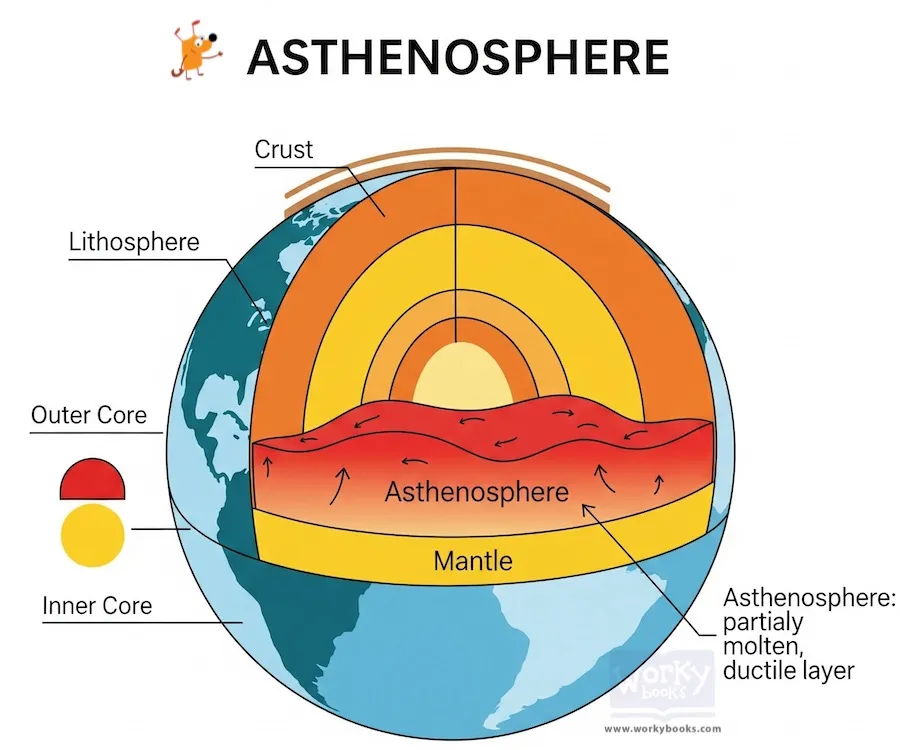
What is the Asthenosphere? Asthenosphere is a layer deep inside Earth, found below the hard outer shell called the lithosphere. This layer is made of solid rock, but it is so hot and under such high pressure that it flows very, very slowly—almost like warm caramel under a chocolate shell. While it holds its shape like a solid, it can move and bend over thousands of years.
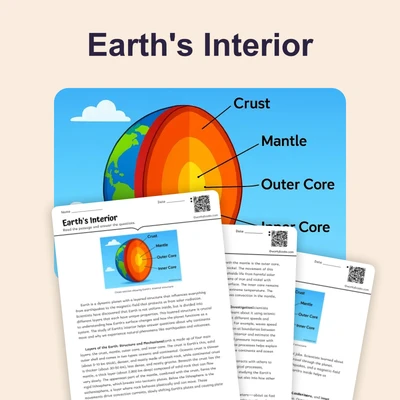
Where is the Asthenosphere? The asthenosphere is located about 50 to 120 miles (80 to 200 kilometers) beneath Earth’s surface, and it stretches down to about 200 to 440 miles (350 to 700 kilometers) deep. Its thickness can range from 100 to 200 miles (150 to 350 kilometers), depending on where you look inside the Earth.
Why Does the Asthenosphere Flow? The rock in the asthenosphere flows because it is extremely hot—between 1,800°F and 4,000°F (1,000°C to 2,200°C)! The heat softens the rock and makes it flexible, but the pressure from all the rock above keeps it from melting completely. This means the asthenosphere acts like a super-slow-moving liquid, taking thousands of years to flow even a short distance.
Why Does Its Thickness Change? The asthenosphere is thinner under oceans, where it is hotter and not as deep. It is thicker under continents, which are cooler and heavier. Scientists use earthquake waves to measure these differences because the waves slow down in the softer asthenosphere.
Why is the Asthenosphere Important? The asthenosphere matters because tectonic plates—the giant slabs that make up Earth’s surface—float and move on top of it. The slow flow of the asthenosphere helps drive the movement of these plates, which causes earthquakes, volcanoes, and even the formation of mountains. Without the asthenosphere, Earth's surface would not be able to change and grow.
How Do We Know It Exists? Scientists discovered the asthenosphere by studying earthquake waves. These waves travel slower through the asthenosphere because it is softer than the layers above and below. This region is called the “low-velocity zone.” The name asthenosphere comes from the Greek word “asthenos,” which means “weak”—it is the weak, soft layer that lets plates move.
Interesting Fact: Some volcanoes and earthquakes happen because the asthenosphere’s slow flow pushes and pulls on the plates above!
Where is the asthenosphere found?
Below the lithosphereAbove the crustInside the coreOn Earth's surface
What is the asthenosphere made of?
Solid rockLiquid waterAirMetal
How thick can the asthenosphere be?
100-200 miles1 mile10,000 miles5 miles
Why does the asthenosphere flow?
It is very hotIt is coldIt is dryIt is made of gas
What happens to earthquake waves in the asthenosphere?
They slow downThey speed upThey stopThey disappear
What floats and moves on the asthenosphere?
Tectonic platesCloudsFishMountains
The asthenosphere is thicker under oceans. True or False?
TrueFalse
What does the word 'asthenosphere' mean?
Weak layerHot waterStrong rockFast zone
Perfect For:
👩🏫 Teachers
• Reading comprehension practice
• Auto-graded assessments
• Literacy skill development
👨👩👧👦 Parents
• Reading practice at home
• Comprehension improvement
• Educational reading time
🏠 Homeschoolers
• Reading curriculum support
• Independent reading practice
• Progress monitoring
Reading Features:
📖
Reading Passage
Engaging fiction or nonfiction text
❓
Comprehension Quiz
Auto-graded questions
📊
Instant Feedback
Immediate results and scoring
📄
Printable Version
Download for offline reading
🔊
Read Aloud
Voice-over with word highlighting
Reviews & Ratings
No reviews yet. Be the first to share your experience!
Related Content
Tools and Technology in Earth Science
This middle school science reading passage explores the wide range of tools and technologies used in Earth science, from...
MS-ESS2-2MS-ESS3-2MS-ETS1-1MS-PS4-3
Scientific Inquiry in Earth Science
This passage explores scientific inquiry in Earth science for grades 6-8, aligned with NGSS standards MS-ESS1-4, MS-ESS2...
MS-ESS1-4MS-ESS2-1MS-ESS3-5SEP
What Is Earth Science?
This engaging middle school science passage introduces students to the field of Earth science, aligning with NGSS standa...
MS-ESS1MS-ESS2MS-ESS3SEP
Earth: Our Home in Space
This engaging Grade 4-5 science passage, aligned to NGSS, introduces students to Earth's special place in the solar syst...
Earth's Spheres
This middle school science passage introduces students to Earth's four major spheres: the geosphere, hydrosphere, atmosp...
MS-ESS2-4MS-ESS2-6
What Is Space Weather and How Does It Affect the Earth?
This NGSS-aligned science passage for middle school explains what space weather is and how it affects Earth. Students le...
MS-ESS2-2
Earth's Energy Balance
This engaging, NGSS-aligned science passage for grades 6–8 explores Earth's energy balance, a key process that keeps our...
MS-ESS2-6
Earth's Rotation
This middle school science passage, aligned with NGSS standard MS-ESS1-1, focuses on Earth's rotation—how Earth spins on...
MS-ESS1-1
Earth's Land and Water
This 250-word reading passage introduces fourth-grade students to the fundamental concept of how land and water are dist...
NGSS 4-ESS2-2ESS2.B
Earth's Interior
This comprehensive passage for grades 6-8 explores Earth's layered interior, including the crust, mantle, outer core, an...
MS-ESS2-1MS-ESS2-2
Facts About Earth
This engaging science reading passage introduces Grade 4 and 5 students to Earth, our home planet. Aligned with NGSS sta...
Meteorite Impacts on Earth
This engaging science reading passage for Grades 4-5 explores meteorite impacts on Earth, aligning with NGSS standards. ...
Venus: Earth's Twin?
This comprehensive science passage for grades 6-8 examines Venus—often called Earth's twin—by exploring its similarities...
MS-ESS1-2MS-ESS1-3
Earth Changes Over Millions of Years
This engaging, audio-integrated science passage for Grade 4-5 students explores how Earth has changed over millions of y...
Volcano Patterns on Earth
This Grade 4 science reading passage introduces students to volcano patterns on Earth, aligned with NGSS standard 4-ESS2...
NGSS 4-ESS2-2
Earth's Moon Facts
This engaging science passage, 'The Moon: Earth's Companion,' is designed for Grade 4-5 students and aligns with NGSS ge...
Earth's Quick and Slow Changes
In 'Earth's Quick and Slow Changes,' students categorize 12 Earth events by their speed of occurrence, enhancing underst...
Earth: Our Home Planet
This comprehensive science passage for grades 6-8 explores Earth’s unique characteristics and the interconnected systems...
MS-ESS1-2
Earth's Revolution
This middle school science passage explores the science behind Earth's revolution around the Sun, closely aligned with N...
MS-ESS1-1
Earthquake Patterns on Earth
This engaging 250-word reading passage introduces fourth-grade students to earthquake patterns on Earth, aligned with NG...