Reading PassagePremium

James Madison Virginia Plan

Interactive passage with audio narration, comprehension questions, and printable PDF.

No ratings yet
Grades 6–8ElaSocial-studiesHistoryEnglish · SpanishInteractive · Printable
Just this resource
$1.50
One-time purchase
Best value
Unlock everything
$49.99$29.99/yr
40% off until Aug 1 — 10,000+ resources
Renews at $49.99/year.
Unlock above to use these actions

What's included

Reading passage
Audio narration
Comprehension quiz
Writing activity
Glossary & flashcards
Differentiated version
Spanish translation

James Madison Virginia Plan preview and details

About this printable James Madison Virginia Plan reading passage (Grades 6-8)

This passage examines James Madison's vital role at the Constitutional Convention of 1787, focusing on his proposal of the Virginia Plan and its profound impact on the structure of the United States government. Students will explore the challenges the delegates faced, the differences between various proposals, and Madison's ability to influence the path toward a stronger central government. The passage integrates academic vocabulary such as convention, proposal, delegate, and compromise to support historical literacy. In addition to the main passage, students receive a differentiated version for accessibility, a Spanish translation, a glossary, and multiple engaging activities, including quizzes, writing prompts, and graphic organizers. This resource is aligned with history standard HSS 8.2.3 and common core standards RI.6-8.1 and RI.6-8.6. The passage supports deep analysis, critical thinking, and evidence-based reasoning, making it ideal for developing historical understanding. Read aloud audio and Spanish translation are included to support diverse learners.
Written by Workybooks TeamPublished by Workybooks
Preview

Sample passage and quiz from James Madison Virginia Plan

Reading passage and comprehension quiz preview

James Madison Virginia Plan
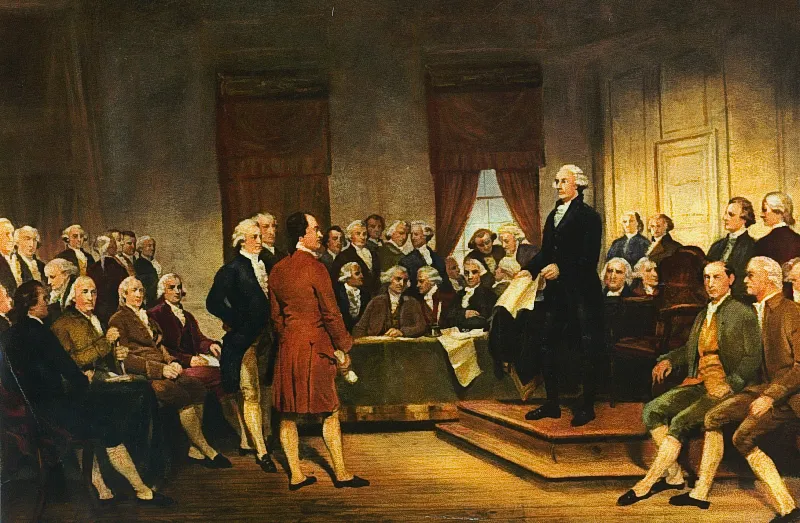
Washington Constitutional Convention 1787

"Washington Constitutional Convention 1787" by Junius Brutus Stearns
Source: Wikimedia Commons (Public domain).

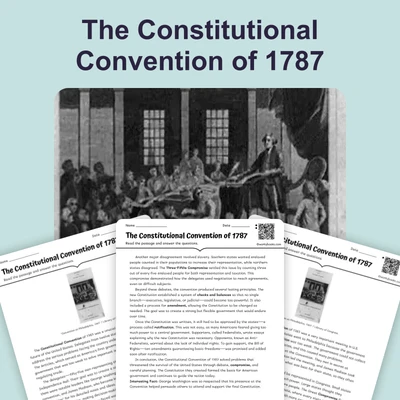
The Constitutional Convention of 1787 was a turning point in American history. Delegates from different states gathered in Philadelphia to address the weaknesses of the Articles of Confederation, the country’s first governing document. Among those present, James Madison of Virginia stood out for his preparation and vision. He arrived with detailed notes, an understanding of government theory, and a bold proposal that would shape the future of the United States.

The major challenge facing the convention was how to design a fair and effective government. The existing system under the Articles had left the national government weak and unable to solve important problems, like regulating trade or raising taxes. Madison recognized this as a major obstacle to the new nation’s survival. He believed that creating a stronger central government was essential for unity and stability.

To address these issues, Madison introduced the Virginia Plan. This proposal called for a new government with three branches: legislative, executive, and judicial. The legislative branch would have two houses, and representation in both would be based on a state’s population. This system would give more power to larger states. Madison argued that such a structure would prevent tyranny, encourage cooperation among states, and allow the government to act decisively.

However, not everyone agreed with Madison’s ideas. Delegates from smaller states worried that they would lose influence under the Virginia Plan. They preferred equal representation, where each state, no matter its size, had the same number of votes. This conflict led to heated debates and highlighted the complexity of building a fair government. The compromise that eventually emerged—the Great Compromise—created a Congress with two houses: one based on population (the House of Representatives) and one with equal representation for every state (the Senate).

Madison’s influence at the convention was significant. He was skilled at building coalitions and persuading others through careful reasoning and evidence. He kept detailed records of the debates, which later became an important historical source. Although not all his ideas were adopted exactly as he proposed, Madison’s vision laid the foundation for the Constitution. His work demonstrated the importance of compromise and thoughtful debate in creating a successful government.

The final Constitution reflected many of Madison’s core principles, such as a system of checks and balances and separation of powers. These ideas helped prevent any one branch or group from becoming too powerful. The influence of the Virginia Plan can still be seen in the U.S. government today, reminding us of the lasting impact of Madison’s preparation and leadership.

Interesting Fact: Although James Madison is often called the “Father of the Constitution,” he was just 36 years old during the convention and worked tirelessly behind the scenes rather than as a main speaker.

Comprehension quiz (8 questions)

1. Who proposed the Virginia Plan?

James Madison
George Washington
Benjamin Franklin
John Adams

2. Where was the Constitutional Convention held?

New York
Philadelphia
Boston
Richmond

3. Which document was replaced by the Constitution?

Articles of Confederation
Bill of Rights
Declaration of Independence
Federalist Papers

4. Why did small states oppose the Virginia Plan?

It gave big states more power
It banned trade
It had no president
It reduced taxes

5. What was the main goal of the convention?

Create a stronger government
Declare independence
Fight Britain again
Write the Bill of Rights

6. How did Madison influence the convention?

He built coalitions and used evidence
He refused to speak
He left early
He wrote the Federalist Papers

7. The Great Compromise created two houses of Congress. True or False?

True
False

8. What does 'compromise' mean?

An agreement where each side gives up something
A secret meeting
A plan to win
A type of government
Who it's for

Perfect for the way you teach

Teachers
  • Build comprehension skills
  • Auto-graded quiz
  • Differentiated reading
Parents
  • Read together at home
  • Improve fluency
  • Quiet reading time
Homeschoolers
  • Reading curriculum support
  • Independent practice
  • Track Lexile growth
Topics

Reviews & Ratings

No reviews yet. Be the first to share your experience!

More reading you might love

20 more
Passage
Presidential Precedents George Washington  - reading educational content

Presidential Precedents George Washington

Reading Passage

$1.50
Passage
New Nation America - reading educational content

New Nation America

Reading Passage · HSS 5.6.1

$1.50
Passage
George Washington First President - reading educational content

George Washington First President

Reading Passage

$1.50
Passage
The Cherokee Nation: History and Culture - reading educational content

The Cherokee Nation: History and Culture

Reading Passage · D2.HIS.2.3-5

$1.50
Passage
American Indians and U.S. Citizenship - reading educational content

American Indians and U.S. Citizenship

Reading Passage

$1.50
Passage
John Adams: Second President - reading educational content

John Adams: Second President

Reading Passage · D2.HIS.2.3-5

$1.50
Passage
George Washington: Our First President - reading educational content

George Washington: Our First President

Reading Passage · D2.HIS.2.3-5

$1.50
Passage
James Madison Early Life - reading educational content

James Madison Early Life

Reading Passage

$1.50
Passage
New Orleans: An Important Port - reading educational content

New Orleans: An Important Port

Reading Passage · D2.HIS.3.3-5

$1.50
Passage
George Washington Early Life - reading educational content

George Washington Early Life

Reading Passage

$1.50
Passage
John Adams Presidency - reading educational content

John Adams Presidency

Reading Passage · D2.HIS.2.3-5

$1.50
Passage
George Washington Whiskey Rebellion - reading educational content

George Washington Whiskey Rebellion

Reading Passage

$1.50
Passage
Modern American Presidents - reading educational content

Modern American Presidents

Reading Passage · D2.HIS.1-4.3-5RI.4.3

$1.50
Passage
Hamilton vs Jefferson - reading educational content

Hamilton vs Jefferson

Reading Passage

$1.50
Passage
Leaders Call for a New Constitution - reading educational content

Leaders Call for a New Constitution

Reading Passage

$1.50
Passage
Madison War of 1812 - reading educational content

Madison War of 1812

Reading Passage

$1.50
Passage
Battle of New Orleans 1815 - reading educational content

Battle of New Orleans 1815

Reading Passage · D2.HIS.2.3-5

$1.50
Passage
James Madison: Father of the Constitution - reading educational content

James Madison: Father of the Constitution

Reading Passage

$1.50
Passage
James Monroe and the Monroe Doctrine - reading educational content

James Monroe and the Monroe Doctrine

Reading Passage · D2.HIS.1-4.3-5

$1.50
Passage
Madison First Congress - reading educational content

Madison First Congress

Reading Passage

$1.50
Copyright © 2026 Workybooks. Made with ♥ in California.