Madison Bill of Rights
Interactive passage with audio narration, comprehension questions, and printable PDF.
By completing this purchase you agree to our Terms of Use and Privacy Policy. Your subscription renews automatically until you cancel. You can cancel anytime from your account settings. All sales are final and non-refundable. Digital content is available for download in your account immediately upon purchase.
What's included
Madison Bill of Rights preview and details
About this printable Madison Bill of Rights reading passage (Grades 6-8)
Sample passage and quiz from Madison Bill of Rights
Reading passage and comprehension quiz preview
Madison Bill of Rights
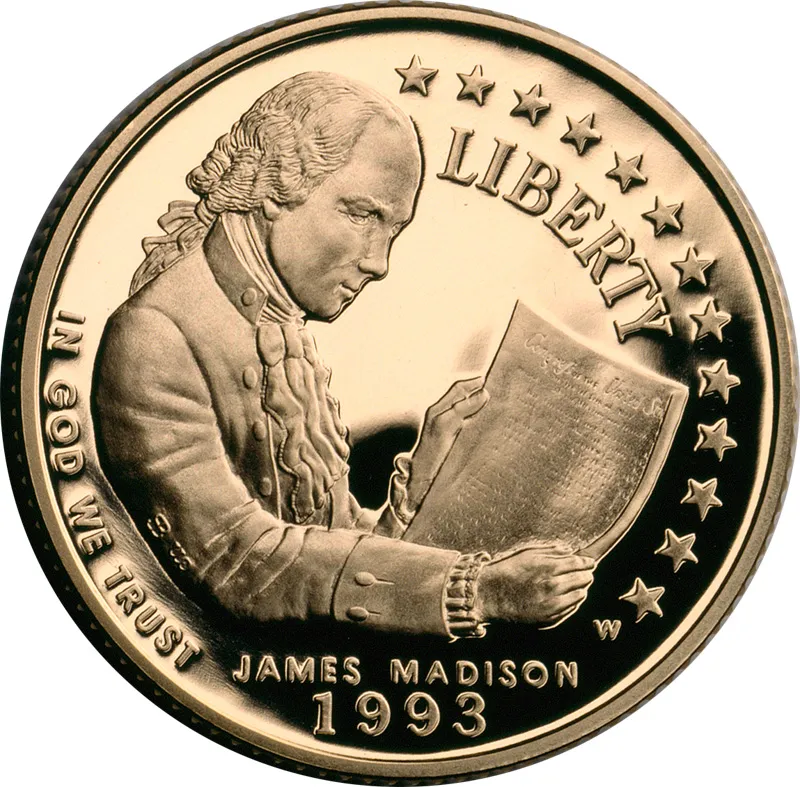
"James Madison Bill of Rights $5 commemorative obverse" by United States Mint image /
Source: Wikimedia Commons (Public domain).
The first years of the United States government brought both hope and tension. After the Constitution was written in 1787, many Americans worried that it did not clearly protect their rights. Some believed a strong central government might threaten personal liberty. These critics were known as Anti-Federalists. They demanded that specific amendments be added to guarantee freedoms such as speech, religion, and fair trials.
James Madison, a leader from Virginia, played a critical role in resolving this conflict. Although Madison originally thought the Constitution was strong enough, he listened to the concerns of the Anti-Federalists. He realized that the nation needed unity and public trust for the new government to survive. Madison decided to propose a set of amendments to protect individual rights, a decision that would later be seen as one of his biggest contributions to American history.
In 1789, Madison took action by drafting a list of changes to the Constitution. He carefully reviewed ideas from state constitutions and debates from the Constitutional Convention. Madison selected the most essential rights and wrote them as proposals for Congress to consider. He aimed to address the problem of protecting liberty while maintaining a strong federal government. This process required skillful negotiation and compromise among leaders with very different views.
Congress debated Madison’s proposals intensely. Some representatives thought the amendments would weaken the government, while others believed they did not go far enough. Despite these disagreements, Madison worked persistently to build support. He used clear reasoning and evidence, arguing that amendments would make the Constitution stronger and more respected by the people. His leadership helped Congress pass twelve amendments, of which ten were ratified by the states and became known as the Bill of Rights in 1791.
The Bill of Rights became a foundation for American democracy. It guaranteed freedoms such as speech, religion, press, assembly, and protection from unfair government actions. Madison’s efforts created a solution to a serious problem: how to balance government authority with individual rights. His work did not solve all conflicts, but it established principles that remain essential to American democracy today. The process also showed how compromise and debate can produce important changes in history.
Interesting Fact: When Madison first introduced the amendments, some members of Congress thought they were unnecessary, but over time, they became some of the most valued parts of the Constitution.
Comprehension quiz (8 questions)
1. Who was the main author of the Bill of Rights?
2. What year were the Bill of Rights ratified?
3. What did Anti-Federalists want?
4. What was Madison's main goal?
5. How did Madison address Anti-Federalist concerns?
6. Why was compromise important in this process?
7. The Bill of Rights protects freedom of speech. True or false?
8. What is an amendment?
Perfect for the way you teach
- Build comprehension skills
- Auto-graded quiz
- Differentiated reading
- Read together at home
- Improve fluency
- Quiet reading time
- Reading curriculum support
- Independent practice
- Track Lexile growth