Reading PassagePremium

Practical Uses of Azimuth

Interactive passage with audio narration, comprehension questions, and printable PDF.

No ratings yet
Grade 6ScienceEnglish · SpanishInteractive · Printable
Just this resource
$1.50
One-time purchase
Best value
Unlock everything
$49.99$29.99/yr
40% off until Aug 1 — 10,000+ resources
Renews at $49.99/year.
Unlock above to use these actions

What's included

Reading passage
Audio narration
Comprehension quiz
Writing activity
Glossary & flashcards
Differentiated version
Spanish translation

Practical Uses of Azimuth preview and details

About this printable Practical Uses of Azimuth science reading passage, NGSS-aligned (Grade 6)

This audio-integrated reading passage, titled "Practical Uses of Azimuth," is designed for Grade 6 students and explores the concept of azimuth and its diverse applications in real-world scenarios. Students will learn how azimuth, defined as the horizontal angle measured clockwise from a north reference, is crucial for navigation, surveying, and engineering. The passage covers how tools like compasses and GPS utilize azimuth to provide precise directional information. It aligns with NGSS 3-5-ETS1-2, encouraging students to understand how different tools and methods help solve problems related to direction and location. The content includes key terms and examples, making complex ideas accessible and engaging. This resource helps students connect scientific concepts to practical problem-solving.
Written by Workybooks TeamPublished by Workybooks
Preview

Sample passage and quiz from Practical Uses of Azimuth

Reading passage and comprehension quiz preview

Practical Uses of Azimuth
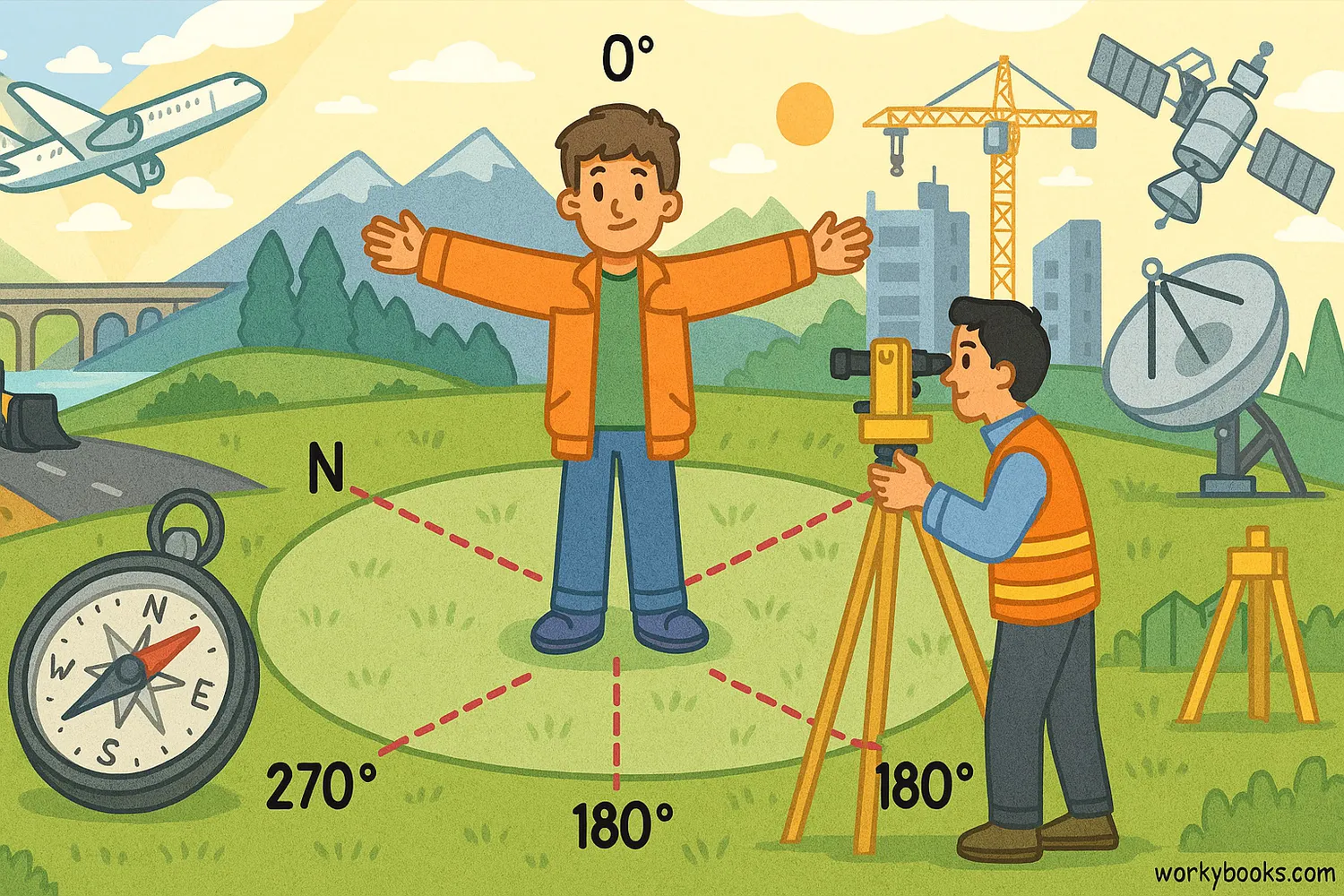
Wide illustration showing azimuth applications in navigation, surveying, astronomy, and communication.
Azimuth in action: guiding navigation, construction, astronomy, and satellite alignment.

What is Azimuth?
Azimuth is a way to describe direction using numbers instead of just words like north, south, east, or west. With azimuth, we use degrees (°) to show exactly which way to go. North is 0°, east is 90°, south is 180°, west is 270°, and a full circle brings you back to north at 360°.

How Do We Use Azimuth?
Azimuth makes directions much more precise. For example, instead of saying “Go northeast,” someone using azimuth would say, “Go at 45°.” This helps people travel in the exact right direction.

How to Read a Compass
A compass is a tool that shows direction. The needle always points north. Around the edge, the compass has numbers from 0° to 360°. To find an azimuth, you turn the compass until the needle lines up with north. Then you count the degrees to your target direction.

Real-Life Uses for Azimuth
Azimuth is important for many people. Hikers use azimuth to walk through forests without getting lost. Pilots use it to fly airplanes between cities. Sailors use azimuth to find their way across oceans. Search and rescue teams use it to locate missing people. Even astronomers use azimuth to point telescopes at exact stars in the sky.

Why Numbers Matter
Using numbers for direction is more exact than words. Saying “go toward the big tree” can be confusing, but “go at 120°” is clear for everyone. Azimuth is like using an address instead of just saying “go that way!”

Practice on the Playground
You can practice azimuth by using a compass on the playground. Try walking at 90° (east) or 180° (south) and see where you end up. Challenge friends to find a hidden object using azimuth directions!

Interesting Fact: The word "azimuth" comes from an old Arabic word that means "the direction." Scientists and explorers all over the world use azimuth to help them navigate accurately.

Comprehension quiz (8 questions)

1. What does azimuth use to show direction?

Numbers (degrees)
Colors
Letters only
Shapes

2. Which tool helps you find azimuth?

Compass
Map
Ruler
Flashlight

3. Which is more precise: 45° or northeast?

45°
Northeast
West
Left

4. Who uses azimuth to find lost people?

Search and rescue teams
Chefs
Librarians
Painters

5. How does a compass help with azimuth?

Shows north and degrees
Shows time
Makes noise
Shows temperature

6. Why is azimuth better than just words?

It is more exact
It uses colors
It is faster
It is older

7. Azimuth is only used by sailors. True or false?

True
False

8. What does 'precise' mean?

Exact and clear
Very slow
Very noisy
Always round
Who it's for

Perfect for the way you teach

Teachers
  • Build comprehension skills
  • Auto-graded quiz
  • Differentiated reading
Parents
  • Read together at home
  • Improve fluency
  • Quiet reading time
Homeschoolers
  • Reading curriculum support
  • Independent practice
  • Track Lexile growth
Topics

Reviews & Ratings

No reviews yet. Be the first to share your experience!

More reading you might love

20 more
Passage
Tools and Technology in Earth Science - reading educational content

Tools and Technology in Earth Science

Reading Passage · MS-ESS2-2

$1.50
Passage
Scientific Inquiry in Earth Science - reading educational content

Scientific Inquiry in Earth Science

Reading Passage · MS-ESS1-4

$1.50
Passage
What Is Earth Science? - reading educational content

What Is Earth Science?

Reading Passage · MS-ESS1

$1.50
Passage
What Powers Earth's Systems - reading educational content

What Powers Earth's Systems

Reading Passage · MS-ESS2-1

$1.50
Passage
Earth: Our Home in Space - reading educational content

Earth: Our Home in Space

Reading Passage

$1.50
Passage
How Earth's Systems Interact - reading educational content

How Earth's Systems Interact

Reading Passage · MS-ESS2-1

$1.50
Passage
How Earth Science Fields Work Together - reading educational content

How Earth Science Fields Work Together

Reading Passage · MS-ESS2-1

$1.50
Passage
How Earth Science Shapes Our World - reading educational content

How Earth Science Shapes Our World

Reading Passage · MS-ESS3-1

$1.50
Passage
Earth's Spheres - reading educational content

Earth's Spheres

Reading Passage · MS-ESS2-4

$1.50
Passage
How Earth Systems Show Repeating Patterns - reading educational content

How Earth Systems Show Repeating Patterns

Reading Passage · MS-ESS2-1

$1.50
Passage
What Is Space Weather and How Does It Affect the Earth? - reading educational content

What Is Space Weather and How Does It Affect the Earth?

Reading Passage · MS-ESS2-2

$1.50
Passage
How Satellites Help Scientists Study Earth From Space - reading educational content

How Satellites Help Scientists Study Earth From Space

Reading Passage · MS-ESS2-1

$1.50
Passage
How Small Changes Affect Earth Systems - reading educational content

How Small Changes Affect Earth Systems

Reading Passage · MS-ESS2-1

$1.50
Worksheet
The Earth-Sun-Moon System - worksheet educational content

The Earth-Sun-Moon System

Worksheet · NGSS. MS-ESS1-1

$1.50
Passage
How Energy Flows Through Earth’s Systems - reading educational content

How Energy Flows Through Earth’s Systems

Reading Passage · MS-ESS2-1

$1.50
Passage
What Is the Science of Astronomy - reading educational content

What Is the Science of Astronomy

Reading Passage · MS-ESS1-1

$1.50
Passage
Earth's Rotation - reading educational content

Earth's Rotation

Reading Passage · MS-ESS1-1

$1.50
Passage
Earth's Interior - reading educational content

Earth's Interior

Reading Passage · MS-ESS2-1

$1.50
Passage
How Did Ancient Cultures Observe and Explain Earth - reading educational content

How Did Ancient Cultures Observe and Explain Earth

Reading Passage · MS-ESS2-1

$1.50
Passage
How Matter Cycles Through Earth Systems - reading educational content

How Matter Cycles Through Earth Systems

Reading Passage · MS-ESS2-1

$1.50
Copyright © 2026 Workybooks. Made with ♥ in California.