This learning resource is available in interactive and printable formats. The interactive worksheet can be played online and assigned to students. The Printable PDF version can be downloaded and printed for completion by hand.
This Grade 6-8 science reading passage introduces students to the concept of radio telescopes, focusing on their function, importance, and the scientific principles behind their operation. Aligned with NGSS standards MS-ESS1-3 and MS-ETS1-1, the passage explores how radio telescopes detect radio waves from distant cosmic sources, such as pulsars, quasars, and the cosmic microwave background. Students learn about the advantages of radio telescopes over optical telescopes, the engineering challenges of building large dishes, and the innovative technique of interferometry. Notable observatories like Arecibo, FAST, and the Very Large Array are described, as well as the Event Horizon Telescope’s role in imaging a black hole. The passage integrates scientific thinking by explaining cause-and-effect relationships and the mechanisms behind radio observations. Activities include a glossary, comprehension quiz, writing prompts for analytical thinking, and graphic organizers for comparing telescope types and analyzing cause and effect. Audio integration and Spanish translations ensure accessibility. This resource is ideal for middle school students exploring astronomy, technology, and the nature of scientific discovery.
CONTENT PREVIEW
Expand content preview
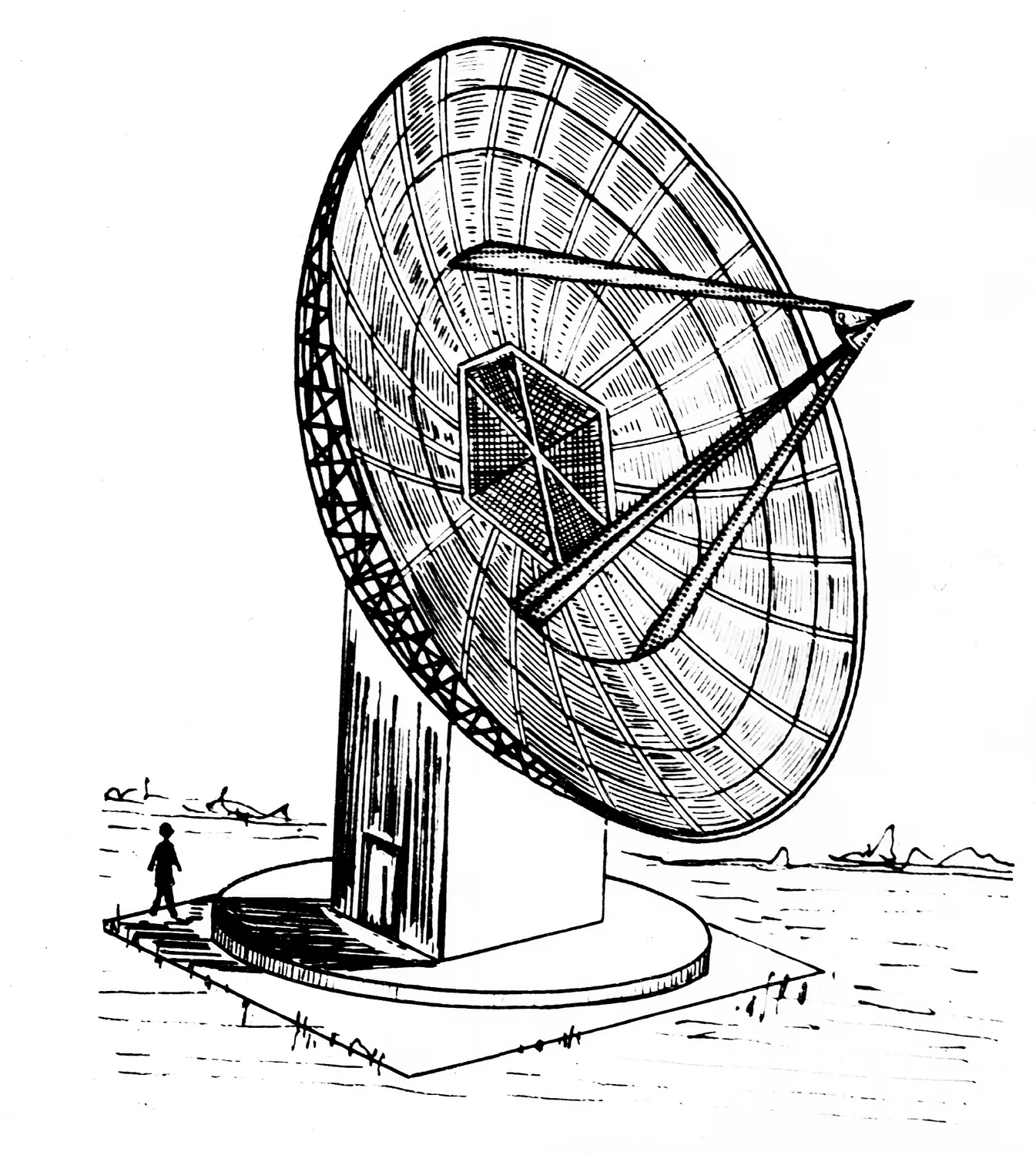
"Radio telescope with human for scale (PSF)" Pearson Scott Foresman / Source: Wikimedia Commons (Public domain).
Radio telescopes are essential tools for exploring the universe beyond what the human eye can see. Unlike optical telescopes, which collect visible light, radio telescopes detect radio waves—a form of invisible electromagnetic energy—emitted by cosmic objects. This ability allows scientists to study phenomena hidden from ordinary view, revealing mysteries about the structure and evolution of the universe.
How Radio Telescopes Work
Radio telescopes use large, curved parabolic dishes to collect and focus faint radio signals from space onto a sensitive receiver. The size of a dish determines its resolution, or the ability to distinguish fine details. Because radio waves have much longer wavelengths than visible light, radio telescopes must be enormous to achieve sharp images. For example, the Arecibo Observatory in Puerto Rico, before it collapsed in 2020, had a 305-meter-wide dish. China’s FAST telescope is currently the world’s largest single-dish radio telescope at 500 meters. Some observatories, such as the Very Large Array (VLA) in New Mexico, use interferometry—combining signals from many smaller dishes spread over large distances. This technique creates a ‘virtual telescope’ as wide as the array, greatly improving resolution. The Event Horizon Telescope combined radio telescopes around the globe to create an Earth-sized instrument, leading to the first image of a black hole in 2019.
What Radio Telescopes Reveal
Many cosmic sources emit strong radio waves, including pulsars (rapidly spinning neutron stars), quasars (extremely bright and distant objects powered by black holes), gas clouds, and even some planets in our solar system. The discovery of the cosmic microwave background—the faint afterglow of the Big Bang—was made possible by radio observations. Unlike optical telescopes, radio telescopes can observe through clouds, dust, and even during the daytime, because radio waves pass through these obstacles. This makes them invaluable for continuous monitoring of space. Scientists also use radio telescopes for the Search for Extraterrestrial Intelligence (SETI), scanning the universe for possible signals from alien civilizations.
Challenges and Innovations
Radio telescopes face challenges because longer wavelengths require much larger dishes for detailed imaging, making construction and maintenance complex and expensive. Engineers solved this with interferometry, linking multiple telescopes to act as one giant instrument. This approach not only increases resolution but also enables astronomers to study cosmic phenomena with unprecedented clarity. For example, the VLA’s 27 dishes can be arranged over 36 kilometers, acting like a single telescope of that size. Such technology has led to major discoveries, including the identification of pulsars, mapping of gas clouds, and insights into the early universe.
Radio telescopes have transformed our understanding of the universe, revealing invisible structures and energetic events that optical telescopes cannot detect. As technology advances, future radio telescopes will continue to expand our knowledge of space, offering new opportunities for discovery and innovation in astronomy and engineering.
Interesting Fact: The first detection of pulsars in 1967 was made with a radio telescope, leading to a Nobel Prize in Physics.
What is the main job of a radio telescope?
To collect and focus radio waves from space.To reflect visible light from distant stars.To measure earthquakes on Earth.To launch satellites into orbit.
Why must radio telescopes have large dishes?
To collect enough radio waves for sharp images.To protect equipment from rain.To increase their height above ground.To make them easier to transport.
Which cosmic event did the Event Horizon Telescope help image for the first time?
A black holeA comet hitting a planetThe formation of the MoonThe explosion of a supernova
What does the word 'resolution' mean in the passage?
How detailed or sharp a telescope's images areThe speed at which a telescope movesThe color of light a telescope collectsThe power of a telescope's computer
According to the passage, what is interferometry?
Combining signals from multiple telescopes for better imagesMeasuring the temperature of gas cloudsReflecting sunlight to EarthUsing lasers to create holograms
Why can radio telescopes work during the day and through clouds?
Because radio waves pass through clouds and sunlightBecause the telescopes are waterproofBecause they are buried undergroundBecause clouds increase radio signal strength
How did scientists solve the problem of long wavelengths needing huge dishes?
By using interferometry to combine multiple telescopesBy only observing during the nightBy using special mirrorsBy shrinking the radio waves
Which of the following is NOT a source of strong radio waves mentioned in the passage?
The SunPulsarsQuasarsGas clouds
True or False: The Arecibo radio telescope is still operating today.
TrueFalse
True or False: SETI uses radio telescopes to search for signals from alien civilizations.
TrueFalse
Perfect For:
👩🏫 Teachers
• Reading comprehension practice
• Auto-graded assessments
• Literacy skill development
👨👩👧👦 Parents
• Reading practice at home
• Comprehension improvement
• Educational reading time
🏠 Homeschoolers
• Reading curriculum support
• Independent reading practice
• Progress monitoring
Reading Features:
📖
Reading Passage
Engaging fiction or nonfiction text
❓
Comprehension Quiz
Auto-graded questions
📊
Instant Feedback
Immediate results and scoring
📄
Printable Version
Download for offline reading
🔊
Read Aloud
Voice-over with word highlighting
Reviews & Ratings
No reviews yet. Be the first to share your experience!
Related Content
Sunspots and Solar Flares
This quiz is designed to test your understanding of the fascinating phenomena of sunspots and solar flares, as described...
RI.4.1RI.4.4RI.5.1ESS1.A
The Hottest Planet in the Solar System
This NGSS-aligned middle school reading passage explains why Venus is the hottest planet in our solar system. Students l...
MS-ESS1-3
Mercury: Closest to the Sun
This comprehensive, standards-aligned passage explores Mercury—the smallest and closest planet to the Sun. Students in g...
MS-ESS1-2MS-ESS1-3
Venus: Earth's Twin?
This comprehensive science passage for grades 6-8 examines Venus—often called Earth's twin—by exploring its similarities...
MS-ESS1-2MS-ESS1-3
Mars: The Red Planet
This middle school science passage explores Mars, the Red Planet, providing students in grades 6-8 with a comprehensive ...
MS-ESS1-2MS-ESS1-3
What Is the Solar System?
This passage provides a comprehensive overview of the solar system for grades 6-8, aligned with NGSS standards MS-ESS1-2...
MS-ESS1-2MS-ESS1-3
Structure of the Solar System
This comprehensive science reading passage introduces middle school students (grades 6-8) to the structure of the solar ...
MS-ESS1-2MS-ESS1-3
Scale of the Solar System
This passage, aligned to NGSS standard MS-ESS1-3, helps middle school students grasp the immense scale of the solar syst...
MS-ESS1-3
Exploration of the Solar System
This comprehensive passage for grades 6-8 examines how humans explore the solar system, aligning with NGSS standards MS-...
MS-ESS1-3MS-ETS1-1
Optical Telescopes
This comprehensive passage explores the science of optical telescopes for middle school students, aligning with NGSS sta...
MS-ESS1-3MS-ETS1-1
Future of Alien Search
This informational passage for grades 6-8 explores how scientists are using cutting-edge missions and technology to sear...
MS-ESS1-3MS-ETS1-1
Communicating with Aliens
This middle school science passage, aligned with NGSS standard MS-ESS1-3, examines the scientific and technological chal...
MS-ESS1-3
Measuring Distances in Space
This middle school science passage explores how astronomers measure the vast distances in space, aligning with NGSS stan...
MS-ESS1-3
Astronomy
This comprehensive reading passage introduces middle school students to the science of astronomy, which is the study of ...
MS-ESS1-2MS-ESS1-3MS-PS4-2MS-ETS1-1
The Solar System
This middle school science passage introduces students to the solar system, aligning with NGSS standards MS-ESS1-2 and M...
MS-ESS1-2MS-ESS1-3
The Inner Planets
This comprehensive science passage for grades 6-8 explores the inner (terrestrial) planets of our solar system—Mercury, ...
MS-ESS1-2MS-ESS1-3
The Outer Planets
This engaging science passage for grades 6-8 introduces students to the outer planets—Jupiter, Saturn, Uranus, and Neptu...
MS-ESS1-2MS-ESS1-3
Light-Years and Cosmic Distances
This middle school science passage, aligned to NGSS MS-ESS1-3, explores how astronomers measure the vast distances in sp...
MS-ESS1-3
Space Stations
This informational science reading passage for grades 6-8 explores the complex systems and technology behind space stati...
MS-ESS1-3MS-ETS1-1
Types of Spacecraft
This passage introduces middle school students to the various types of spacecraft used to explore our solar system and b...