Renaissance Anatomy Art
Interactive passage with audio narration, comprehension questions, and printable PDF.
By completing this purchase you agree to our Terms of Use and Privacy Policy. Your subscription renews automatically until you cancel. You can cancel anytime from your account settings. All sales are final and non-refundable. Digital content is available for download in your account immediately upon purchase.
What's included
Renaissance Anatomy Art preview and details
About this printable Renaissance Anatomy Art reading passage (Grades 5-8)
Sample passage and quiz from Renaissance Anatomy Art
Reading passage and comprehension quiz preview
Renaissance Anatomy Art
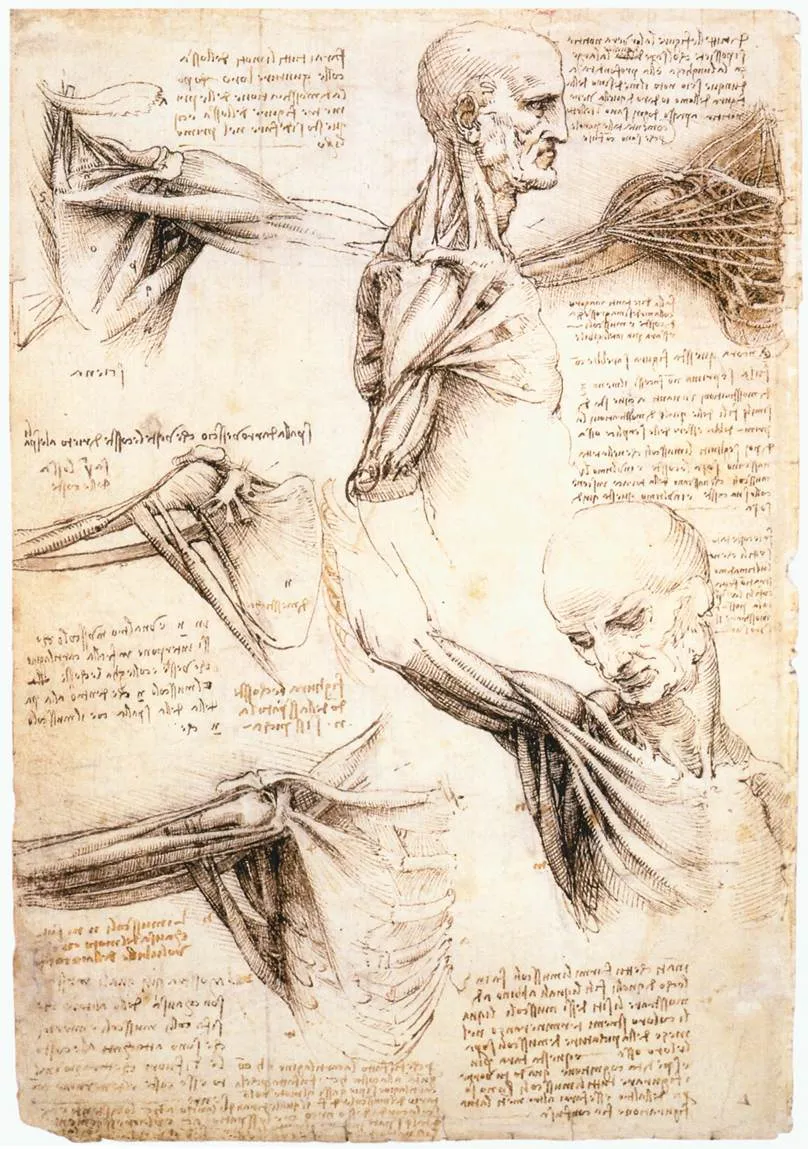
"Anatomical studies of the shoulder" by Leonardo da Vinci / Wikimedia Commons.
The Renaissance was a period in European history, beginning in the 1300s in Italy, when art, science, and learning flourished. During this time, artists wanted to create more realistic images of the human body. To achieve this, they began to study anatomy—the structure of living things—through direct observation and dissection.
Before the Renaissance, most artists relied on traditional methods and religious rules to guide their work. Human figures in medieval art often looked stiff or unrealistic. However, new ideas from ancient Greece and Rome inspired artists to observe nature closely. In cities like Florence and Milan, artists such as Leonardo da Vinci and Andreas Vesalius began to dissect human bodies. This practice was controversial, as many people believed it was disrespectful or even forbidden. Despite this, some universities and city-states allowed dissections for scientific purposes.
One of the most famous Renaissance artists, Leonardo da Vinci, created hundreds of detailed anatomical drawings between 1489 and 1513. He dissected over 30 bodies, carefully recording his observations in notebooks. Leonardo's drawings of muscles, bones, and organs were so accurate that they are still admired today. For example, his sketch of the human skeleton from around 1510 shows each bone in precise detail. Leonardo wrote notes in mirror writing, making his studies difficult for others to read at the time. He believed that understanding the body’s structure was essential for making art that looked natural and alive.
These anatomical discoveries had a powerful effect on art and science. Renaissance artists, including Michelangelo and Raphael, used what they learned to paint and sculpt more lifelike human figures. For instance, Michelangelo's statue of David reveals muscles and posture that reflect real human anatomy. Meanwhile, scientists such as Vesalius published books with detailed illustrations, changing the way doctors and students studied medicine. Over time, the study of anatomy helped bridge the gap between art and science, leading to new ideas about health, movement, and the human experience.
In conclusion, the Renaissance was a turning point for both art and science. By dissecting bodies and studying anatomy, artists and scientists gained new knowledge that transformed how people saw the human body. Their work set the stage for advances in medicine and the creation of masterpieces that are still admired today. The study of Renaissance anatomy art shows how curiosity and careful observation can lead to lasting change in society.
This topic connects to broader world history themes of innovation, the spread of ideas, and the interaction between different fields of knowledge.
Interesting Fact: Leonardo da Vinci's anatomical drawings were not published until centuries after his death, but today they are considered some of the most important studies in both art and science.
Comprehension quiz (8 questions)
1. When did the Renaissance begin?
2. Who drew detailed anatomy sketches?
3. What did Renaissance artists want?
4. Why did artists dissect bodies?
5. How did Leonardo record his studies?
6. What was an effect of anatomy studies?
7. Renaissance artists used anatomy for realistic art.
8. What does 'anatomy' mean?
Perfect for the way you teach
- Build comprehension skills
- Auto-graded quiz
- Differentiated reading
- Read together at home
- Improve fluency
- Quiet reading time
- Reading curriculum support
- Independent practice
- Track Lexile growth