Renaissance Religious Art
Interactive passage with audio narration, comprehension questions, and printable PDF.
By completing this purchase you agree to our Terms of Use and Privacy Policy. Your subscription renews automatically until you cancel. You can cancel anytime from your account settings. All sales are final and non-refundable. Digital content is available for download in your account immediately upon purchase.
What's included
Renaissance Religious Art preview and details
About this printable Renaissance Religious Art reading passage (Grades 5-8)
Sample passage and quiz from Renaissance Religious Art
Reading passage and comprehension quiz preview
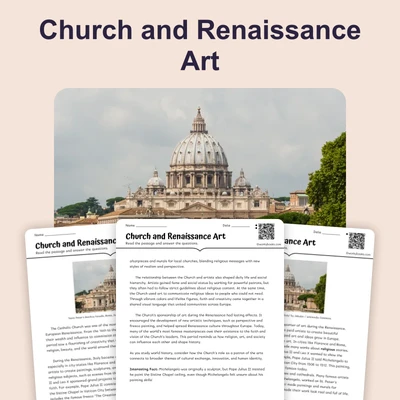
Renaissance Religious Art
![[The last supper]](https://assets.workybooks.com/INTERACTIVE/media/pd--The-last-supper--1766426764167-929548961.webp)
"The last supper" / Library of Congress.
The Renaissance was a period of great cultural change in Europe, beginning in Italy during the 1300s and spreading throughout the continent over the next two centuries. One of the most remarkable transformations during this era took place in religious art. Artists began to move away from the medieval style, which often showed holy figures as flat, symbolic icons, and instead embraced naturalism—a style that aimed to represent the world and people more realistically.
During the Middle Ages, religious art was focused on teaching the beliefs of the church. Paintings and sculptures often used gold backgrounds and stiff poses to communicate the power and mystery of biblical subjects. For example, the mosaics in Ravenna, Italy, from the 6th century, show saints with serious faces and no clear sense of space or depth. These works were designed to inspire awe, not to reflect real life. The church was the main patron, or supporter, of artists, and religious themes dominated almost all artwork.
As the Renaissance began, artists such as Leonardo da Vinci, Michelangelo, and Raphael started to experiment with new techniques. They studied human anatomy, used perspective to create depth, and placed biblical scenes in familiar, earthly settings. For example, Leonardo da Vinci's famous mural, The Last Supper (1495–1498), shows the apostles as real people reacting with surprise, sadness, or confusion when Jesus reveals one will betray him. Michelangelo's frescoes in the Sistine Chapel (completed 1512) show prophets and biblical heroes with muscular bodies and expressive faces, making them appear more human than ever before.
This new approach reflected the influence of humanism—a movement that valued the study of classical cultures and the potential of individuals. Artists wanted viewers to connect emotionally with the stories they showed, rather than simply admire them from a distance. Patrons of art also changed. Wealthy families such as the Medicis of Florence, along with church leaders, commissioned works that celebrated both religious devotion and the beauty of the natural world.
The shift from medieval to Renaissance religious art had lasting effects. By making sacred figures seem more real and relatable, artists encouraged people to see their faith as part of their everyday lives. The use of perspective, anatomy, and emotion in art spread throughout Europe, influencing later artistic styles and even shaping how people understood religion and humanity. Today, masterpieces like The Last Supper and the Sistine Chapel ceiling are admired not just for their beauty, but for how they reflect the changing ideas of their time.
The Renaissance focus on naturalism and human emotion in religious art connects to broader themes in world history, such as cultural change, technological innovation, and the relationship between art, society, and belief.
Interesting Fact: During the Renaissance, artists sometimes included portraits of their sponsors or even themselves in religious paintings, blending sacred and everyday life.
Comprehension quiz (8 questions)
1. Which country did the Renaissance begin in?
2. What is naturalism in art?
3. Who painted The Last Supper?
4. How did medieval art show holy figures?
5. Why did Renaissance art use perspective?
6. What was a major influence on Renaissance art?
7. Renaissance art made sacred figures seem more real.
8. What is a patron in art?
Perfect for the way you teach
- Build comprehension skills
- Auto-graded quiz
- Differentiated reading
- Read together at home
- Improve fluency
- Quiet reading time
- Reading curriculum support
- Independent practice
- Track Lexile growth