Renaissance Oil Painting
Interactive passage with audio narration, comprehension questions, and printable PDF.
By completing this purchase you agree to our Terms of Use and Privacy Policy. Your subscription renews automatically until you cancel. You can cancel anytime from your account settings. All sales are final and non-refundable. Digital content is available for download in your account immediately upon purchase.
What's included
Renaissance Oil Painting preview and details
About this printable Renaissance Oil Painting reading passage (Grades 5-8)
Sample passage and quiz from Renaissance Oil Painting
Reading passage and comprehension quiz preview
Oil Painting Techniques During the Renaissance
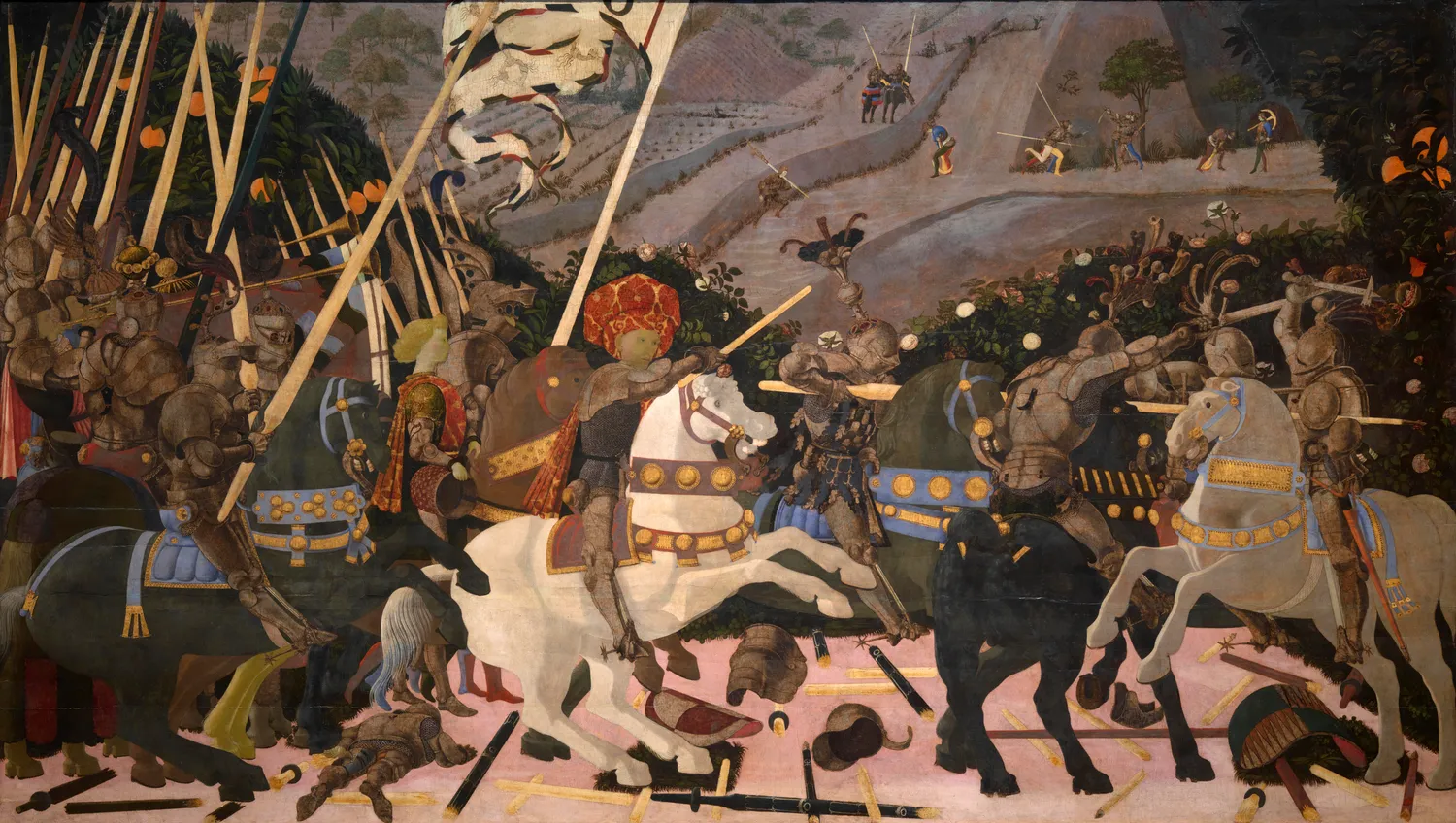
"San Romano Battle" by Paolo Uccello / Wikimedia Commons.
The Renaissance period in Europe, which began in the 14th century, transformed the world of art. This era saw artists experimenting with new materials and methods to create more lifelike images. One of the most important changes was the shift from tempera painting, which used egg yolk as a binder, to oil painting. This change in technique allowed artists to achieve remarkable effects that were not possible before.
In earlier centuries, European painters used egg-based tempera for their artworks. In tempera, pigments were mixed with egg yolk and applied in thin layers. This method dried quickly, which meant artists had to work fast and could not easily blend colors. As a result, tempera paintings often have crisp outlines and flat, bright colors. Some famous examples of tempera painting come from Italian city-states like Florence, where artists such as Sandro Botticelli painted works like “The Birth of Venus” in the 1480s. Tempera was valued for its clarity and precision, but it limited artists’ ability to create soft shadows and realistic textures.
Oil painting began to spread in Europe in the 15th century. Oil paints were made by mixing pigments with oils such as linseed or walnut oil. This new medium dried much more slowly than tempera, allowing artists to blend colors and create smooth transitions between light and shadow. Oil painting also produced deeper, richer colors and a shiny surface. One of the earliest documented uses of oil painting in Italy was by Antonello da Messina, an artist from Sicily. Around 1475, Antonello introduced new oil painting techniques he had learned from Northern European artists, such as Jan van Eyck, who had been using oil paints in the Low Countries (modern-day Belgium and the Netherlands) since the early 1400s.
Antonello da Messina’s innovations had a major impact on Italian art. By using oil paints, Antonello could achieve greater realism in his portraits, such as the famous "Portrait of a Man." He mastered techniques like glazing, applying thin layers of transparent color to build up depth. His methods influenced other artists, including Giovanni Bellini and Leonardo da Vinci, who further developed oil painting in Venice and Florence. Over time, oil painting became the preferred technique for European artists, replacing tempera almost entirely.
This transition in painting techniques reflected broader changes in Renaissance society. Artists gained higher social status as their skills and innovations were celebrated by wealthy patrons, such as the Medici family in Florence. Oil painting allowed artists to express human emotions and the natural world with greater subtlety. This new level of artistic expression matched the Renaissance focus on individual achievement and scientific study.
The development of oil painting during the Renaissance demonstrates how new technologies and cross-cultural exchange can change the course of art history. The spread of oil painting from Northern Europe to Italy shows the importance of sharing ideas between regions. Today, oil painting remains a major part of artistic tradition, thanks to the innovations of Renaissance artists.
Interesting Fact: Antonello da Messina is believed to have learned oil painting techniques from Flemish (Belgian) artists, showing how ideas traveled across Europe during the Renaissance.
Comprehension quiz (8 questions)
1. What did egg-based tempera use as a binder?
2. Who introduced oil painting to Italy?
3. What city-state was 'The Birth of Venus' painted in?
4. Why did oil paints allow more blending?
5. How did oil painting affect artists' status?
6. What technique made paintings more realistic?
7. Oil painting replaced tempera. True or false?
8. What is a patron?
Perfect for the way you teach
- Build comprehension skills
- Auto-graded quiz
- Differentiated reading
- Read together at home
- Improve fluency
- Quiet reading time
- Reading curriculum support
- Independent practice
- Track Lexile growth