The Galilean Moons of Jupiter
Interactive passage with audio narration, comprehension questions, and printable PDF.
By completing this purchase you agree to our Terms of Use and Privacy Policy. Your subscription renews automatically until you cancel. You can cancel anytime from your account settings. All sales are final and non-refundable. Digital content is available for download in your account immediately upon purchase.
What's included
The Galilean Moons of Jupiter preview and details
About this printable The Galilean Moons of Jupiter science reading passage, NGSS-aligned (Grades 5-8)
Sample passage and quiz from The Galilean Moons of Jupiter
Reading passage and comprehension quiz preview
The Galilean Moons of Jupiter
The
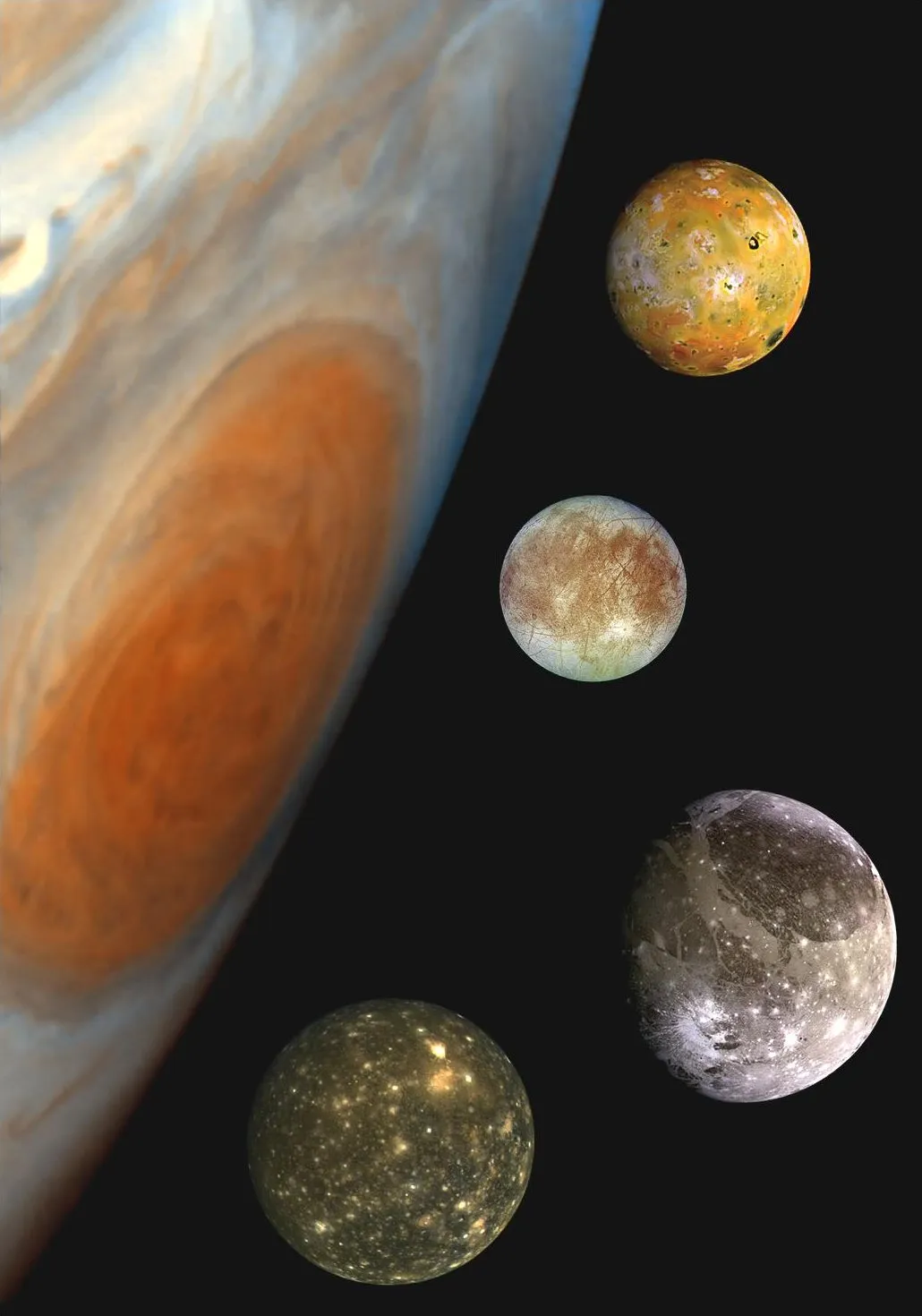
"Jupiter and the Galilean Moons" by NASA/JPL/DLR / Wikimedia Commons
are Jupiter's four largest moons. These moons are named Io, Europa, Ganymede, and Callisto. Italian astronomer Galileo Galilei discovered them in January 1610. He used a simple telescope to observe these distant worlds. This discovery changed how scientists understood the solar system. The Galilean moons were the first objects seen orbiting something other than Earth.
Each Galilean moon is a unique world with distinct features. Io is the closest moon to Jupiter. Evidence shows that Io has more than 400 active volcanoes on its surface. These volcanoes make Io the most volcanically active body in our solar system. Europa is covered with a thick layer of ice. Scientists explain that beneath this ice may exist a vast ocean of liquid water. This subsurface ocean makes Europa an interesting place to search for life. Ganymede holds the record as the largest moon in the entire solar system. It is even larger than the planet Mercury. Callisto is the outermost Galilean moon. Its surface is heavily covered with impact craters, showing its ancient age.
Galileo's discovery of these moons provided important evidence for a new understanding of space. Before 1610, most people believed everything in space orbited Earth. When Galileo observed moons orbiting Jupiter, this idea was challenged. His observations supported the heliocentric model, which places the Sun at the center of the solar system. Scientists continue to study the Galilean moons today. Spacecraft like NASA's Galileo mission and the upcoming Europa Clipper mission collect data about these fascinating worlds.
Understanding the Galilean moons helps scientists learn about planetary formation and the possibility of life beyond Earth. Europa's subsurface ocean contains more water than all of Earth's oceans combined. This makes it a prime target for future exploration. Studying these moons also helps us understand how celestial bodies interact through gravity. The knowledge gained from the Galilean moons expands our understanding of the solar system and our place within it.
Interesting Fact: Io's volcanic activity is so intense that its surface changes constantly, and scientists can observe new volcanic features appearing between spacecraft visits.
Comprehension quiz (10 questions)
1. Who discovered the Galilean moons?
2. Which Galilean moon is the largest in the entire solar system?
3. What makes Io unique among the Galilean moons?
4. What does the term 'orbiting' mean in the context of the passage?
5. Based on the passage, why is Europa considered interesting for the search for life?
6. What model of the solar system did Galileo's discovery support?
7. How did Galileo's discovery change scientific understanding in 1610?
8. What feature on Callisto's surface indicates its ancient age?
9. True or False: The Galilean moons were the first objects observed orbiting something other than Earth.
10. True or False: Europa's subsurface ocean contains less water than all of Earth's oceans combined.
Perfect for the way you teach
- Build comprehension skills
- Auto-graded quiz
- Differentiated reading
- Read together at home
- Improve fluency
- Quiet reading time
- Reading curriculum support
- Independent practice
- Track Lexile growth