What Are Dwarf Planets
Interactive passage with audio narration, comprehension questions, and printable PDF.
By completing this purchase you agree to our Terms of Use and Privacy Policy. Your subscription renews automatically until you cancel. You can cancel anytime from your account settings. All sales are final and non-refundable. Digital content is available for download in your account immediately upon purchase.
What's included
What Are Dwarf Planets preview and details
About this printable What Are Dwarf Planets science reading passage, NGSS-aligned (Grades 5-8)
Sample passage and quiz from What Are Dwarf Planets
Reading passage and comprehension quiz preview
What Are Dwarf Planets
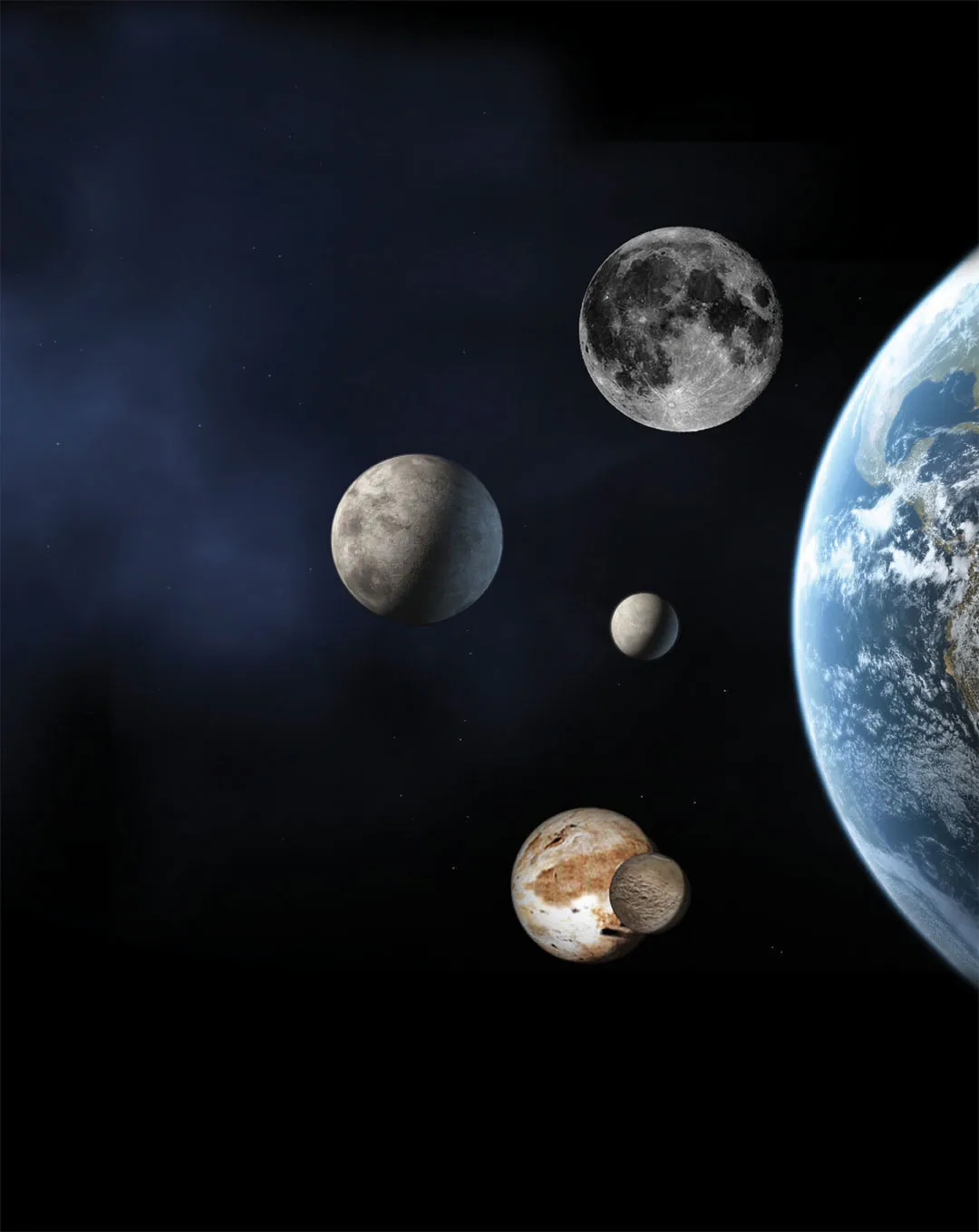
An artist's concept showing the size of the best known dwarf planets compared to Earth and its moon (top). Eris is left center; Ceres is the small body to its right and Pluto and its moon Charon are at the bottom. Dwarf Comparison1" by NASA / Wikimedia Commons
A dwarf planet is a type of celestial object that orbits the Sun. It has enough mass to pull itself into a round shape. However, it has not cleared its orbital path of other debris. This third requirement separates dwarf planets from regular planets. The International Astronomical Union (IAU) created these criteria in 2006 to classify objects in our solar system.
Scientists recognize five official dwarf planets in our solar system. Pluto is the most famous dwarf planet. It was once considered the ninth planet until scientists reclassified it. Ceres orbits in the asteroid belt between Mars and Jupiter. It is the only dwarf planet located in the inner solar system. Eris is slightly smaller than Pluto but contains more mass. Scientists discovered Eris in 2005, and its discovery led to Pluto's reclassification. Makemake and Haumea are the other two recognized dwarf planets. Both orbit in the distant region beyond Neptune.
The key difference between planets and dwarf planets involves orbital clearing. Regular planets have strong enough gravity to clear their orbital paths. They sweep up or push away asteroids and other small objects. Dwarf planets share their orbital space with many other objects. Evidence shows that Pluto's orbit crosses paths with numerous icy bodies. This shared space prevents Pluto from meeting the planet definition. Scientists observe that dwarf planets can have moons just like regular planets. Pluto has five known moons, and Haumea has two.
In 2006, astronomers gathered in Prague to vote on planet definitions. They decided that Pluto no longer fit the criteria for a full planet. This decision created the dwarf planet category. The vote was controversial, and some scientists still debate the classification system. New Horizons spacecraft flew past Pluto in 2015. The mission revealed that Pluto has a complex surface with mountains and plains. Scientists may discover more dwarf planets as telescope technology improves. Researchers estimate that dozens or even hundreds may exist in the outer solar system.
Understanding dwarf planets helps scientists learn about solar system formation. These objects preserve information from when the solar system was young. They contain materials that have changed little over billions of years. Studying dwarf planets also helps us understand how gravity shapes celestial bodies. The classification system shows how scientific knowledge can change with new discoveries. Scientists continue to refine their understanding of what makes a planet.
Interesting Fact: Haumea is one of the strangest dwarf planets because it spins so fast that it has an elongated, football-like shape instead of being round like most planets.
Comprehension quiz (10 questions)
1. According to the passage, what are the three criteria that define a dwarf planet?
2. Which dwarf planet is the only one located in the inner solar system?
3. What does the term 'orbital clearing' mean in the context of planet classification?
4. Based on the passage, what can you infer about why Eris's discovery was important?
5. What makes Haumea different from most other planets and dwarf planets?
6. If scientists discovered a new round object orbiting the Sun that shares its orbital space with many asteroids, how would it most likely be classified?
7. Why do scientists study dwarf planets to learn about solar system formation?
8. What evidence from the New Horizons mission changed scientists' understanding of Pluto?
9. True or False: All dwarf planets are located beyond Neptune in the outer solar system.
10. True or False: The International Astronomical Union created the dwarf planet classification in 2006.
Perfect for the way you teach
- Build comprehension skills
- Auto-graded quiz
- Differentiated reading
- Read together at home
- Improve fluency
- Quiet reading time
- Reading curriculum support
- Independent practice
- Track Lexile growth