Reading PassagePremium

What Are Moons

Interactive passage with audio narration, comprehension questions, and printable PDF.

No ratings yet
Grades 5–8ScienceElaEnglish · SpanishInteractive · Printable
Aligned toMS-ESS1-3
Just this resource
$1.50
One-time purchase
Best value
Unlock everything
$49.99$29.99/yr
40% off until Aug 1 — 10,000+ resources
Renews at $49.99/year.
Unlock above to use these actions

What's included

Reading passage
Audio narration
Comprehension quiz
Writing activity
Glossary & flashcards
Differentiated version
Spanish translation

What Are Moons preview and details

About this printable What Are Moons science reading passage, NGSS-aligned (Grades 5-8)

This 400-500 word informational science reading passage introduces middle school students (grades 6-8) to the concept of moons as natural satellites. Aligned with NGSS standard MS-ESS1-3 and Disciplinary Core Idea MS-ESS1.B (Earth and the Solar System), the passage defines moons and emphasizes their remarkable diversity in size, composition, and origin. Students learn that moons range from tiny captured asteroids to worlds larger than Mercury, challenging the common misconception that all moons resemble Earth's Moon. The passage includes real-world examples from our solar system, incorporates science practices through evidence-based language, and features audio integration for enhanced accessibility. Supplementary materials include a Spanish translation, simplified differentiated version for English Language Learners and struggling readers, glossary of key terms, multiple-choice comprehension questions, writing activities, and graphic organizers. This comprehensive resource helps students develop foundational understanding of celestial bodies and their relationships within the solar system.
Written by Workybooks TeamPublished by Workybooks
Preview

Sample passage and quiz from What Are Moons

Reading passage and comprehension quiz preview

What Are Moons
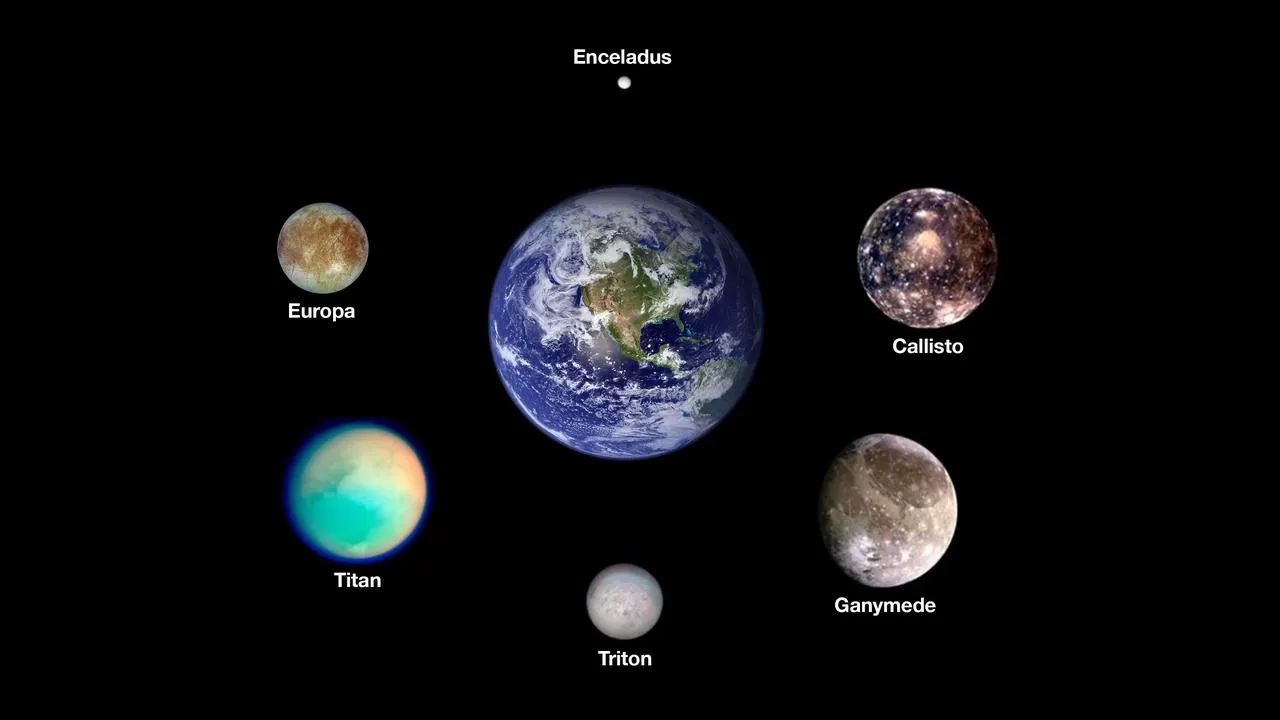
Icy Moons in Our Solar System That May Have Oceans Now

Scientists think six icy moons in our solar system may currently host oceans of liquid water beneath their outer surfaces. Arranged around Earth are images from NASA spacecraft of, clockwise from the top, Saturn's moon Enceladus, Jupiter's moons Callisto and Ganymede, Neptune's moon Triton, Saturn's moon Titan, and Jupiter's moon Europa, the target of NASA's Europa Clipper mission./ NASA

A moon is any natural satellite that orbits a planet, dwarf planet, or asteroid. Scientists observe that moons come in many different sizes and shapes. Some moons are tiny rocks only a few kilometers wide. Other moons are massive worlds larger than the planet Mercury. This incredible variety shows that moons can form in different ways.

Evidence shows that moons have different origins and compositions. Some moons formed alongside their parent planets from the same cloud of gas and dust. Other moons are captured objects that wandered too close to a planet's gravitational pull. Scientists explain that captured moons often have irregular shapes because they were once asteroids. Regular moons tend to be more spherical because gravity shaped them during formation. The composition of moons varies widely too. Some contain mostly ice, while others are made of rock and metal.

Jupiter's moon Ganymede provides a clear example of moon diversity. Ganymede measures 5,268 kilometers in diameter, making it larger than Mercury. This giant moon has its own magnetic field, something most moons lack. In contrast, Mars has two small moons called Phobos and Deimos. These moons measure only 22 and 12 kilometers across. Scientists think Phobos and Deimos may be captured asteroids because of their irregular shapes and rocky composition. The difference between Ganymede and Phobos shows how different moons can be.

Understanding moons helps scientists learn about the history of our solar system. Moons provide clues about how planets formed and evolved over billions of years. Some moons may have subsurface oceans that could support life. Studying the variety of moons teaches us that celestial bodies in space are more diverse than we once thought. Each moon has its own story to tell about the solar system.

Interesting Fact: Saturn has at least 146 known moons, more than any other planet in our solar system. Scientists continue to discover new small moons orbiting Saturn using powerful telescopes.

Comprehension quiz (10 questions)

1. What is a moon?

A natural satellite that orbits a planet, dwarf planet, or asteroid
A man-made object that orbits Earth
A star that produces its own light
A planet that orbits the Sun

2. According to the passage, how do captured moons differ from moons that formed with their planets?

Captured moons are always larger than regular moons
Captured moons often have irregular shapes while regular moons are more spherical
Captured moons are made only of ice
Captured moons orbit faster than regular moons

3. What does the word 'composition' mean in the context of this passage?

The speed at which a moon orbits
The distance between a moon and its planet
What something is made of or the materials that form it
The size and shape of an object

4. Which moon mentioned in the passage is larger than the planet Mercury?

Phobos
Deimos
Earth's Moon
Ganymede

5. Why do scientists think Phobos and Deimos might be captured asteroids?

Because they are very far from Mars
Because they have irregular shapes and rocky composition
Because they are larger than Earth's Moon
Because they have their own magnetic fields

6. Based on the passage, what can studying moons tell scientists?

Only how planets orbit the Sun
How to build better telescopes
About the history and formation of the solar system
The exact age of Earth

7. What makes Ganymede unusual compared to most other moons?

It is made entirely of ice
It has its own magnetic field
It orbits Mars instead of Jupiter
It is the smallest moon in the solar system

8. Which statement best describes the variety of moons in our solar system?

All moons are similar in size and composition
Moons vary greatly in size, composition, and origin
Only large planets have moons
All moons are made of rock and metal

9. True or False: All moons formed at the same time as their parent planets.

True
False

10. True or False: Saturn has more known moons than any other planet in our solar system.

True
False
Who it's for

Perfect for the way you teach

Teachers
  • Build comprehension skills
  • Auto-graded quiz
  • Differentiated reading
Parents
  • Read together at home
  • Improve fluency
  • Quiet reading time
Homeschoolers
  • Reading curriculum support
  • Independent practice
  • Track Lexile growth
Topics

Reviews & Ratings

No reviews yet. Be the first to share your experience!

More reading you might love

20 more
Passage
Sunspots and Solar Flares - reading educational content
Grades 4–5

Sunspots and Solar Flares

earth science · RI.4.1

Free
Passage
The Hottest Planet in the Solar System - reading educational content
Grades 3–7

The Hottest Planet in the Solar System

science · MS-ESS1-3

Free
Passage
Mercury: Closest to the Sun - reading educational content
Grades 5–8

Mercury: Closest to the Sun

science · MS-ESS1-2

$1.50
Passage
Venus: Earth's Twin? - reading educational content
Grades 5–8

Venus: Earth's Twin?

science · MS-ESS1-2

$1.50
Passage
Mars: The Red Planet - reading educational content
Grades 5–8

Mars: The Red Planet

science · MS-ESS1-2

$1.50
Passage
What Is the Solar System? - reading educational content
Grades 5–8

What Is the Solar System?

science · MS-ESS1-2

$1.50
Passage
Structure of the Solar System - reading educational content
Grades 5–8

Structure of the Solar System

science · MS-ESS1-2

$1.50
Passage
Scale of the Solar System - reading educational content
Grades 5–8

Scale of the Solar System

science · MS-ESS1-3

$1.50
Passage
Exploration of the Solar System - reading educational content
Grades 5–8

Exploration of the Solar System

science · MS-ESS1-3

$1.50
Passage
Optical Telescopes - reading educational content
Grades 5–8

Optical Telescopes

science · MS-ESS1-3

$1.50
Passage
Future of Alien Search - reading educational content
Grades 5–8

Future of Alien Search

science · MS-ESS1-3

$1.50
Passage
Communicating with Aliens - reading educational content
Grades 5–8

Communicating with Aliens

science · MS-ESS1-3

$1.50
Passage
Measuring Distances in Space - reading educational content
Grades 5–8

Measuring Distances in Space

earth science · MS-ESS1-3

$1.50
Passage
 Astronomy - reading educational content
Grades 5–8

Astronomy

earth science · MS-ESS1-2

$1.50
Passage
The Solar System - reading educational content
Grades 5–8

The Solar System

science · MS-ESS1-2

$1.50
Passage
The Inner Planets - reading educational content
Grades 5–8

The Inner Planets

science · MS-ESS1-2

$1.50
Passage
The Outer Planets - reading educational content
Grades 5–8

The Outer Planets

science · MS-ESS1-2

$1.50
Passage
Light-Years and Cosmic Distances - reading educational content
Grades 5–8

Light-Years and Cosmic Distances

science · MS-ESS1-3

$1.50
Passage
Space Stations - reading educational content
Grades 5–8

Space Stations

science · MS-ESS1-3

$1.50
Passage
Types of Spacecraft - reading educational content
Grades 5–8

Types of Spacecraft

science · MS-ESS1-3

$1.50
Copyright © 2026 Workybooks. Made with ♥ in California.