Reading PassagePremium

What Are Sea Stacks

Interactive passage with audio narration, comprehension questions, and printable PDF.

No ratings yet
Grades 5–8ScienceElaEnglish · SpanishInteractive · Printable
Aligned toMS-ESS2-2
Just this resource
$1.50
One-time purchase
Best value
Unlock everything
$49.99$29.99/yr
40% off until Aug 1 — 10,000+ resources
Renews at $49.99/year.
Unlock above to use these actions

What's included

Reading passage
Audio narration
Comprehension quiz
Writing activity
Glossary & flashcards
Differentiated version
Spanish translation

What Are Sea Stacks preview and details

About this printable What Are Sea Stacks science reading passage, NGSS-aligned (Grades 5-8)

This comprehensive middle school science lesson explores sea stacks and coastal erosion processes aligned with NGSS standard MS-ESS2-2. Students learn how waves, weathering, and erosion shape coastlines over time, creating dramatic rock formations called sea stacks. The lesson includes a 400-500 word reading passage explaining the formation process, from initial headland erosion through arch creation to final stack isolation. Key vocabulary terms include erosion, weathering, headland, sea arch, and abrasion. The resource features audio-integrated passages for accessibility, a simplified differentiated version for English Language Learners and struggling readers, Spanish translations of all passages, comprehension questions at multiple DOK levels, writing activities requiring scientific explanation, and graphic organizers focusing on sequence and cause-effect relationships. Real-world examples connect concepts to observable coastal features, helping students understand how Earth's surface changes over geologic time through the interaction of water and rock.
Written by Workybooks TeamPublished by Workybooks
Preview

Sample passage and quiz from What Are Sea Stacks

Reading passage and comprehension quiz preview

What Are Sea Stacks
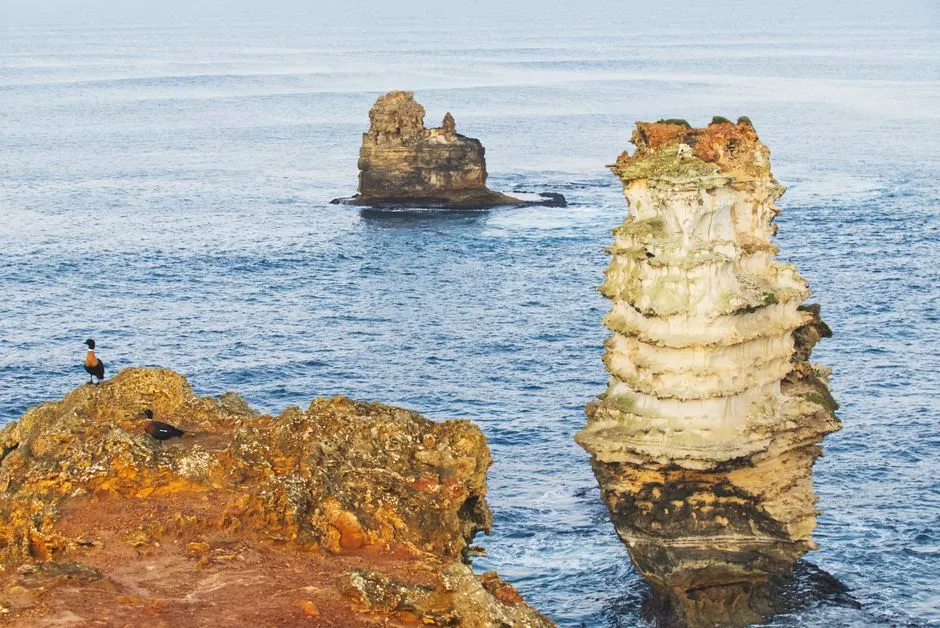
Stunning rock formations along the coast of Victoria, Australia captured in vibrant colors.

Sea stacks are tall, isolated rock formations that rise from the ocean near coastlines.  Rock formations along the coast of Victoria, Australia by Abdus Samad Mahkri / Pexels.

Sea stacks are tall, isolated rock formations that rise from the ocean near coastlines. These dramatic pillars stand alone in the water, separated from the mainland cliffs behind them. Scientists explain that sea stacks form through a slow process of erosion that can take thousands of years. Understanding how sea stacks develop helps us see how coastal landscapes constantly change over time.

The formation process begins when ocean waves repeatedly strike rocky headlands that jut out into the sea. Waves carry tremendous energy and force. When waves crash against cliff faces, they compress air into cracks in the rock. This pressure gradually widens the cracks through a process called hydraulic action. At the same time, sand and pebbles carried by waves scrape against the rock in a grinding process scientists call abrasion. Evidence shows that waves erode softer rock layers faster than harder layers. Over many years, waves may hollow out a cave at the base of a headland. If erosion continues on both sides of the headland, the cave can break through completely, forming a natural bridge called a sea arch.

Eventually, the roof of the arch becomes too thin and heavy to support itself. Weathering from rain, wind, and salt spray weakens the rock from above. When the arch collapses, it leaves behind a separated column of rock standing in the water. This isolated pillar is a sea stack. The same erosion processes continue to wear away the stack itself. Over time, the stack may shrink and eventually disappear beneath the waves. Meanwhile, erosion keeps working on the mainland cliff, potentially creating new arches and stacks.

The Twelve Apostles along Australia's southern coast provide a clear example of sea stacks in action. Despite the name, only eight limestone stacks remain standing today. One stack collapsed into the ocean in 2005, demonstrating that coastal erosion continues in the present day. These formations attract millions of visitors each year. Scientists study sites like this to understand erosion rates and predict future coastal changes.

Sea stacks matter because they show us that Earth's surface constantly changes through natural processes. Coastal erosion affects human communities by removing land and threatening buildings near shorelines. Understanding how waves reshape coastlines helps engineers design better coastal protection. It also reminds us that geological change happens continuously, even if we cannot always see it occurring. The same forces creating sea stacks also move sand along beaches through longshore drift, connecting these processes to broader coastal dynamics.

Interesting Fact: Some sea stacks contain fossils of ancient marine creatures, revealing that the rock forming these pillars was once an ocean floor millions of years ago.

Comprehension quiz (10 questions)

1. What are sea stacks?

Tall, isolated rock formations that stand alone in the ocean near coastlines
Natural bridges that connect islands to the mainland
Underground caves formed by ocean waves
Sandy beaches that form along rocky coastlines

2. Which process occurs when waves compress air into cracks in rock?

Abrasion
Weathering
Hydraulic action
Longshore drift

3. According to the passage, what happens BEFORE a sea arch forms?

The arch collapses into the ocean
A sea stack stands isolated in the water
Waves hollow out caves on both sides of a headland
The entire headland disappears beneath the waves

4. What does the term 'abrasion' mean in the context of coastal erosion?

The breaking down of rock by rain and wind
The grinding and scraping of rock by sand and pebbles carried by waves
The compression of air into rock cracks
The movement of sand along the coastline

5. Why do scientists study sites like the Twelve Apostles in Australia?

To find ancient fossils buried in the sand
To understand erosion rates and predict future coastal changes
To count how many sea stacks exist worldwide
To measure the depth of the ocean floor

6. Based on the passage, what can you infer about the relationship between rock hardness and erosion?

All rocks erode at exactly the same rate
Harder rocks resist erosion better than softer rocks
Softer rocks never erode in ocean environments
Rock hardness has no effect on coastal erosion

7. If a coastal engineer wanted to protect a beach from erosion, understanding sea stack formation would help because:

Sea stacks prevent all coastal erosion naturally
It shows how wave energy and rock properties interact over time
Engineers can build artificial sea stacks to stop waves
Sea stacks create more sand for beaches

8. What role does weathering play in sea stack formation?

It strengthens the rock and prevents erosion
It only affects rocks on land, not in the ocean
It weakens the arch roof from above, contributing to collapse
It creates new headlands along the coastline

9. True or False: The formation of a sea stack typically takes only a few years.

True
False

10. True or False: Once a sea stack forms, it remains unchanged forever.

True
False
Who it's for

Perfect for the way you teach

Teachers
  • Build comprehension skills
  • Auto-graded quiz
  • Differentiated reading
Parents
  • Read together at home
  • Improve fluency
  • Quiet reading time
Homeschoolers
  • Reading curriculum support
  • Independent practice
  • Track Lexile growth
Topics

Reviews & Ratings

No reviews yet. Be the first to share your experience!

More reading you might love

20 more
Passage
Talus Slopes: Formation and Features - reading educational content
Grades 5–8

Talus Slopes: Formation and Features

science · MS-ESS2-1

Free
Passage
Stratigraphic Columns: Decoding Earth’s Geological Layers - reading educational content
Grades 5–8

Stratigraphic Columns: Decoding Earth’s Geological Layers

science · MS-ESS2-2

Free
Passage
Frost Wedging: How Ice Splits Rock - reading educational content
Grades 5–8

Frost Wedging: How Ice Splits Rock

science · MS-ESS2-1

$1.50
Passage
Chemical Weathering: The Breakdown of Rocks Through Chemical Reactions - reading educational content
Grades 5–8

Chemical Weathering: The Breakdown of Rocks Through Chemical Reactions

science · MS-ESS2-1

Free
Passage
What Is Space Weather and How Does It Affect the Earth? - reading educational content
Grades 3–7

What Is Space Weather and How Does It Affect the Earth?

science · MS-ESS2-2

$1.50
Passage
When Was The Last Ice Age - reading educational content
Grade 6

When Was The Last Ice Age

earth science · MS-ESS2-2

$1.50
Passage
Tools and Technology in Earth Science - reading educational content
Grades 5–8

Tools and Technology in Earth Science

science · MS-ESS2-2

$1.50
Passage
Maps and Mapping - reading educational content
Grades 5–8

Maps and Mapping

earth science · MS-ESS2-2

$1.50
Passage
Latitude and Longitude - reading educational content
Grades 5–8

Latitude and Longitude

earth science · MS-ESS2-2

$1.50
Passage
Topographic Maps - reading educational content
Grades 5–8

Topographic Maps

earth science · MS-ESS2-2

$1.50
Passage
Contour Lines and Elevation - reading educational content
Grades 5–8

Contour Lines and Elevation

science · MS-ESS2-2

$1.50
Passage
Types of Maps  - reading educational content
Grades 5–8

Types of Maps

earth science · MS-ESS2-2

$1.50
Passage
Mountains and Mountain Building - reading educational content
Grades 5–8

Mountains and Mountain Building

science · MS-ESS2-1

$1.50
Passage
Earth's Interior - reading educational content
Grades 5–8

Earth's Interior

science · MS-ESS2-1

$1.50
Passage
Continental Drift Theory - reading educational content
Grades 5–8

Continental Drift Theory

science · MS-ESS2-2

Free
Passage
Seafloor Spreading - reading educational content
Grades 5–8

Seafloor Spreading

science · MS-ESS2-2

$1.50
Passage
Theory of Plate Tectonics - reading educational content
Grades 5–8

Theory of Plate Tectonics

science · MS-ESS2-2

$1.50
Passage
Divergent Plate Boundaries - reading educational content
Grades 5–8

Divergent Plate Boundaries

science · MS-ESS2-2

$1.50
Passage
Convergent Plate Boundaries - reading educational content
Grades 5–8

Convergent Plate Boundaries

science · MS-ESS2-2

$1.50
Passage
Transform Plate Boundaries - reading educational content
Grades 5–8

Transform Plate Boundaries

science · MS-ESS2-2

$1.50
Copyright © 2026 Workybooks. Made with ♥ in California.