What Is a Planet
Interactive passage with audio narration, comprehension questions, and printable PDF.
By completing this purchase you agree to our Terms of Use and Privacy Policy. Your subscription renews automatically until you cancel. You can cancel anytime from your account settings. All sales are final and non-refundable. Digital content is available for download in your account immediately upon purchase.
What's included
What Is a Planet preview and details
About this printable What Is a Planet science reading passage, NGSS-aligned (Grades 5-8)
Sample passage and quiz from What Is a Planet
Reading passage and comprehension quiz preview
What Is a Planet?
A planet is a large celestial object that orbits a star. Scientists use a precise definition created by the International Astronomical Union (IAU) in 2006. This definition includes three specific criteria that an object must meet to be called a planet.
The first criterion states that a planet must orbit the Sun. This means the object travels around the Sun in a regular path. The second criterion requires that a planet must be round in shape. Gravity pulls the object's material toward its center, creating a spherical form. Scientists explain that an object needs enough mass for gravity to shape it this way. The third criterion is the most complex. A planet must have cleared its orbital neighborhood of other debris. Evidence shows that planets are massive enough to push away or absorb smaller objects near their orbital paths.
These three criteria help scientists classify objects in our solar system. When astronomers discovered many small, icy objects beyond Neptune, they needed to decide how to classify them. Pluto, once considered the ninth planet, became the center of scientific debate. Observations revealed that Pluto shares its orbital region with thousands of similar objects in the Kuiper Belt. Pluto has not cleared its orbital neighborhood. In 2006, the IAU reclassified Pluto as a dwarf planet. Dwarf planets meet the first two criteria but fail the third one.
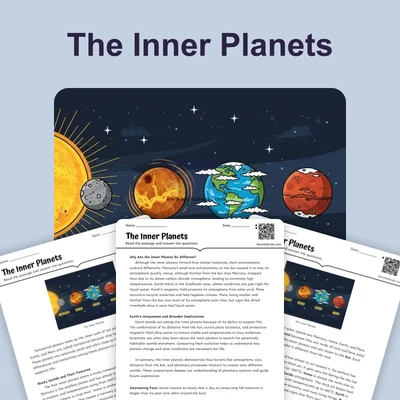
This reclassification matters because scientific definitions serve as tools for understanding. Definitions help scientists organize information and communicate clearly about discoveries. The planet definition allows astronomers to distinguish between different types of objects. Our solar system now has eight recognized planets: Mercury, Venus, Earth, Mars, Jupiter, Saturn, Uranus, and Neptune. Understanding what makes a planet helps us study how solar systems form and change over time.
Interesting Fact: Scientists have discovered thousands of planets orbiting stars beyond our Sun. These exoplanets may not orbit our Sun, so astronomers use modified criteria to classify them.
Comprehension quiz (10 questions)
1. According to the passage, how many criteria must an object meet to be classified as a planet?
2. What does it mean when a planet has 'cleared its orbital neighborhood'?
3. In the passage, the word 'criterion' most nearly means:
4. What does the term 'dwarf planet' mean in this passage?
5. Why was Pluto reclassified as a dwarf planet in 2006?
6. Based on the passage, what can you infer about scientific definitions?
7. If astronomers discovered a new round object orbiting the Sun that shares its orbital path with many other objects, how would it most likely be classified?
8. According to the passage, what role does gravity play in planet formation?
9. True or False: Our solar system currently has nine recognized planets.
10. True or False: Exoplanets orbit stars other than our Sun.
Perfect for the way you teach
- Build comprehension skills
- Auto-graded quiz
- Differentiated reading
- Read together at home
- Improve fluency
- Quiet reading time
- Reading curriculum support
- Independent practice
- Track Lexile growth