This comprehensive 400-500 word reading passage introduces middle school students to the astronomical unit (AU), a fundamental measurement in space science. Students learn that one AU equals approximately 150 million kilometers, the average distance from Earth to the Sun. The passage explains why scientists invented this unit—solar system distances are too large and unwieldy when expressed in kilometers, making the AU a practical tool for comparison. Aligned with NGSS standards MS-ESS1.B and MS-ESS1-3, this resource includes audio-integrated reading support, a simplified differentiated version for struggling readers and English Language Learners, Spanish translations, vocabulary glossary, multiple-choice comprehension questions, writing activities, and graphic organizers. The content helps students understand scale and distance in Earth's place in the universe, developing their ability to analyze and interpret data about astronomical phenomena using appropriate measurement systems.
Written by Workybooks TeamPublished by Workybooks
Preview
Sample passage and quiz content
CONTENT PREVIEW
Expand content preview
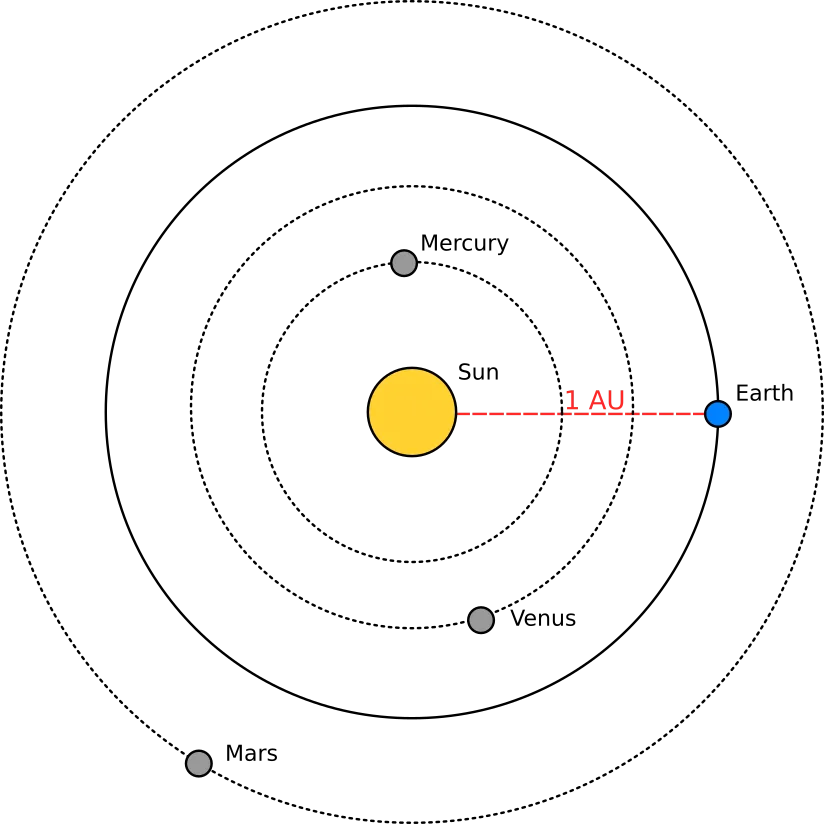
Diagram showing an astronomical unit, roughly equal to the average orbital distance of earth. "Astronomical unit diagram" by Maxmath12 / Wikimedia Commons
An astronomical unit, or AU, is a measurement scientists use to describe distances in space. One AU equals about 150 million kilometers. This distance represents the average space between Earth and the Sun. Scientists created this unit because measuring solar system distances in kilometers becomes difficult and confusing.
Imagine trying to describe how far Neptune is from the Sun using kilometers. You would need to write 4,500,000,000 kilometers. That number is hard to read and even harder to remember. However, scientists can say Neptune is about 30 AU from the Sun. This measurement is much simpler to understand and compare. The AU makes it easier to see patterns in our solar system.
Evidence shows that Earth's distance from the Sun changes slightly throughout the year. Earth follows an elliptical orbit, which means its path is shaped like a stretched circle. Scientists measure the average of these distances to define one AU. This standard measurement helps researchers communicate clearly about space.
Scientists observe that different planets sit at different distances from the Sun. Mars orbits at about 1.5 AU from the Sun. Jupiter is roughly 5.2 AU away. Venus is only 0.7 AU from the Sun. Using AU instead of kilometers helps students and scientists quickly compare these planetary distances. The pattern becomes clear when you use this unit.
The AU matters because it helps us understand Earth's place in the universe. Scientists use this measurement to calculate how long light takes to reach different planets. They also use it to plan spacecraft missions. When engineers know distances in AU, they can better estimate fuel needs and travel time. This unit connects mathematical thinking with real exploration of space.
Interesting Fact: Light from the Sun takes about 8 minutes and 20 seconds to travel one AU and reach Earth. This means we see the Sun as it looked over 8 minutes ago!
What does one astronomical unit (AU) represent?
The distance light travels in one yearThe average distance from Earth to the SunThe diameter of the SunThe distance from Earth to the Moon
Approximately how many kilometers equal one AU?
15 million kilometers150 thousand kilometers150 million kilometers1.5 billion kilometers
Why did scientists create the astronomical unit?
To measure the speed of lightTo make solar system distances easier to understand and compareTo calculate the mass of planetsTo determine the age of the solar system
In the passage, what does the word 'elliptical' mean when describing Earth's orbit?
Perfectly circularSquare-shapedShaped like a stretched circleStraight line
According to the passage, how far is Neptune from the Sun in AU?
About 5.2 AUAbout 15 AUAbout 30 AUAbout 50 AU
Which planet is closest to the Sun according to the passage?
Earth at 1 AUMars at 1.5 AUVenus at 0.7 AUJupiter at 5.2 AU
Based on the passage, why is the AU useful for spacecraft missions?
It helps engineers estimate fuel needs and travel timeIt measures the temperature in spaceIt calculates the weight of the spacecraftIt determines the color of planets
If Mars is 1.5 AU from the Sun and Earth is 1 AU from the Sun, what can you infer?
Mars is closer to the Sun than EarthMars is 1.5 times farther from the Sun than EarthMars and Earth are the same distance from the SunMars orbits faster than Earth
True or False: Earth's distance from the Sun stays exactly the same throughout the year.
TrueFalse
True or False: Using AU makes it easier to compare distances between planets than using kilometers.
TrueFalse
Who it's for
Perfect for the way you teach
Teachers
Build comprehension skills
Auto-graded quiz
Differentiated reading
Parents
Read together at home
Improve fluency
Quiet reading time
Homeschoolers
Reading curriculum support
Independent practice
Track Lexile growth
Topics
astronomical unitAUsolar system distancesEarth to Sun distancespace measurementNGSS MS-ESS1-3middle school scienceplanetary distances
Reviews & Ratings
No reviews yet. Be the first to share your experience!
More reading you might love
20 more
Sunspots and Solar Flares
This quiz is designed to test your understanding of the fascinating phenomena of sunspots and solar flares, as described...
RI.4.1RI.4.4RI.5.1ESS1.A
The Hottest Planet in the Solar System
This NGSS-aligned middle school reading passage explains why Venus is the hottest planet in our solar system. Students l...
MS-ESS1-3
Mercury: Closest to the Sun
This comprehensive, standards-aligned passage explores Mercury—the smallest and closest planet to the Sun. Students in g...
MS-ESS1-2MS-ESS1-3
Venus: Earth's Twin?
This comprehensive science passage for grades 6-8 examines Venus—often called Earth's twin—by exploring its similarities...
MS-ESS1-2MS-ESS1-3
Mars: The Red Planet
This middle school science passage explores Mars, the Red Planet, providing students in grades 6-8 with a comprehensive ...
MS-ESS1-2MS-ESS1-3
What Is the Solar System?
This passage provides a comprehensive overview of the solar system for grades 6-8, aligned with NGSS standards MS-ESS1-2...
MS-ESS1-2MS-ESS1-3
Structure of the Solar System
This comprehensive science reading passage introduces middle school students (grades 6-8) to the structure of the solar ...
MS-ESS1-2MS-ESS1-3
Scale of the Solar System
This passage, aligned to NGSS standard MS-ESS1-3, helps middle school students grasp the immense scale of the solar syst...
MS-ESS1-3
Exploration of the Solar System
This comprehensive passage for grades 6-8 examines how humans explore the solar system, aligning with NGSS standards MS-...
MS-ESS1-3MS-ETS1-1
Optical Telescopes
This comprehensive passage explores the science of optical telescopes for middle school students, aligning with NGSS sta...
MS-ESS1-3MS-ETS1-1
Future of Alien Search
This informational passage for grades 6-8 explores how scientists are using cutting-edge missions and technology to sear...
MS-ESS1-3MS-ETS1-1
Communicating with Aliens
This middle school science passage, aligned with NGSS standard MS-ESS1-3, examines the scientific and technological chal...
MS-ESS1-3
Measuring Distances in Space
This middle school science passage explores how astronomers measure the vast distances in space, aligning with NGSS stan...
MS-ESS1-3
Astronomy
This comprehensive reading passage introduces middle school students to the science of astronomy, which is the study of ...
MS-ESS1-2MS-ESS1-3MS-PS4-2MS-ETS1-1
The Solar System
This middle school science passage introduces students to the solar system, aligning with NGSS standards MS-ESS1-2 and M...
MS-ESS1-2MS-ESS1-3
The Inner Planets
This comprehensive science passage for grades 6-8 explores the inner (terrestrial) planets of our solar system—Mercury, ...
MS-ESS1-2MS-ESS1-3
The Outer Planets
This engaging science passage for grades 6-8 introduces students to the outer planets—Jupiter, Saturn, Uranus, and Neptu...
MS-ESS1-2MS-ESS1-3
Light-Years and Cosmic Distances
This middle school science passage, aligned to NGSS MS-ESS1-3, explores how astronomers measure the vast distances in sp...
MS-ESS1-3
Space Stations
This informational science reading passage for grades 6-8 explores the complex systems and technology behind space stati...
MS-ESS1-3MS-ETS1-1
Types of Spacecraft
This passage introduces middle school students to the various types of spacecraft used to explore our solar system and b...