Reading PassagePremium

What Is Longshore Drift

Interactive passage with audio narration, comprehension questions, and printable PDF.

No ratings yet
Grades 5–8ScienceElaEnglish · SpanishInteractive · Printable
Aligned toMS-ESS2-2
Just this resource
$1.50
One-time purchase
Best value
Unlock everything
$49.99$29.99/yr
40% off until Aug 1 — 10,000+ resources
Renews at $49.99/year.
Unlock above to use these actions

What's included

Reading passage
Audio narration
Comprehension quiz
Writing activity
Glossary & flashcards
Differentiated version
Spanish translation

What Is Longshore Drift preview and details

About this printable What Is Longshore Drift science reading passage, NGSS-aligned (Grades 5-8)

This comprehensive 400-500 word reading passage explains longshore drift, a fundamental coastal process aligned to NGSS MS-ESS2-2 and MS-ESS2.A Earth's systems. Students in grades 6-8 learn how waves approach beaches at angles, creating a zigzag pattern that transports sediment along the shoreline. The passage includes real-world examples, explores the mechanism behind sediment transport, and connects to broader coastal erosion concepts including sea stacks, arches, and caves. Audio-integrated features support diverse learners, while the Lexile level of 800-1050L ensures age-appropriate comprehension. The lesson includes a simplified differentiated version for English Language Learners and struggling readers, Spanish translations, glossary terms, multiple-choice questions spanning DOK levels 1-3, writing activities, and graphic organizers. Students discover how this process shapes coastlines, affects human structures, and connects to the broader story of coastal landform development through erosion and deposition.
Written by Workybooks TeamPublished by Workybooks
Preview

Sample passage and quiz from What Is Longshore Drift

Reading passage and comprehension quiz preview

What Is Longshore Drift
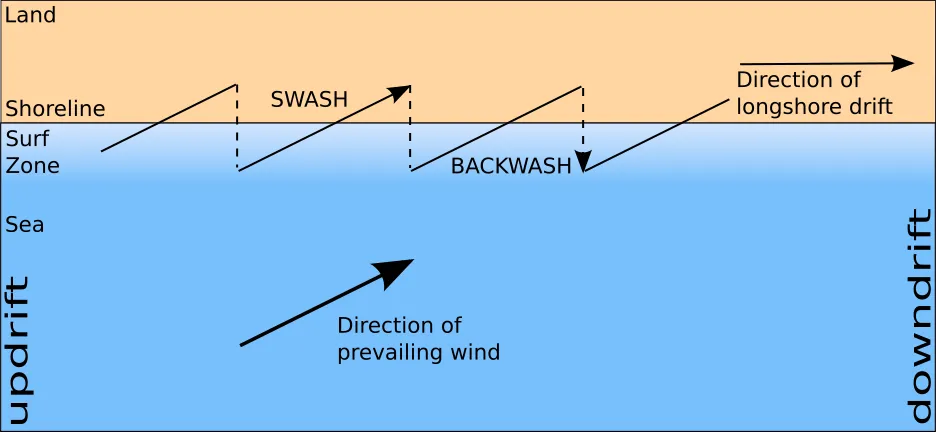
Longshore drift

"Longshore drift" by Yefi / Wikimedia Commons

Longshore drift is a natural coastal process that moves sand and sediment along the shoreline. This movement happens when waves approach the beach at an angle rather than straight on. The process creates a zigzag pattern that transports material parallel to the coast. Scientists observe that longshore drift can move millions of tons of sediment each year.

The mechanism behind longshore drift involves two main movements. When a wave breaks on the beach at an angle, it pushes water and sediment up the shore in that same diagonal direction. This upward movement is called swash. After the wave energy fades, gravity pulls the water and sediment straight back down the beach slope. This return flow is called backwash. The combination of angled swash and straight backwash creates a zigzag path. Each wave moves sand grains a short distance along the coast. Over time, countless waves transport sediment far from its original location.

Wave direction depends on prevailing winds and ocean currents in each region. Evidence shows that sediment typically moves in one dominant direction along most coastlines. The prevailing wind direction determines which way waves approach the shore. For example, along the California coast, longshore drift generally moves sediment from north to south. This process constantly reshapes beaches and can affect headlands where rocky points jut into the ocean.

Longshore drift connects to the broader story of coastal erosion. The same wave energy that transports sediment also carves sea caves, arches, and stacks from headlands. While drift moves loose material along flat beaches, wave erosion attacks solid rock on exposed points. Both processes work together to reshape coastlines. Human structures like groins and jetties can interrupt longshore drift. These barriers trap sediment on one side but may cause beach loss on the other side.

Understanding longshore drift matters because it affects coastal communities and ecosystems. Beaches protect shorelines from storm damage and provide habitat for many species. When humans build structures that block sediment transport, beaches can disappear downstream. Scientists study longshore drift to help engineers design coastal projects that work with natural processes rather than against them. This knowledge helps protect both human infrastructure and natural coastal landforms.

Interesting Fact: Some beaches lose so much sand to longshore drift that communities must pump it back from where it accumulated. This process, called beach nourishment, can cost millions of dollars.

Comprehension quiz (10 questions)

1. What is longshore drift?

A process where waves move sediment along the coastline
A type of ocean current that flows in circles
The formation of sea caves in headlands
The straight movement of waves toward the beach

2. What is swash?

The water flowing straight down the beach after a wave
The upward rush of water and sediment after a wave breaks
A barrier built to trap sediment
The zigzag pattern created by waves

3. According to the passage, what determines the direction waves approach the shore?

The depth of the ocean floor
The temperature of the water
Prevailing winds and ocean currents
The shape of the coastline

4. In the context of the passage, what does the word 'mechanism' most likely mean?

A machine or tool
The way a process works
A type of wave
A coastal landform

5. What role does gravity play in longshore drift?

It pushes waves toward the shore at an angle
It creates the prevailing wind patterns
It pulls water and sediment straight back down the beach slope
It causes waves to break on the beach

6. Based on the passage, why do groins cause problems for beaches downstream?

They create larger waves that damage the coast
They block sediment transport, causing beach loss on the other side
They increase the speed of longshore drift
They change the direction of prevailing winds

7. How does longshore drift connect to the formation of sea caves and stacks?

Drift deposits sediment that forms these features
Both processes use the same wave energy to reshape coastlines
Drift prevents these features from forming
Sea caves create the waves that cause drift

8. If a coastal community wanted to protect its beach from longshore drift, what might happen according to the passage?

The beach would grow larger on all sides
Waves would stop hitting the shore
Beaches downstream might lose sand and disappear
The prevailing wind direction would change

9. True or False: Longshore drift always moves sediment in the same direction on every coastline around the world.

True
False

10. True or False: Beach nourishment is a process where communities pump sand back to beaches that have lost sediment to longshore drift.

True
False
Who it's for

Perfect for the way you teach

Teachers
  • Build comprehension skills
  • Auto-graded quiz
  • Differentiated reading
Parents
  • Read together at home
  • Improve fluency
  • Quiet reading time
Homeschoolers
  • Reading curriculum support
  • Independent practice
  • Track Lexile growth
Topics

Reviews & Ratings

No reviews yet. Be the first to share your experience!

More reading you might love

20 more
Passage
Talus Slopes: Formation and Features - reading educational content
Grades 5–8

Talus Slopes: Formation and Features

science · MS-ESS2-1

Free
Passage
Stratigraphic Columns: Decoding Earth’s Geological Layers - reading educational content
Grades 5–8

Stratigraphic Columns: Decoding Earth’s Geological Layers

science · MS-ESS2-2

Free
Passage
Frost Wedging: How Ice Splits Rock - reading educational content
Grades 5–8

Frost Wedging: How Ice Splits Rock

science · MS-ESS2-1

$1.50
Passage
Chemical Weathering: The Breakdown of Rocks Through Chemical Reactions - reading educational content
Grades 5–8

Chemical Weathering: The Breakdown of Rocks Through Chemical Reactions

science · MS-ESS2-1

Free
Passage
What Is Space Weather and How Does It Affect the Earth? - reading educational content
Grades 3–7

What Is Space Weather and How Does It Affect the Earth?

science · MS-ESS2-2

$1.50
Passage
When Was The Last Ice Age - reading educational content
Grade 6

When Was The Last Ice Age

earth science · MS-ESS2-2

$1.50
Passage
Tools and Technology in Earth Science - reading educational content
Grades 5–8

Tools and Technology in Earth Science

science · MS-ESS2-2

$1.50
Passage
Maps and Mapping - reading educational content
Grades 5–8

Maps and Mapping

earth science · MS-ESS2-2

$1.50
Passage
Latitude and Longitude - reading educational content
Grades 5–8

Latitude and Longitude

earth science · MS-ESS2-2

$1.50
Passage
Topographic Maps - reading educational content
Grades 5–8

Topographic Maps

earth science · MS-ESS2-2

$1.50
Passage
Contour Lines and Elevation - reading educational content
Grades 5–8

Contour Lines and Elevation

science · MS-ESS2-2

$1.50
Passage
Types of Maps  - reading educational content
Grades 5–8

Types of Maps

earth science · MS-ESS2-2

$1.50
Passage
Mountains and Mountain Building - reading educational content
Grades 5–8

Mountains and Mountain Building

science · MS-ESS2-1

$1.50
Passage
Earth's Interior - reading educational content
Grades 5–8

Earth's Interior

science · MS-ESS2-1

$1.50
Passage
Continental Drift Theory - reading educational content
Grades 5–8

Continental Drift Theory

science · MS-ESS2-2

Free
Passage
Seafloor Spreading - reading educational content
Grades 5–8

Seafloor Spreading

science · MS-ESS2-2

$1.50
Passage
Theory of Plate Tectonics - reading educational content
Grades 5–8

Theory of Plate Tectonics

science · MS-ESS2-2

$1.50
Passage
Divergent Plate Boundaries - reading educational content
Grades 5–8

Divergent Plate Boundaries

science · MS-ESS2-2

$1.50
Passage
Convergent Plate Boundaries - reading educational content
Grades 5–8

Convergent Plate Boundaries

science · MS-ESS2-2

$1.50
Passage
Transform Plate Boundaries - reading educational content
Grades 5–8

Transform Plate Boundaries

science · MS-ESS2-2

$1.50
Copyright © 2026 Workybooks. Made with ♥ in California.