This engaging 400-500 word reading passage for grades 6-8 explains why Jupiter is so massive compared to other planets in our solar system. Aligned with NGSS MS-ESS1-3 and the Earth and Space Sciences Disciplinary Core Idea MS-ESS1.B, the passage traces the cause-and-effect relationship between Jupiter's formation location in the cold outer solar system and its ability to capture enormous amounts of hydrogen and helium gas. Students learn how Jupiter's growing core developed enough gravitational pull to attract these abundant gases, ultimately growing to 318 times Earth's mass. The passage includes key vocabulary terms such as gas giant, core, gravity, hydrogen, helium, solar nebula, and mass. Audio-integrated features support diverse learners, while differentiated versions and Spanish translations ensure accessibility for all middle school students studying planetary science and solar system formation.
Written by Workybooks TeamPublished by Workybooks
Preview
Sample passage and quiz content
CONTENT PREVIEW
Expand content preview
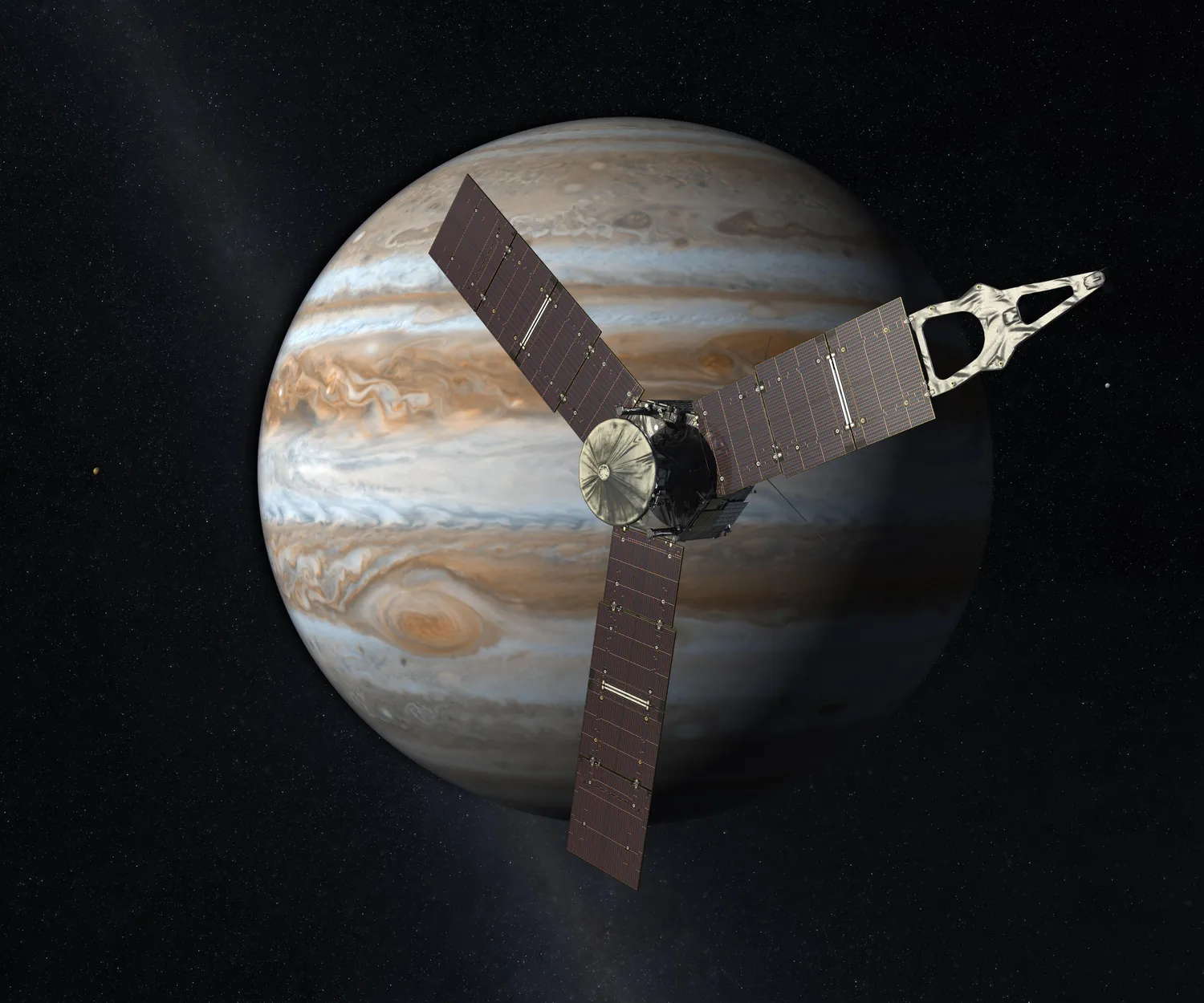
Jupiter stands as the giant of our solar system. "JUNO - PIA13746" by NASA/JPL / Wikimedia Commons
Jupiter stands as the giant of our solar system. This enormous planet has a mass about 318 times greater than Earth's mass. Scientists explain that Jupiter's incredible size resulted from where and how it formed billions of years ago.
The solar system began as a spinning cloud of gas and dust called a solar nebula. As this cloud collapsed, the Sun formed at the center. The remaining material spread into a disk around the young Sun. The inner regions near the Sun became very hot. Only metals and rocks could remain solid in these high temperatures. This explains why Mercury, Venus, Earth, and Mars are small, rocky planets.
Jupiter formed much farther from the Sun in the cold outer solar system. In this frigid region, temperatures stayed low enough for ices to form. Water ice, frozen methane, and frozen ammonia were abundant. These ices combined with rock and metal to build Jupiter's core. Evidence shows that Jupiter's core grew to about 10 times Earth's mass. This large core created strong gravity that pulled in surrounding material.
The outer solar system contained vast amounts of hydrogen and helium gas left over from the solar nebula. Jupiter's growing core had enough gravitational pull to capture these gases. The planet pulled in hydrogen and helium for millions of years. These two elements make up about 90 percent of Jupiter's total mass today. This process transformed Jupiter into a gas giant, a planet composed mostly of hydrogen and helium rather than rock.
NASA's Juno spacecraft has been studying Jupiter since 2016. Data from Juno reveals that Jupiter's core may be larger and more spread out than scientists previously thought. The spacecraft's measurements help researchers understand how gas giants form and grow. Jupiter's massive size also affects other objects in the solar system. Its strong gravity can deflect asteroids and comets, sometimes protecting inner planets like Earth from impacts.
Understanding Jupiter's formation helps scientists learn about planet formation throughout the universe. The same processes that created Jupiter may create gas giants around other stars. Jupiter's story shows how location, temperature, and available materials determine what kind of planet can form in different parts of a solar system.
Interesting Fact: If Jupiter had grown to about 80 times its current mass, it would have become a star instead of a planet, generating energy through nuclear fusion like our Sun.
How many times more massive is Jupiter compared to Earth?
About 318 times more massiveAbout 100 times more massiveAbout 500 times more massiveAbout 80 times more massive
Where did Jupiter form in the solar system?
Close to the Sun in the inner solar systemIn the cold outer solar system far from the SunBetween Mars and EarthBeyond Neptune in the Kuiper Belt
What does the term 'gas giant' mean in the passage?
A planet that has a lot of stormsA planet made mostly of rock with some gasA planet composed mostly of hydrogen and helium gasA planet that is very hot
What is a solar nebula?
A type of star that explodesA large cloud of gas and dust that collapsed to form the solar systemThe outer layer of the SunA moon that orbits Jupiter
Why did Jupiter's core grow large enough to capture hydrogen and helium?
It formed in the cold outer solar system where ices and materials were abundantIt was closer to the Sun than other planetsIt had more moons than other planetsIt rotated faster than other planets
What two elements make up about 90 percent of Jupiter's mass?
Oxygen and nitrogenCarbon and oxygenHydrogen and heliumIron and nickel
According to the passage, what effect does Jupiter's gravity have on the solar system?
It makes the Sun rotate fasterIt can deflect asteroids and comets, sometimes protecting inner planetsIt pulls all planets closer to the SunIt creates new moons around Earth
What spacecraft has been studying Jupiter since 2016?
VoyagerHubbleJunoCassini
True or False: The inner planets are small and rocky because the region near the Sun was too hot for gases and ices to remain.
TrueFalse
True or False: If Jupiter had grown to about 80 times its current mass, it would have become another Earth-like planet.
TrueFalse
Who it's for
Perfect for the way you teach
Teachers
Build comprehension skills
Auto-graded quiz
Differentiated reading
Parents
Read together at home
Improve fluency
Quiet reading time
Homeschoolers
Reading curriculum support
Independent practice
Track Lexile growth
Topics
Jupitergas giantsolar system formationhydrogenheliumplanetary massouter solar systemgravityNGSS MS-ESS1-3
Reviews & Ratings
No reviews yet. Be the first to share your experience!
More reading you might love
20 more
Sunspots and Solar Flares
This quiz is designed to test your understanding of the fascinating phenomena of sunspots and solar flares, as described...
RI.4.1RI.4.4RI.5.1ESS1.A
The Hottest Planet in the Solar System
This NGSS-aligned middle school reading passage explains why Venus is the hottest planet in our solar system. Students l...
MS-ESS1-3
Mercury: Closest to the Sun
This comprehensive, standards-aligned passage explores Mercury—the smallest and closest planet to the Sun. Students in g...
MS-ESS1-2MS-ESS1-3
Venus: Earth's Twin?
This comprehensive science passage for grades 6-8 examines Venus—often called Earth's twin—by exploring its similarities...
MS-ESS1-2MS-ESS1-3
Mars: The Red Planet
This middle school science passage explores Mars, the Red Planet, providing students in grades 6-8 with a comprehensive ...
MS-ESS1-2MS-ESS1-3
What Is the Solar System?
This passage provides a comprehensive overview of the solar system for grades 6-8, aligned with NGSS standards MS-ESS1-2...
MS-ESS1-2MS-ESS1-3
Structure of the Solar System
This comprehensive science reading passage introduces middle school students (grades 6-8) to the structure of the solar ...
MS-ESS1-2MS-ESS1-3
Scale of the Solar System
This passage, aligned to NGSS standard MS-ESS1-3, helps middle school students grasp the immense scale of the solar syst...
MS-ESS1-3
Exploration of the Solar System
This comprehensive passage for grades 6-8 examines how humans explore the solar system, aligning with NGSS standards MS-...
MS-ESS1-3MS-ETS1-1
Optical Telescopes
This comprehensive passage explores the science of optical telescopes for middle school students, aligning with NGSS sta...
MS-ESS1-3MS-ETS1-1
Future of Alien Search
This informational passage for grades 6-8 explores how scientists are using cutting-edge missions and technology to sear...
MS-ESS1-3MS-ETS1-1
Communicating with Aliens
This middle school science passage, aligned with NGSS standard MS-ESS1-3, examines the scientific and technological chal...
MS-ESS1-3
Measuring Distances in Space
This middle school science passage explores how astronomers measure the vast distances in space, aligning with NGSS stan...
MS-ESS1-3
Astronomy
This comprehensive reading passage introduces middle school students to the science of astronomy, which is the study of ...
MS-ESS1-2MS-ESS1-3MS-PS4-2MS-ETS1-1
The Solar System
This middle school science passage introduces students to the solar system, aligning with NGSS standards MS-ESS1-2 and M...
MS-ESS1-2MS-ESS1-3
The Inner Planets
This comprehensive science passage for grades 6-8 explores the inner (terrestrial) planets of our solar system—Mercury, ...
MS-ESS1-2MS-ESS1-3
The Outer Planets
This engaging science passage for grades 6-8 introduces students to the outer planets—Jupiter, Saturn, Uranus, and Neptu...
MS-ESS1-2MS-ESS1-3
Light-Years and Cosmic Distances
This middle school science passage, aligned to NGSS MS-ESS1-3, explores how astronomers measure the vast distances in sp...
MS-ESS1-3
Space Stations
This informational science reading passage for grades 6-8 explores the complex systems and technology behind space stati...
MS-ESS1-3MS-ETS1-1
Types of Spacecraft
This passage introduces middle school students to the various types of spacecraft used to explore our solar system and b...