Chaucer's Canterbury Tales
Interactive passage with audio narration, comprehension questions, and printable PDF.
By completing this purchase you agree to our Terms of Use and Privacy Policy. Your subscription renews automatically until you cancel. You can cancel anytime from your account settings. All sales are final and non-refundable. Digital content is available for download in your account immediately upon purchase.
What's included
Chaucer's Canterbury Tales preview and details
About this printable Chaucer's Canterbury Tales reading passage (Grades 5-8)
Sample passage and quiz from Chaucer's Canterbury Tales
Reading passage and comprehension quiz preview
Chaucer's Canterbury Tales
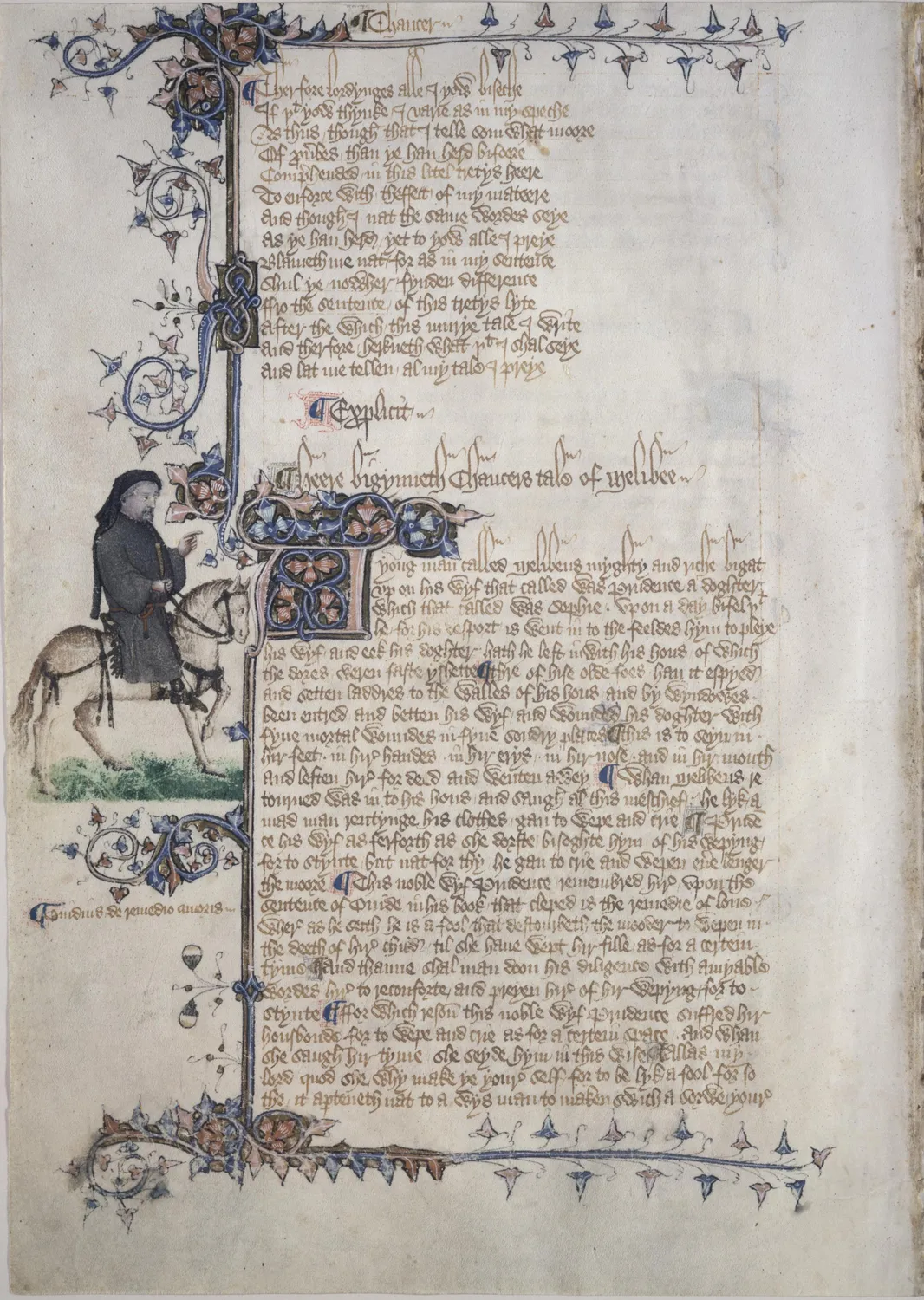
"The Ellesmere Chaucer with an illustration of Chaucer" / Wikimedia Commons.
Geoffrey Chaucer is recognized as one of the most important figures in English literary history. Born in London in the early 1340s, Chaucer lived during a period of great change in Europe. His most famous work, The Canterbury Tales, was written between 1387 and 1400. This collection of stories became a turning point in English literature and offers a unique look into society on the edge of the Renaissance.
The Canterbury Tales begins with a group of thirty pilgrims preparing to travel from London to the shrine of Saint Thomas Becket in Canterbury. Each pilgrim comes from a different background, including a knight, a miller, a prioress, and a cook. On their journey, they agree to tell stories to pass the time. This storytelling contest allows Chaucer to explore different parts of medieval society and to use humor, irony, and social commentary to reveal the values, habits, and conflicts of the time. For example, the "Wife of Bath" tells a story that challenges ideas about women and marriage, while the "Pardoner" reveals corruption within the church. These tales are based on observations from Chaucer’s own experiences as a traveler, diplomat, and royal official.
One of Chaucer’s greatest achievements was his decision to write in vernacular English rather than Latin or French, which were commonly used by scholars. This made the stories more accessible to ordinary people in England. The language Chaucer used was Middle English, which sounds quite different from modern English but was the everyday language of his audience. The Ellesmere Manuscript, an illuminated copy of the text from around 1410, provides evidence of how these tales were read and shared in the medieval period.
The Canterbury Tales also reflects the growing changes of the Renaissance. While the tales are set in the Middle Ages, they show new ideas about individuals and society that were spreading across Europe. Chaucer’s characters are complex and realistic, and his stories question old traditions and encourage critical thinking. This shift connects The Canterbury Tales to broader changes in art, science, and literature, making it a bridge between medieval and Renaissance worlds.
The impact of The Canterbury Tales was far-reaching. It helped establish English as a respected literary language and provided a detailed picture of English life in the late 1300s. Chaucer’s use of humor, irony, and storytelling inspired later writers. Today, historians and students study The Canterbury Tales not just for its entertainment but for the insights it gives into the lives and beliefs of people living at a time of great change. It remains a symbol of how literature can both reflect and shape society.
This study of Chaucer’s work connects to wider themes in world history, such as the development of language, the rise of new ideas during the Renaissance, and the role of literature in society.
Interesting Fact: The first printed edition of The Canterbury Tales appeared in 1476, just decades after the invention of the printing press, helping the stories reach even more readers.
Comprehension quiz (8 questions)
1. Who wrote The Canterbury Tales?
2. What language did Chaucer use?
3. Where were the pilgrims traveling?
4. Why did Chaucer use vernacular English?
5. What is social commentary?
6. How did The Canterbury Tales influence literature?
7. The Canterbury Tales was first printed in 1476.
8. What does 'pilgrim' mean?
Perfect for the way you teach
- Build comprehension skills
- Auto-graded quiz
- Differentiated reading
- Read together at home
- Improve fluency
- Quiet reading time
- Reading curriculum support
- Independent practice
- Track Lexile growth