Chiaroscuro Technique
Interactive passage with audio narration, comprehension questions, and printable PDF.
By completing this purchase you agree to our Terms of Use and Privacy Policy. Your subscription renews automatically until you cancel. You can cancel anytime from your account settings. All sales are final and non-refundable. Digital content is available for download in your account immediately upon purchase.
What's included
Chiaroscuro Technique preview and details
About this printable Chiaroscuro Technique reading passage (Grades 5-8)
Sample passage and quiz from Chiaroscuro Technique
Reading passage and comprehension quiz preview
Chiaroscuro Light Shadow
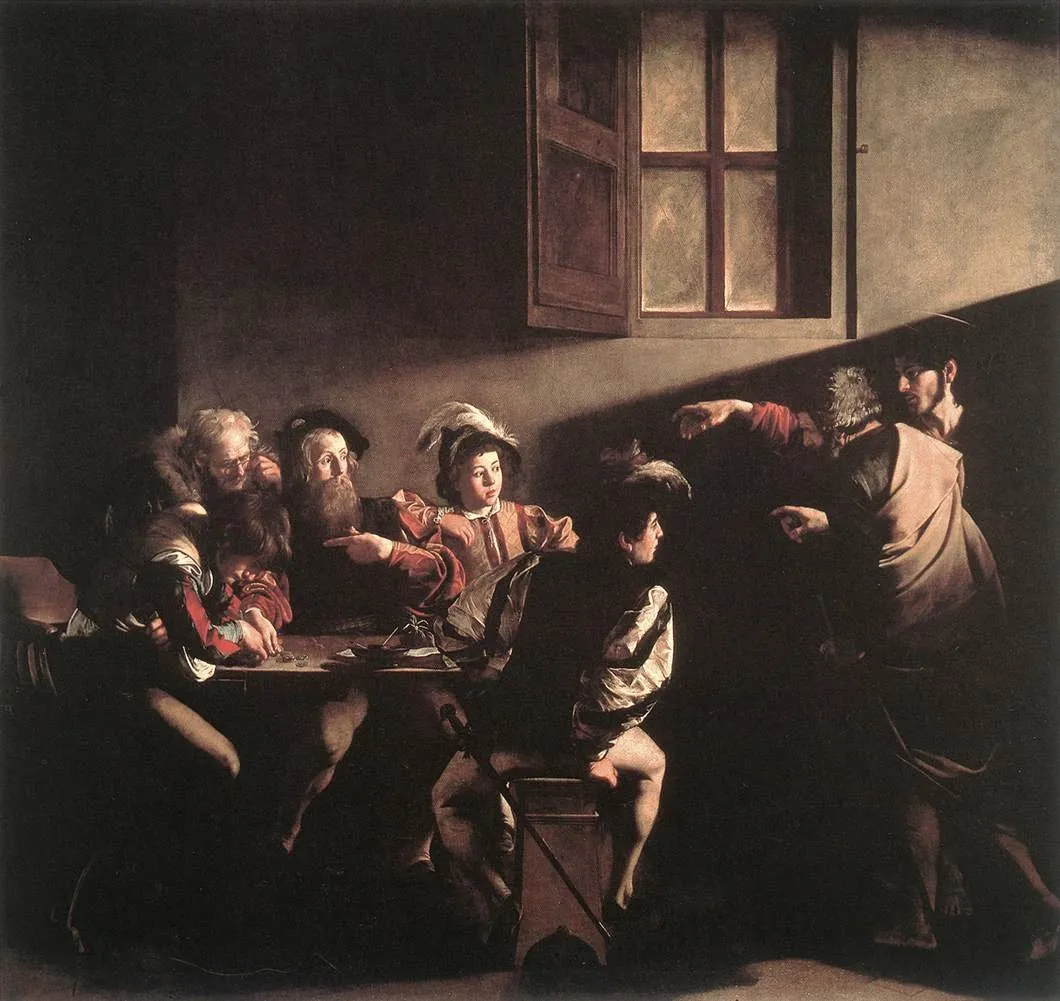
"Calling-of-st-matthew" by Caravaggio / Wikimedia Commons.
Chiaroscuro is a painting technique that became famous during the Renaissance, a period from the 14th to the 17th centuries in Europe. Artists used chiaroscuro to create powerful contrasts between light and shadow. This method allowed painters to make flat surfaces appear three-dimensional, giving their works a sense of depth and realism that was rarely seen before. The word 'chiaroscuro' comes from the Italian words for 'light' (chiaro) and 'dark' (oscuro).
During the Renaissance, cities like Florence and Rome became major centers for art and learning. Artists wanted to make their paintings look as lifelike as possible. By carefully studying how light fell on objects and people, painters like Leonardo da Vinci developed new ways of modeling forms. Leonardo's drawings and paintings, such as 'The Virgin and Child with St. Anne' (c. 1510), show his skillful use of chiaroscuro. He used soft transitions between light and dark to suggest volume and create a more natural appearance.
Another artist who transformed Renaissance art with chiaroscuro was Caravaggio. Working in Rome in the late 1500s and early 1600s, Caravaggio used extreme contrasts of light and shadow, a style sometimes called 'tenebrism.' In works like 'The Calling of Saint Matthew' (1599–1600), Caravaggio illuminated his subjects with dramatic, almost theatrical lighting. This made the figures stand out as if spotlights were shining on them, while the background often faded into deep darkness. Caravaggio's technique influenced artists across Europe, showing the wide impact of chiaroscuro.
Chiaroscuro was more than just a technical trick. It helped artists represent the real world in new ways. By observing and depicting natural light, painters could show emotion, movement, and story within their artworks. The use of light and shadow could make a scene feel mysterious or dramatic. For example, in Leonardo's notebooks, he explained how to use shadows to model faces and hands, making his figures appear more alive. Archaeological evidence, like unfinished paintings and artists' treatises from the period, reveals that chiaroscuro required careful study and experimentation.
Over time, chiaroscuro became a key part of Western art. Although the technique changed as artists experimented, its core idea—using light and shadow to shape form—remained important. Chiaroscuro's development shows how Renaissance artists valued observation and innovation, shaping the way people understood art and the world around them.
Chiaroscuro connects to the broader story of the Renaissance: a time when artists, scientists, and thinkers worked together to study nature and human experience. In world history, it stands as an example of how cultural and technological changes can transform daily life and creative expression.
Interesting Fact: Some Renaissance artists practiced chiaroscuro by drawing eggs or spheres lit by a single candle, studying the gradual change from light to dark to understand how to create realistic forms.
Comprehension quiz (8 questions)
1. Who invented chiaroscuro?
2. Which city was a Renaissance art center?
3. What does 'chiaroscuro' mean?
4. Why did artists use chiaroscuro?
5. How did Caravaggio use chiaroscuro?
6. What effect did chiaroscuro have on art?
7. Chiaroscuro is about using light and shadow.
8. What is tenebrism?
Perfect for the way you teach
- Build comprehension skills
- Auto-graded quiz
- Differentiated reading
- Read together at home
- Improve fluency
- Quiet reading time
- Reading curriculum support
- Independent practice
- Track Lexile growth