Cold Fronts and Warm Fronts
Interactive passage with audio narration, comprehension questions, and printable PDF.
By completing this purchase you agree to our Terms of Use and Privacy Policy. Your subscription renews automatically until you cancel. You can cancel anytime from your account settings. All sales are final and non-refundable. Digital content is available for download in your account immediately upon purchase.
What's included
Cold Fronts and Warm Fronts preview and details
Sample passage and quiz from Cold Fronts and Warm Fronts
Reading passage and comprehension quiz preview
Cold Fronts and Warm Fronts: A Comparison

Cold fronts and warm fronts are boundaries between air masses that bring changes in weather. While both are types of weather fronts, they have different characteristics and effects.
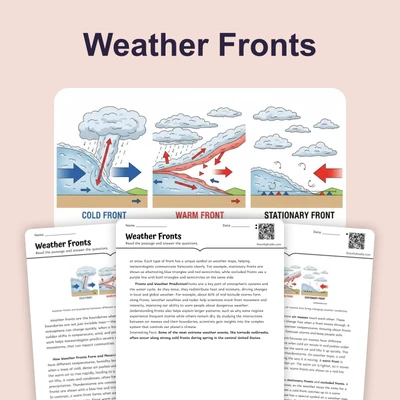
A cold front occurs when a cold air mass pushes under a warm air mass, forcing the warm air to rise quickly. This often leads to thunderstorms, heavy rain, and cooler temperatures. Cold fronts move faster than warm fronts and are represented on weather maps by blue lines with triangles.
A warm front occurs when a warm air mass rises over a cold air mass, leading to light rain or drizzle and warmer temperatures. Warm fronts move more slowly than cold fronts and are represented on weather maps by red lines with semicircles.
Both cold and warm fronts can cause precipitation, but the type and intensity differ. Cold fronts bring sudden, intense weather changes, while warm fronts bring gradual, milder changes. The interaction of cold and warm fronts can also create occluded fronts, which bring complex weather patterns.
Understanding cold and warm fronts helps meteorologists predict weather changes and issue warnings for severe weather.
Fun fact: The term “front” was first used during World War I, inspired by the battlefronts of the war.
Comprehension quiz (8 questions)
1. What is a cold front?
2. What weather does a cold front bring?
3. What is a warm front?
4. What weather does a warm front bring?
5. How are cold fronts represented on weather maps?
6. What is one difference between cold and warm fronts?
7. What is the fun fact mentioned in the passage?
8. What can the interaction of cold and warm fronts create?
Perfect for the way you teach
- Build comprehension skills
- Auto-graded quiz
- Differentiated reading
- Read together at home
- Improve fluency
- Quiet reading time
- Reading curriculum support
- Independent practice
- Track Lexile growth