Reading PassagePremium

How Adiabatic Cooling Makes Clouds

Interactive passage with audio narration, comprehension questions, and printable PDF.

No ratings yet|
1
Grade 6ScienceEnglish · SpanishInteractive · Printable
Aligned toMS-ESS2-5
Just this resource
$1.50
One-time purchase
Best value
Unlock everything
$49.99$24.99/yr
50% off until Sept 15 — 10,000+ resources
Renews at $49.99/year.

By completing this purchase you agree to our Terms of Use and Privacy Policy. Your subscription renews automatically until you cancel. You can cancel anytime from your account settings. All sales are final and non-refundable. Digital content is available for download in your account immediately upon purchase.

Unlock above to use these actions

What's included

Reading passage
Audio narration
Comprehension quiz
Writing activity
Glossary & flashcards
Differentiated version
Spanish translation

How Adiabatic Cooling Makes Clouds preview and details

About this printable How Adiabatic Cooling Makes Clouds science reading passage, NGSS-aligned (Grade 6)

This educational passage, designed for Grade 6 students, explores the fascinating process of adiabatic cooling and its role in forming clouds and precipitation. Aligned with NGSS standard MS-ESS2-5, it helps students understand how the complex interactions of air masses result in changes in weather conditions. Key concepts such as condensation, atmospheric pressure, and the **water cycle** are explained using simple language. Students will learn about how warm, moist air rises, cools, and forms **clouds**, eventually leading to **rain** or snow. This content is audio integrated, making learning accessible and engaging for all students. It's perfect for understanding **weather patterns** and **atmospheric science**.
Written by Workybooks TeamPublished by Workybooks
Preview

Sample passage and quiz from How Adiabatic Cooling Makes Clouds

Reading passage and comprehension quiz preview

How Adiabatic Cooling Makes Clouds
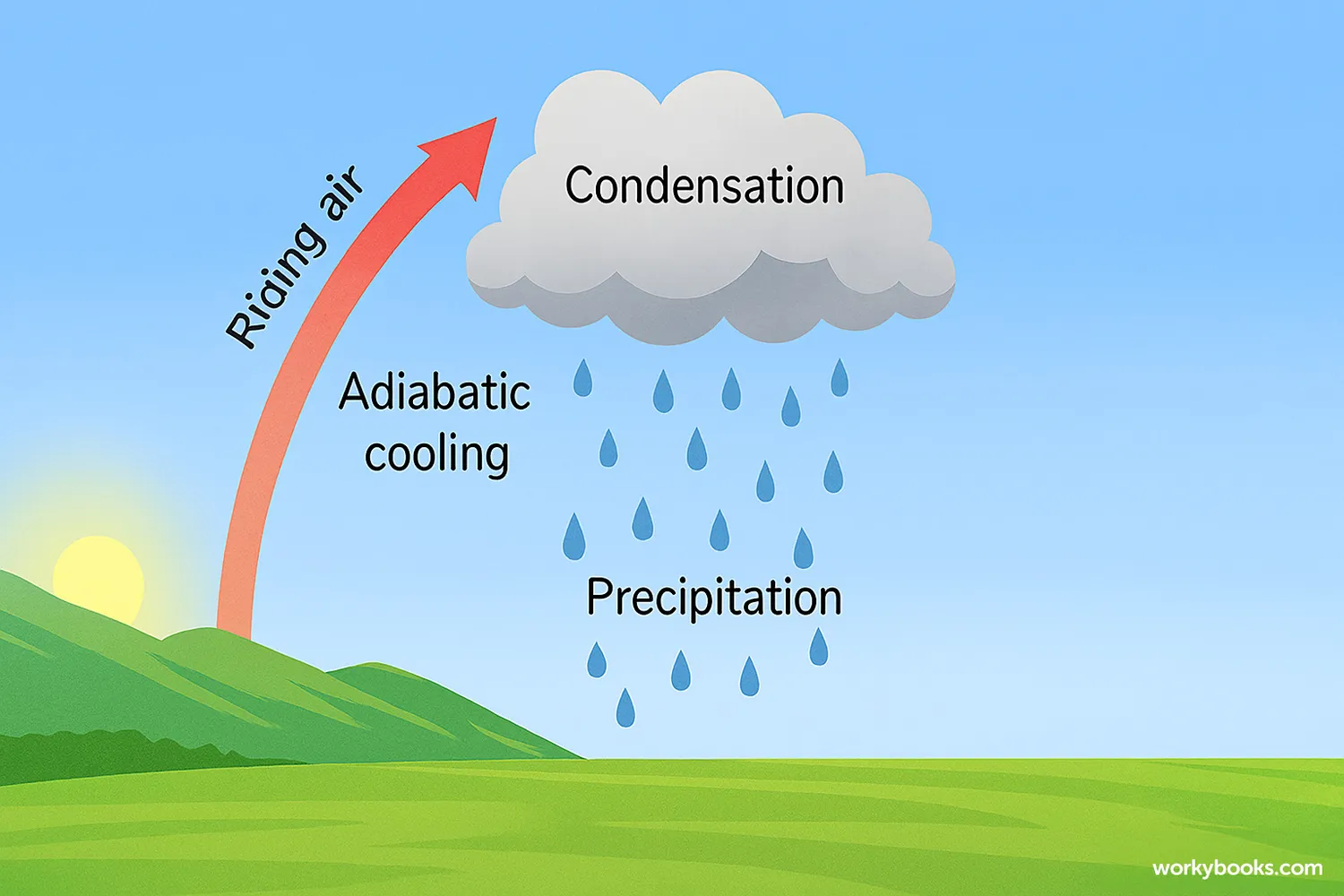
Full-width diagram showing rising air, adiabatic cooling, cloud formation, and precipitation.
Air rises, cools, condenses into clouds, then falls as rain—completing the water cycle.

Have you ever wondered how clouds form high up in the sky, or why it sometimes rains? It's all thanks to a cool scientific process called adiabatic cooling. This process is a key part of the Earth's water cycle and plays a big role in our weather.

Think about what happens when you let air out of a bicycle tire – it feels cold, right? That's a simple example of adiabatic cooling in action! In the atmosphere, when a parcel of air rises, it moves into areas with lower atmospheric pressure. As the pressure around it decreases, the air parcel expands. When air expands, its molecules spread out, and they don't bump into each other as much. This causes the air to lose energy and cool down without losing any heat to its surroundings. This cooling without heat exchange is adiabatic cooling.

So, how does this lead to clouds? Warm, moist air near the Earth's surface is less dense than the cooler air around it, so it naturally starts to rise. As this warm, moist air rises, it experiences adiabatic cooling. The temperature of the air drops. Cool air cannot hold as much water vapor as warm air. Eventually, the rising air cools to its dew point, which is the temperature at which the air becomes saturated with water vapor. At this point, the invisible water vapor in the air begins to turn into tiny liquid water droplets or ice crystals. This process is called condensation.

These tiny water droplets or ice crystals are what we see as clouds. Clouds are essentially millions of these microscopic particles floating in the sky. If these tiny droplets or crystals continue to grow larger, they eventually become too heavy to remain suspended in the air. When they fall to Earth, we experience precipitation in the form of rain, snow, sleet, or hail. This continuous cycle of rising air, adiabatic cooling, condensation, and precipitation is fundamental to understanding global weather patterns and the distribution of freshwater.

Interesting Fact: The highest clouds, called noctilucent clouds, form at altitudes of up to 85 kilometers (53 miles) and can only be seen during twilight hours.

Comprehension quiz (10 questions)

1. What causes air to cool during adiabatic cooling?

Heat loss to surroundings
Air expansion
Air compression
Water vapor addition

2. What process turns water vapor into liquid droplets?

Evaporation
Condensation
Precipitation
Sublimation

3. True or False: Warm air holds less water vapor than cool air.

True
False

4. The 'dew point' is the temperature at which air becomes:

Very hot
Saturated with vapor
Completely dry
Frozen solid

5. What is precipitation?

Rising warm air
Falling water to Earth
Cloud formation
Air pressure change

6. What happens to air pressure as air rises?

Increases
Decreases
Stays the same
Becomes zero

7. What are clouds primarily made of?

Dry air
Dust particles
Water droplets/ice crystals
Gases only

8. How does adiabatic cooling affect air temperature?

Makes it hotter
Makes it cooler
No change
Increases pressure

9. If a warm, moist air mass moves over a mountain range, what weather change would likely occur on the windward side?

Dry conditions
Clear skies
Cloud formation
Rising temperature

10. Imagine you are camping at a high altitude. Why might you notice more clouds forming around mountain peaks even on a sunny day?

Less sunlight
More pollution
Adiabatic cooling
Stronger winds
Who it's for

Perfect for the way you teach

Teachers
  • Build comprehension skills
  • Auto-graded quiz
  • Differentiated reading
Parents
  • Read together at home
  • Improve fluency
  • Quiet reading time
Homeschoolers
  • Reading curriculum support
  • Independent practice
  • Track Lexile growth
Topics

Reviews & Ratings

No reviews yet. Be the first to share your experience!

More reading you might love

19 more
Passage
Cold Fronts and Warm Fronts - reading educational content
Grades 5–8

Cold Fronts and Warm Fronts

weather and climate · MS-ESS2-5+1

$1.50
Passage
The Intertropical Convergence Zone (ITCZ): Earth's Weather Belt - reading educational content
Grades 5–8

The Intertropical Convergence Zone (ITCZ): Earth's Weather Belt

science · MS-ESS2-5+2

Free
Passage
What Is the Antarctic Polar Vortex - reading educational content
Grades 3–7

What Is the Antarctic Polar Vortex

weather and climate · MS-ESS2-5

Free
Passage
What Causes the Temperature to Decrease with Height in the Troposphere - reading educational content
Grades 3–7

What Causes the Temperature to Decrease with Height in the Troposphere

weather and climate · MS-ESS2-5

Free
Passage
Raining Frogs - reading educational content
Grades 5–8

Raining Frogs

life science · MS-ESS2-5

Free
Passage
Hurricanes and Tropical Cyclones - reading educational content
Grades 5–8

Hurricanes and Tropical Cyclones

weather and climate · MS-ESS3-2+1

$1.50
Passage
Tornadoes - reading educational content
Grades 5–8

Tornadoes

weather and climate · MS-ESS3-2+1

$1.50
Passage
Weather Factors - reading educational content
Grades 5–8

Weather Factors

weather and climate · MS-ESS2-5

$1.50
Passage
Air Pressure - reading educational content
Grades 5–8

Air Pressure

science · MS-ESS2-5

$1.50
Passage
Wind - reading educational content
Grades 5–8

Wind

science · MS-ESS2-5+1

$1.50
Passage
Clouds and Precipitation - reading educational content
Grades 5–8

Clouds and Precipitation

weather and climate · MS-ESS2-5

$1.50
Passage
Air Masses - reading educational content
Grades 5–8

Air Masses

weather and climate · MS-ESS2-5

$1.50
Passage
Weather Maps and Forecasting - reading educational content
Grades 5–8

Weather Maps and Forecasting

weather and climate · MS-ESS2-5+1

$1.50
Passage
Weather Fronts - reading educational content
Grades 5–8

Weather Fronts

weather and climate · MS-ESS2-5

$1.50
Passage
What Is Meteorology - reading educational content
Grades 6–8

What Is Meteorology

earth and space science · MS-ESS2-5

$1.50
Passage
Do Trees Cause Wind - reading educational content
Grades 5–8

Do Trees Cause Wind

weather and climate · MS-ESS2-5

Free
Passage
Why San Francisco Is Foggy - reading educational content
Grades 5–8

Why San Francisco Is Foggy

weather and climate · MS-ESS2-5

$1.50
Passage
How Do Scientists Measure Weather - reading educational content
Grades 5–8

How Do Scientists Measure Weather

weather and climate · MS-ESS2-5

$1.50
Passage
How Do Weather Satellites Work - reading educational content
Grades 5–8

How Do Weather Satellites Work

weather and climate · MS-ESS2-5

$1.50
Copyright © 2026 Workybooks. Made with ♥ in California.