This learning resource is available in interactive and printable formats. The interactive worksheet can be played online and assigned to students. The Printable PDF version can be downloaded and printed for completion by hand.
This comprehensive science reading passage for grades 6-8 explores the fundamental relationship between color and light, aligned to NGSS MS-PS4-2. Students will learn how white light is made up of all colors, how prisms demonstrate the separation of light, and why objects appear colored based on the wavelengths they reflect or absorb. The passage explains the difference between the primary colors of light (RGB) and pigments (CMY), and uses real-world examples such as why the sky is blue and sunsets are red to illustrate key concepts. Academic vocabulary is integrated throughout, with a glossary provided for support. Activities include comprehension questions, writing prompts, and graphic organizers to deepen understanding. This resource is designed for middle school science classrooms and includes audio integration for accessibility.
CONTENT PREVIEW
Expand content preview
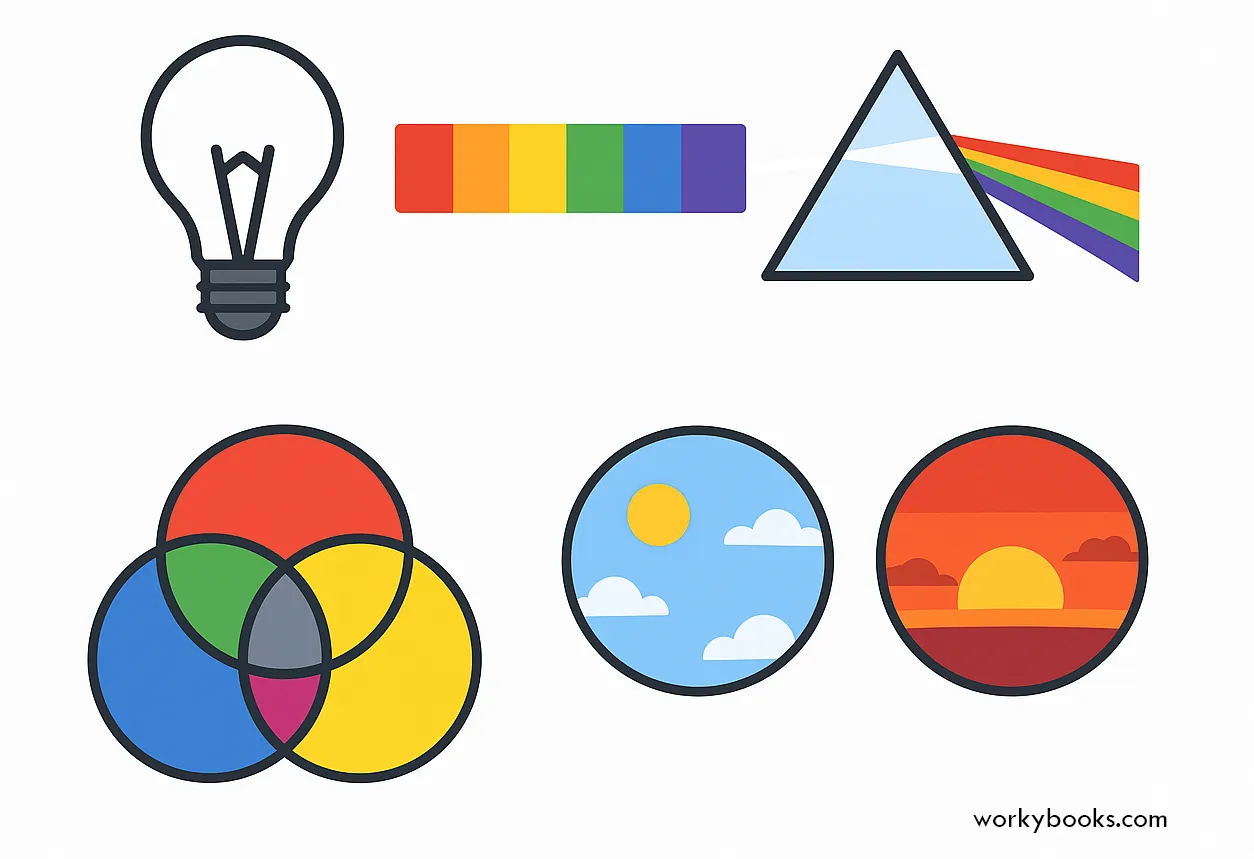
Light splits, mixes, and colors our world—day to sunset.
White light is not just one color, but a combination of many colors. When white light passes through a glass prism, it spreads out into a rainbow of colors known as the visible spectrum. Each color in the spectrum has a different wavelength, which determines how it interacts with materials. The study of how light creates color helps scientists understand important natural events and invent new technologies.
The Mechanism of Color: Reflection and Absorption
Objects appear colored because they interact with light in specific ways. When light strikes an object, certain wavelengths are absorbed, while others are reflected. For example, a red apple appears red because it reflects red wavelengths and absorbs the rest. The color we see depends on which wavelengths are reflected to our eyes. Materials like paint or fabric contain pigments that absorb some colors and reflect others. In contrast, the primary colors of light—red, green, and blue (RGB)—can be combined to make all other colors. When these colors mix together, they create white light again. However, pigments use a different mixing system, called CMY (cyan, magenta, yellow), which is important for printing and art.
Light and Color in the Natural World
The interaction of light and color explains phenomena we see every day. The sky appears blue because air molecules scatter shorter blue wavelengths more than longer red wavelengths. This process is called Rayleigh scattering. During sunset, the sun’s light travels through more atmosphere, so the blue light is scattered away and only the longer red and orange wavelengths reach our eyes. Quantitatively, blue light (about 475 nanometers) scatters nearly ten times more than red light (about 650 nanometers). These observations have been confirmed through scientific experiments and help us understand weather, climate, and even pollution patterns.
Applications and Broader Implications
Understanding color and light is essential in many fields. Scientists and engineers use this knowledge to design better cameras, televisions, and optical instruments. Artists use pigments and color mixing principles to create vivid paintings. Environmental scientists study how light interacts with the atmosphere to monitor Earth’s health. The science of color connects to broader ideas about energy, waves, and how our senses interpret information from the world.
As we continue to learn about light, new discoveries in color science can lead to advances in technology, art, and our understanding of nature.
Interesting Fact: The mantis shrimp can see many more colors than humans, detecting up to 12 different color channels compared to our three!
What happens when white light passes through a prism?
It splits into a spectrum of colors.It disappears completely.It turns into only red and blue light.It becomes invisible to the eye.
Why does a red apple appear red to our eyes?
It absorbs red light and reflects the rest.It reflects red light and absorbs the rest.It produces its own red light.It contains only blue pigments.
Which of the following best describes the visible spectrum?
The part of light we can see, shown as a rainbow of colors.All types of light, including X-rays and microwaves.Only red and blue light.A mixture of sounds and colors.
What does the term 'wavelength' mean in the context of light?
The time it takes for light to travel.The distance between two peaks of a light wave.The speed of light.The color of an object.
Which statement is supported by the passage?
Pigments and light use the same color mixing system.Blue light scatters more than red light in the atmosphere.All objects reflect all wavelengths equally.Only scientists use color mixing principles.
How does understanding color and light help environmental scientists?
It helps them monitor Earth's health and study pollution.It helps them build stronger buildings.It teaches them how to paint.It allows them to predict earthquakes.
True or False: The primary colors of pigment are red, green, and blue.
TrueFalse
True or False: The mantis shrimp can see more colors than humans.
TrueFalse
Perfect For:
👩🏫 Teachers
• Reading comprehension practice
• Auto-graded assessments
• Literacy skill development
👨👩👧👦 Parents
• Reading practice at home
• Comprehension improvement
• Educational reading time
🏠 Homeschoolers
• Reading curriculum support
• Independent reading practice
• Progress monitoring
Reading Features:
📖
Reading Passage
Engaging fiction or nonfiction text
❓
Comprehension Quiz
Auto-graded questions
📊
Instant Feedback
Immediate results and scoring
📄
Printable Version
Download for offline reading
🔊
Read Aloud
Voice-over with word highlighting
Reviews & Ratings
No reviews yet. Be the first to share your experience!
Related Content
Remote Sensing
This middle school science passage introduces students to the concept of remote sensing—the collection of information ab...
MS-ESS3-3MS-PS4-2MS-ETS1-1MS-ETS1-3
The Electromagnetic Spectrum
This comprehensive science reading passage introduces middle school students (grades 6-8) to the electromagnetic spectru...
MS-PS4-1MS-PS4-2
Visible Light and Color
This comprehensive science passage for grades 6-8 explores visible light as the part of the electromagnetic spectrum tha...
MS-PS4-2
Light Waves
This middle school science passage introduces students in grades 6-8 to the concept of light as an electromagnetic wave,...
MS-PS4-2
Wave Absorption
This engaging science passage for grades 6-8 explores the mechanism of wave absorption, where waves transfer energy to m...
MS-PS4-2
Wave Behavior: Transmission
This informational science reading passage for grades 6-8 explores the concept of wave behavior, focusing on transmissio...
MS-PS4-2
Wave Refraction
This comprehensive science passage introduces middle school students to the concept of refraction, a key phenomenon in w...
MS-PS4-2
Wave Reflection
This middle school science passage explores the behavior of waves during reflection, focusing on how and why waves bounc...
MS-PS4-2
Reflection and Mirrors
This engaging passage explores the science behind reflection and mirrors, designed for students in grades 6-8. Aligned w...
MS-PS4-2
Lasers
This passage explores the science of lasers for middle school students, aligning with NGSS standard MS-PS4-2. Students l...
MS-PS4-2
How We See
This informational science passage for grades 6-8 explores the mechanisms behind human vision, focusing on how light ent...
MS-PS4-2
Optical Instruments
This passage introduces middle school students to the fascinating world of optical instruments. Aligned to NGSS standard...
MS-PS4-2
What Is Sound?
This passage explores the science of sound for middle school students, aligned with NGSS standards MS-PS4-1 and MS-PS4-2...
MS-PS4-1MS-PS4-2
Speed of Sound
This comprehensive passage for grades 6-8 explores the science behind the speed of sound and how it varies depending on ...
MS-PS4-1MS-PS4-2
Absorption of Sound
This comprehensive passage, aligned to NGSS MS-PS4-2, explores the science behind the absorption of sound. Students in g...
MS-PS4-2
Sound Through Different Materials
This comprehensive middle school science passage, aligned to NGSS standard MS-PS4-2, explores the fascinating topic of h...
MS-PS4-2
Reflection of Sound: Echoes
This comprehensive middle school science passage explores the phenomenon of echoes, focusing on the reflection of sound ...
MS-PS4-2
How We Hear
This engaging middle school science passage explores the fascinating process of how we hear, tracing sound’s journey fro...
MS-PS4-2
Sonar and Echolocation
This engaging middle school science passage explores the science behind sonar and echolocation, aligned to NGSS standard...
MS-PS4-2
Noise Pollution
This comprehensive, NGSS-aligned middle school science passage explores the concept of noise pollution as harmful or unw...