Dark Ages
Interactive passage with audio narration, comprehension questions, and printable PDF.
By completing this purchase you agree to our Terms of Use and Privacy Policy. Your subscription renews automatically until you cancel. You can cancel anytime from your account settings. All sales are final and non-refundable. Digital content is available for download in your account immediately upon purchase.
What's included
Dark Ages preview and details
About this printable Dark Ages reading passage (Grades 5-8)
Sample passage and quiz from Dark Ages
Reading passage and comprehension quiz preview
Dark Ages
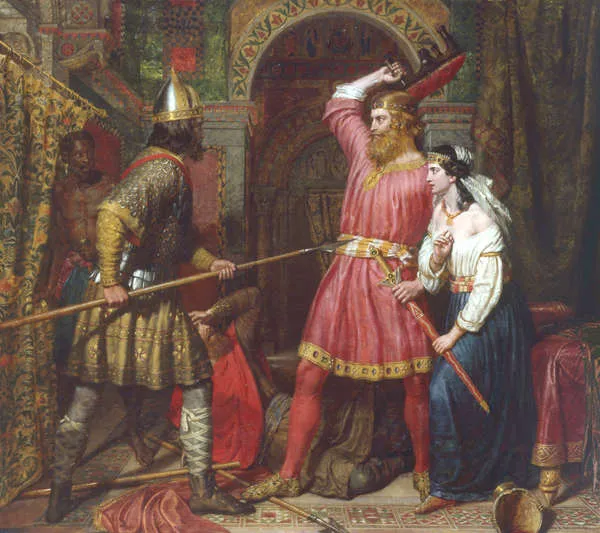
"Assassination of Alboin" by Charles Landseer / Wikimedia Commons.
The term Dark Ages is often used to describe the early Middle Ages in Europe, from about 500 to 1000 CE. Historians today debate whether this label is accurate. The idea of a 'dark' period began during the Renaissance, a later era that looked back on the Middle Ages as a time of decline. To understand why this period was called the 'Dark Ages,' we need to examine how ideas about history have changed over time.
The Roman Empire, a powerful and organized state, fell in the late 400s CE. Many cities shrank, trade slowed, and local rulers gained more power. Some Renaissance writers, like Petrarch in the 1300s, saw this as an age when learning and culture were lost. Petrarch called the time after Rome's fall a "dark" age because he believed there was little art or scholarship. He compared it to his own time, which he thought was a return to the 'light' of ancient Greece and Rome. This view shaped how people thought about the Middle Ages for centuries.
However, archaeological evidence and primary sources show that the Middle Ages were not as dark as Renaissance thinkers believed. Monasteries kept ancient texts safe and copied them by hand. For example, the Benedictine monks at Monte Cassino in Italy preserved Latin works. In the 8th century, rulers like Charlemagne founded schools and encouraged learning. Metalworkers, farmers, and builders made important advances, such as the heavy plow and improved watermills. While some cities declined, others like Constantinople thrived as centers of trade and culture. These facts show there was both change and continuity during the Middle Ages.
The label 'Dark Ages' is also misleading because it ignores the achievements of ordinary people and the diversity of medieval society. Not everyone was a peasant or a knight; there were merchants, scholars, and artists. Social hierarchy was important, but new opportunities appeared as towns grew. The spread of Christianity also changed daily life, influencing art, holidays, and education. Modern historians use terms like 'early Middle Ages' instead of 'Dark Ages' to avoid the idea that this era was only about decline.
In conclusion, the term 'Dark Ages' reflects the opinions of later thinkers rather than the reality of medieval Europe. By studying primary sources, archaeological findings, and different perspectives, historians have shown that the early Middle Ages were a complex and dynamic period. Understanding how ideas about the past change helps us become better historians and critical thinkers.
Interesting Fact: The word 'medieval' comes from the Latin 'medium aevum,' meaning 'the middle age,' which Renaissance scholars used to describe the time between ancient Rome and their own era.
This topic connects to broader themes of how we interpret history, the use of evidence, and the dangers of stereotypes when examining the past.
Comprehension quiz (8 questions)
1. Who first called it the 'Dark Ages'?
2. Which monk group preserved texts at Monte Cassino?
3. What major city thrived during the Middle Ages?
4. Why did Petrarch call the era 'dark'?
5. What is a primary source?
6. What effect did monasteries have?
7. True or False: Modern historians agree with 'Dark Ages.'
8. What does 'hierarchy' mean?
Perfect for the way you teach
- Build comprehension skills
- Auto-graded quiz
- Differentiated reading
- Read together at home
- Improve fluency
- Quiet reading time
- Reading curriculum support
- Independent practice
- Track Lexile growth