Medieval Agricultural Innovations
Interactive passage with audio narration, comprehension questions, and printable PDF.
By completing this purchase you agree to our Terms of Use and Privacy Policy. Your subscription renews automatically until you cancel. You can cancel anytime from your account settings. All sales are final and non-refundable. Digital content is available for download in your account immediately upon purchase.
What's included
Medieval Agricultural Innovations preview and details
About this printable Medieval Agricultural Innovations reading passage (Grades 5-8)
Sample passage and quiz from Medieval Agricultural Innovations
Reading passage and comprehension quiz preview
Farming Inventions in the Middle Ages
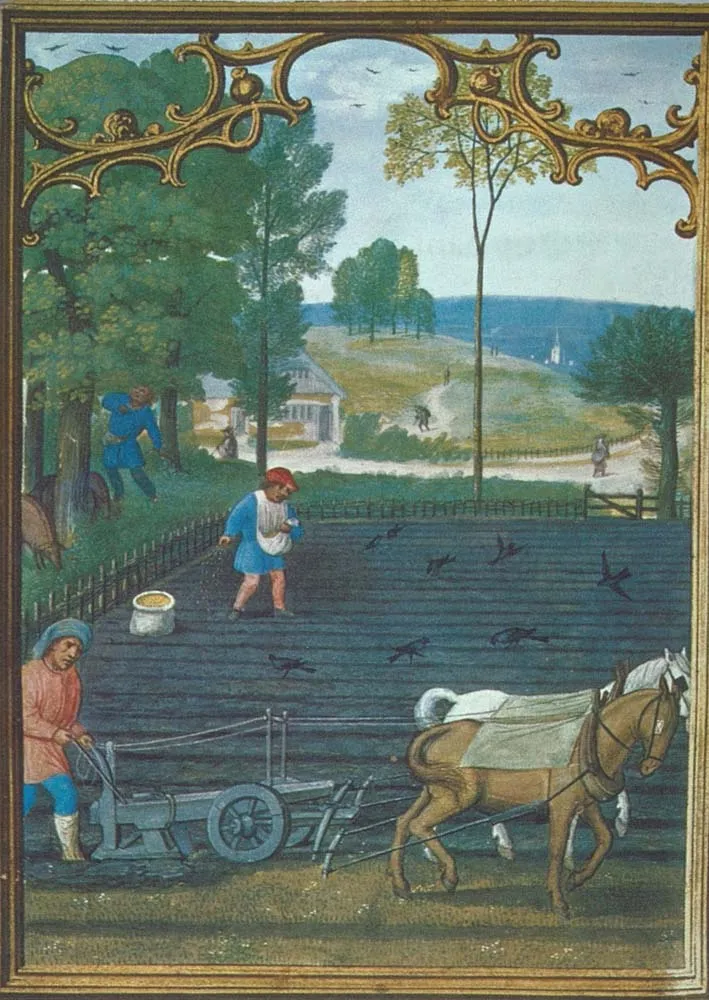
"Plow medieval" by old draw / Wikimedia Commons.
During the Middle Ages, European farmers relied on new farming inventions that transformed how people produced food. The heavy plow, three-field system, and horse collar were essential tools that increased agricultural productivity. These innovations changed daily life for peasants, influenced social hierarchies, and contributed to the growth of towns and trade across medieval Europe.
One of the most important inventions was the heavy plow. Before its introduction around the 6th century CE, farmers in northern Europe struggled with thick, clay-rich soils that were difficult to turn. The lighter, wooden plows used in southern Europe were not effective in these regions. The heavy plow, made of iron and equipped with a moldboard, could dig deeper and turn over heavy soil, making it possible to farm lands that were previously uncultivable. Archaeological finds in modern-day Poland and Germany show early heavy plows dating to this period. The use of the heavy plow led to increased crop yields and allowed villages to expand into new territories.
Another major advancement was the three-field system. Instead of dividing land into just two parts (one planted, one left fallow), farmers began splitting their fields into three sections. One field grew winter crops such as wheat or rye, another held spring crops like barley or legumes, and the third was left fallow to recover nutrients. Each year, the crops rotated. This system, mentioned in 9th-century Carolingian records from France, improved soil fertility and reduced the risk of famine. It also allowed more land to be cultivated at any one time, further increasing food supplies.
The introduction of the horse collar in the 8th or 9th century CE marked another leap in efficiency. Earlier, oxen were the main draft animals because harnesses for horses would choke them. The new horse collar distributed weight across a horse’s shoulders, allowing the animal to pull heavier loads for longer periods without injury. Horses could plow faster than oxen, so farmers could cultivate more land in less time. Illuminated manuscripts and art from the period depict horses wearing these collars, signaling their widespread adoption by the late Middle Ages.
These inventions did more than just increase food output—they changed society. With more reliable harvests, populations grew, and surplus food supported urbanization and the rise of markets. Lords and landowners benefited from higher rents and greater wealth, while peasants sometimes gained more consistent access to food. However, most of the work still fell on peasants and serfs, who remained at the bottom of the social structure. Over time, improved farming methods contributed to the development of medieval towns and set the stage for later technological advances in Europe.
The agricultural revolution of the Middle Ages demonstrates how innovation can change society, connect to geography, and shape human history.
Interesting Fact: In some parts of Europe, the heavy plow was so important that villages were named after it, showing how central it became to medieval life.
Comprehension quiz (8 questions)
1. Which tool was made of iron?
2. What did the three-field system improve?
3. Where were early heavy plows found?
4. How did the horse collar help farmers?
5. Why did food production increase?
6. What effect did surplus food have?
7. The horse collar made horses work slower. True or false?
8. What does "arable" mean?
Perfect for the way you teach
- Build comprehension skills
- Auto-graded quiz
- Differentiated reading
- Read together at home
- Improve fluency
- Quiet reading time
- Reading curriculum support
- Independent practice
- Track Lexile growth