Middle Ages Legacy
Interactive passage with audio narration, comprehension questions, and printable PDF.
By completing this purchase you agree to our Terms of Use and Privacy Policy. Your subscription renews automatically until you cancel. You can cancel anytime from your account settings. All sales are final and non-refundable. Digital content is available for download in your account immediately upon purchase.
What's included
Middle Ages Legacy preview and details
About this printable Middle Ages Legacy reading passage (Grades 5-8)
Sample passage and quiz from Middle Ages Legacy
Reading passage and comprehension quiz preview
Middle Ages Legacy
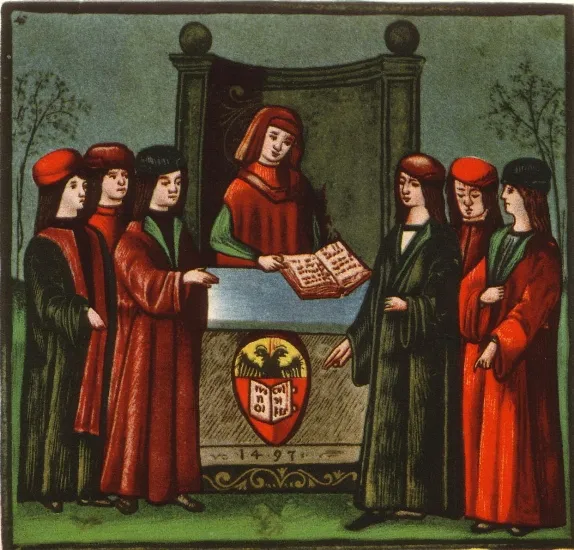
"University of Bologna, German Nation" / Wikimedia Commons.
The Middle Ages, which lasted from about 500 to 1500 CE, created a foundation for modern European civilization. During this thousand-year period, societies across Europe developed many institutions and traditions that still influence us today. The legacies of the Middle Ages include the rise of universities, the development of legal systems, new architectural styles, lasting works of literature, and changes in social organization.
One major legacy of the Middle Ages is the creation of universities. The University of Bologna, founded in 1088 in Italy, is considered the world's oldest university. Universities in Paris, Oxford, and Cambridge soon followed. These institutions became centers for learning and debate, where students studied law, medicine, and philosophy. Many of the traditions and organization of today’s universities, like faculties and degrees, can be traced back to these medieval schools. Primary sources, such as the early statutes of the University of Paris, show how students and teachers organized themselves into guilds and set rules for learning.
The legal systems developed during the Middle Ages also have a lasting impact. The English common law, which began to take shape in the 12th century, became a model for many countries. Royal courts recorded their decisions, creating precedents that shaped future cases. The Magna Carta, signed in 1215 by King John of England, is an important document that limited royal power and protected certain rights. This influence can be seen in legal systems around the world today. Evidence from court records and legal charters helps historians understand how laws were made and enforced.
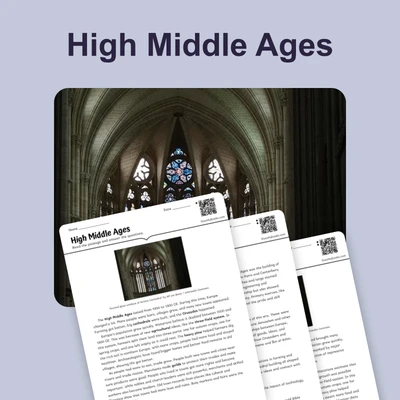
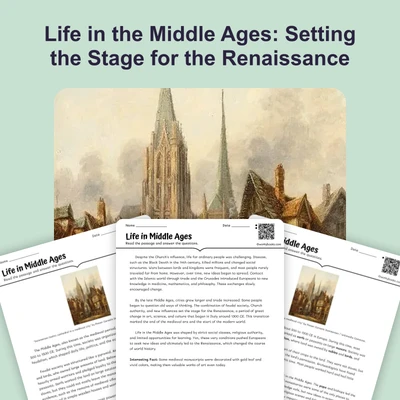
Another remarkable legacy is the rise of Gothic architecture. Cathedrals like Notre-Dame de Paris and Chartres Cathedral, built in the 12th and 13th centuries, show innovations such as pointed arches, ribbed vaults, and stained-glass windows. These buildings were not only places of worship but also centers of community life. Archaeological discoveries, like the construction tools and stone carvings found at cathedral sites, reveal the skills and organization needed for these projects. The style spread across Europe, influencing city skylines and inspiring later architects.
The Middle Ages also produced influential literature. Works such as Dante’s "Divine Comedy" (early 1300s) and Geoffrey Chaucer’s "Canterbury Tales" (late 1300s) reflect the values, humor, and beliefs of their time. These stories helped shape languages and national identities. Manuscripts and early printed books allow historians to trace how stories traveled and changed across regions.
Overall, the Middle Ages left a rich legacy that continues to shape laws, education, architecture, and culture in Europe and beyond. These developments show how people adapted to new challenges and created institutions that lasted for centuries. By studying this period, we see how change and continuity work together to build civilizations.
The legacy of the Middle Ages connects to broader themes in world history, such as cultural diffusion, innovation, and the building of institutions.
Interesting Fact: The University of Oxford’s motto, "Dominus Illuminatio Mea" (The Lord is my Light), has been used since the Middle Ages and is still in use today.
Comprehension quiz (8 questions)
1. When was the University of Bologna founded?
2. Which document limited the king’s power in 1215?
3. What style are Notre-Dame and Chartres?
4. How did universities organize themselves?
5. Why is the Magna Carta important?
6. What effect did Gothic architecture have?
7. The Middle Ages ended in 1500. True or false?
8. What is a cathedral?
Perfect for the way you teach
- Build comprehension skills
- Auto-graded quiz
- Differentiated reading
- Read together at home
- Improve fluency
- Quiet reading time
- Reading curriculum support
- Independent practice
- Track Lexile growth