Islamic Golden Age Inventions
Interactive passage with audio narration, comprehension questions, and printable PDF.
By completing this purchase you agree to our Terms of Use and Privacy Policy. Your subscription renews automatically until you cancel. You can cancel anytime from your account settings. All sales are final and non-refundable. Digital content is available for download in your account immediately upon purchase.
What's included
Islamic Golden Age Inventions preview and details
About this printable Islamic Golden Age Inventions reading passage (Grades 5-8)
Sample passage and quiz from Islamic Golden Age Inventions
Reading passage and comprehension quiz preview
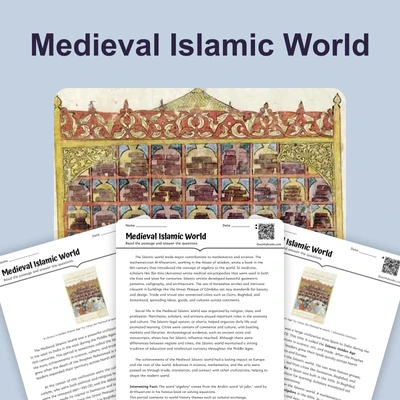
Islamic Golden Age Inventions
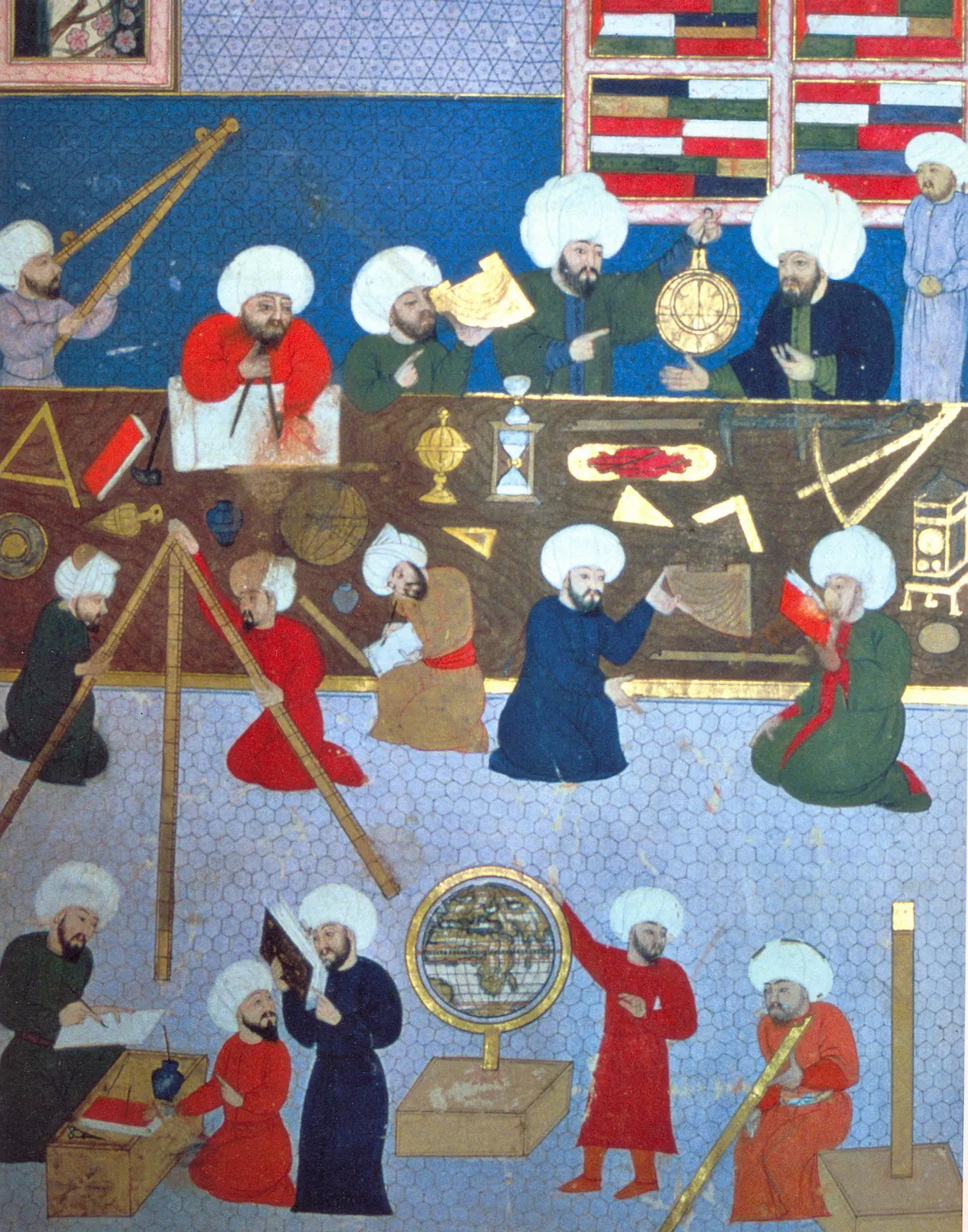
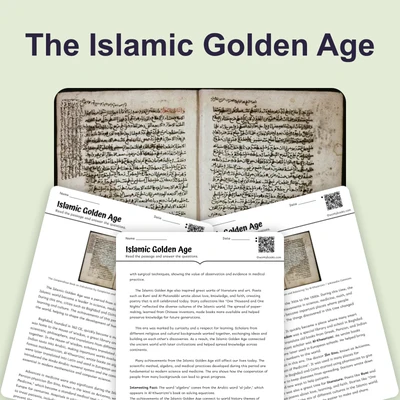
"Islam science" by Ala ad-Din Mansur-Shirazi / Wikimedia Commons.
The Middle Ages witnessed a flourishing of science, technology, and learning in the Islamic world, especially between the 8th and 14th centuries. Muslim scholars and craftsmen created inventions that not only improved daily life but also shaped the direction of world history. Their achievements in mathematics, medicine, engineering, and the preservation of earlier knowledge laid the foundation for later scientific advances across Europe and beyond.
One of the most significant contributions was the development of algebra. The Persian mathematician Al-Khwarizmi, working in Baghdad around 820 CE, wrote a book called “Al-Kitab al-Mukhtasar fi Hisab al-Jabr wal-Muqabala.” This text introduced systematic ways to solve equations and gave algebra its name. Al-Khwarizmi’s work was later translated into Latin and used in European universities. Alongside mathematics, Islamic scholars also contributed to medicine. The renowned physician Al-Zahrawi, who lived in Córdoba in the 10th century, designed surgical instruments such as scalpels and forceps. His illustrated medical encyclopedia, based on his own experience, became a trusted source in both the Islamic world and medieval Europe.
Innovations in energy and technology were also notable. In the arid lands of Persia, the first windmills appeared in the 9th century. These early machines harnessed wind power to grind grain and pump water, making farming possible in dry regions. Their design influenced later windmills in Europe. Another transformative invention was paper-making. After learning the technique from Chinese prisoners in the 8th century, Muslim craftsmen in Samarkand and Baghdad improved it and built large paper mills. Affordable paper made it possible to copy books, spread ideas, and run large libraries, such as the famed House of Wisdom in Baghdad.
One of the greatest achievements of medieval Islamic civilization was the preservation and expansion of Greek knowledge. Scholars translated thousands of ancient Greek works into Arabic, including texts by Aristotle, Galen, and Ptolemy. These texts were studied, critiqued, and expanded upon by Muslim thinkers. Later, these Arabic translations and commentaries were translated into Latin and brought to Europe, sparking new learning during the European Renaissance. Primary sources, like the manuscripts of Al-Khwarizmi or medical tools found in archaeological digs in Spain, provide evidence of these accomplishments.
The impact of medieval Islamic inventions continues today. Their advances in mathematics, medicine, and technology helped shape the modern world. They also show how ideas and inventions can move across cultures and time, especially when societies value learning and exchange. The story of these inventions highlights the importance of curiosity, innovation, and preserving knowledge for future generations.
This study of medieval Islamic inventions connects to broader themes in world history, such as the rise and spread of civilizations, the movement of ideas, and the impact of technology on human societies.
Interesting Fact: The world's oldest university that still awards degrees, the University of Al-Qarawiyyin in Morocco, was founded by a Muslim woman, Fatima al-Fihri, in 859 CE.
Comprehension quiz (8 questions)
1. Who wrote about algebra in Baghdad?
2. What invention helped copy books?
3. Where did Al-Zahrawi live?
4. What was a major effect of paper-making?
5. How did windmills help farmers?
6. Why did scholars translate Greek texts?
7. Algebra was named by Al-Khwarizmi. True or false?
8. What is a manuscript?
Perfect for the way you teach
- Build comprehension skills
- Auto-graded quiz
- Differentiated reading
- Read together at home
- Improve fluency
- Quiet reading time
- Reading curriculum support
- Independent practice
- Track Lexile growth