Early Middle Ages
Interactive passage with audio narration, comprehension questions, and printable PDF.
By completing this purchase you agree to our Terms of Use and Privacy Policy. Your subscription renews automatically until you cancel. You can cancel anytime from your account settings. All sales are final and non-refundable. Digital content is available for download in your account immediately upon purchase.
What's included
Early Middle Ages preview and details
About this printable Early Middle Ages reading passage (Grades 5-8)
Sample passage and quiz from Early Middle Ages
Reading passage and comprehension quiz preview
Early Middle Ages
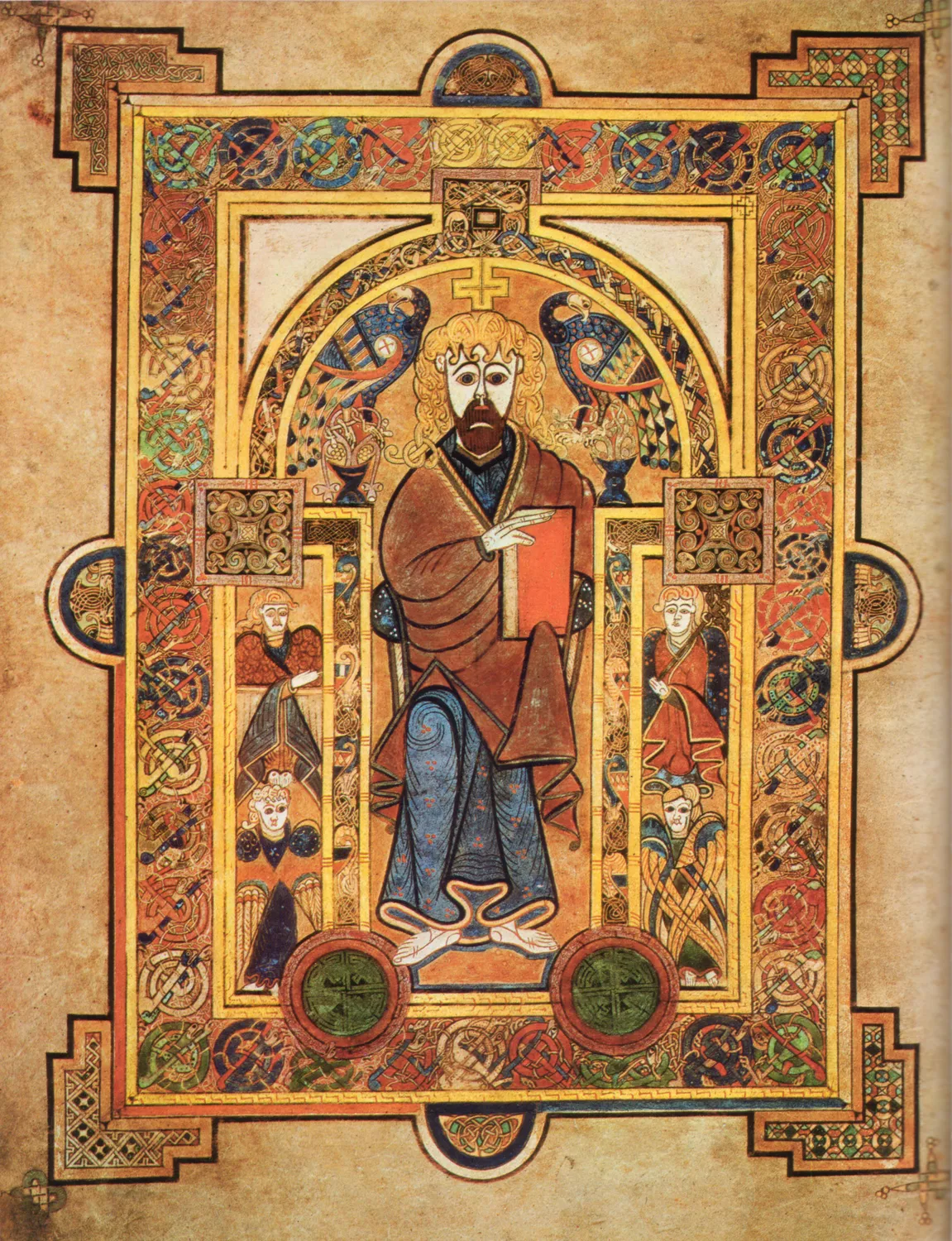
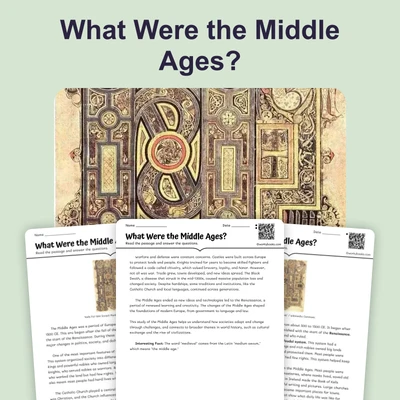
Book of Kells / Wikimedia Commons.
The Early Middle Ages, also called the Dark Ages, is the period in European history between 500 and 1000 CE. This era began after the fall of the Western Roman Empire. During this time, Europe changed dramatically as new powers replaced Roman rule. The collapse of central authority led to the rise of local rulers and new kingdoms, especially those of the Germanic peoples such as the Franks, Visigoths, and Lombards.
One of the most important changes was the decline of trade and city life. With no strong government to protect roads and markets, trade routes became dangerous. Many cities shrank or were abandoned, and people returned to rural, farming-based life. Archaeological evidence from places like Britain and Gaul shows that once-busy Roman towns became villages or ruins. Some Roman roads and buildings, such as the aqueduct at Segovia in Spain, continued to be used, showing a blend of old and new traditions.
Despite these changes, some Roman traditions survived. The Catholic Church became a unifying force across Europe, keeping learning and written records alive. Monasteries, for example, preserved ancient texts and provided education, as seen in the works copied at the Abbey of Monte Cassino. The idea of Roman law also lived on, influencing later legal systems. The social hierarchy of medieval Europe developed, with kings, nobles, and peasants each having specific roles.
New kingdoms formed as Germanic leaders took power. The Frankish king, Charlemagne, ruled much of western Europe by 800 CE and was crowned Emperor by the Pope. His rule helped revive learning and improve government. However, after his death, his empire split into smaller states, leading to continued political fragmentation. The geography of Europe, with forests, rivers, and mountains, made it difficult for any one ruler to control the entire region. This helped shape the feudal system, where local lords held power over small territories.
The Early Middle Ages was a time of adaptation and survival. People faced challenges, but they also preserved and transformed important traditions. The mix of Roman and Germanic influences laid the groundwork for the later development of European culture, law, and government.
This era connects to larger themes in world history, such as how societies respond to the collapse of empires and rebuild new structures from old foundations.
Interesting Fact: The famous Book of Kells, an illuminated manuscript created by monks in Ireland during the Early Middle Ages, contains some of the world's most beautiful medieval art.
Comprehension quiz (8 questions)
1. When did the Early Middle Ages begin?
2. Who was crowned Emperor in 800 CE?
3. What did the Catholic Church help preserve?
4. Why did cities shrink during this era?
5. How did geography affect rulers?
6. What was one effect of Charlemagne’s death?
7. Roman law had no influence in the Middle Ages.
8. What does 'feudal' mean?
Perfect for the way you teach
- Build comprehension skills
- Auto-graded quiz
- Differentiated reading
- Read together at home
- Improve fluency
- Quiet reading time
- Reading curriculum support
- Independent practice
- Track Lexile growth