Italian City-States
Interactive passage with audio narration, comprehension questions, and printable PDF.
By completing this purchase you agree to our Terms of Use and Privacy Policy. Your subscription renews automatically until you cancel. You can cancel anytime from your account settings. All sales are final and non-refundable. Digital content is available for download in your account immediately upon purchase.
What's included
Italian City-States preview and details
About this printable Italian City-States reading passage (Grades 5-8)
Sample passage and quiz from Italian City-States
Reading passage and comprehension quiz preview
Italian City-States
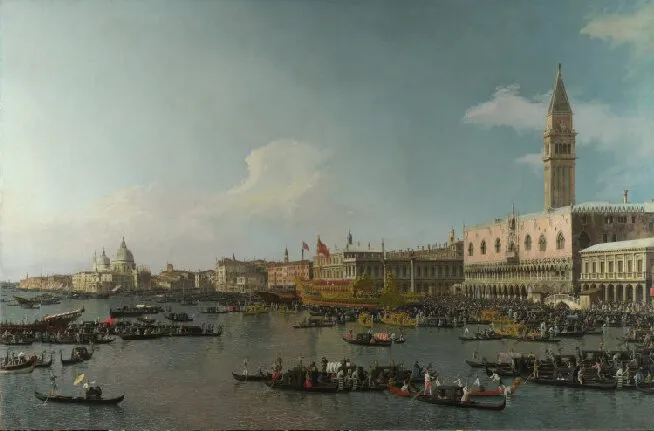
"Venice The Basin of San Marco on Ascension Day" by Canaletto / Wikimedia Commons.
During the Middle Ages, several city-states in Italy rose to become some of the wealthiest and most influential powers in Europe. Among these, Venice, Florence, and Genoa stood out for their economic strength, independence, and cultural achievements. Unlike most European regions, which were ruled by kings or emperors, these city-states developed their own systems of government and controlled their affairs without outside rulers.
Venice, built on over 100 islands in a lagoon on the Adriatic Sea, became famous for its skillful merchants and powerful navy. By the 1200s, Venetian traders controlled valuable routes between Europe and the eastern Mediterranean, importing luxury goods such as spices and silk from Asia. The government of Venice was a republic, led by a Doge elected from the city’s elite. Documents from the time, such as the 1268 "Promissione Ducale," outlined strict rules for the Doge to follow, showing how Venice balanced power among its leaders. The city’s independence from kings allowed it to make treaties, set taxes, and even wage war on its own.
Florence was another major city-state, known especially for its banking and the rise of the Medici family. By the 1400s, Florence became the financial center of Europe. Bankers in Florence developed new ways to manage money, such as using letters of credit, making trade safer and easier. The Medici family acted as both bankers and political leaders, helping to sponsor artists and thinkers during the Renaissance. A famous letter from Giovanni di Bicci de’ Medici (c. 1420) demonstrates how Florentine bankers managed international business, showing their influence across Europe.
Genoa, located on the Ligurian coast, was famous for its shipbuilders and sailors. Genoese merchants traded goods across the Mediterranean and even as far as the Black Sea. In 1298, the city recorded a major naval battle against Venice, as both powers fought for control over sea trade. Genoa’s government was also a republic, where powerful families shared leadership. The city’s harbor and skilled sailors made it a key player in moving goods like grain, cloth, and precious metals.
The success of Venice, Florence, and Genoa was closely tied to their geography. Their locations near the sea or rivers allowed them to build large fleets and connect with distant markets. Their independence from kings let them adapt quickly to changing times and encouraged innovation. Over centuries, these city-states set the stage for the Renaissance, influenced art and science, and helped shape modern ideas about government and trade.
As we study the Italian city-states, we see how geography, leadership, and trade changed society and helped create a new era in European history.
Interesting Fact: Venice once built a secret network of spies called the “Council of Ten” to protect its independence and monitor rivals inside and outside the city.
Comprehension quiz (8 questions)
1. Which city-state was known for banking?
2. Who was the leader of Venice?
3. What year did Genoa and Venice fight a battle?
4. Why did Venice become rich?
5. How did Florence impact the Renaissance?
6. What was a shared feature of these city-states?
7. Venice was a republic. True or false?
8. What does 'harbor' mean?
Perfect for the way you teach
- Build comprehension skills
- Auto-graded quiz
- Differentiated reading
- Read together at home
- Improve fluency
- Quiet reading time
- Reading curriculum support
- Independent practice
- Track Lexile growth