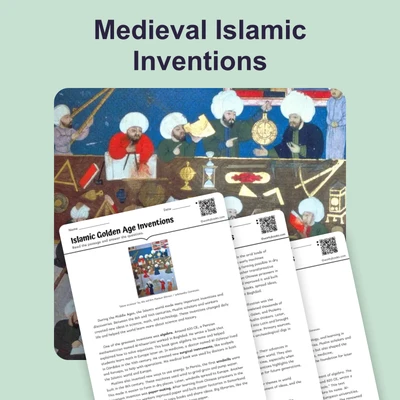
Islamic Golden Age
Interactive passage with audio narration, comprehension questions, and printable PDF.
By completing this purchase you agree to our Terms of Use and Privacy Policy. Your subscription renews automatically until you cancel. You can cancel anytime from your account settings. All sales are final and non-refundable. Digital content is available for download in your account immediately upon purchase.
What's included
Islamic Golden Age preview and details
About this printable Islamic Golden Age reading passage (Grades 5-8)
Sample passage and quiz from Islamic Golden Age
Reading passage and comprehension quiz preview
Islamic Golden Age
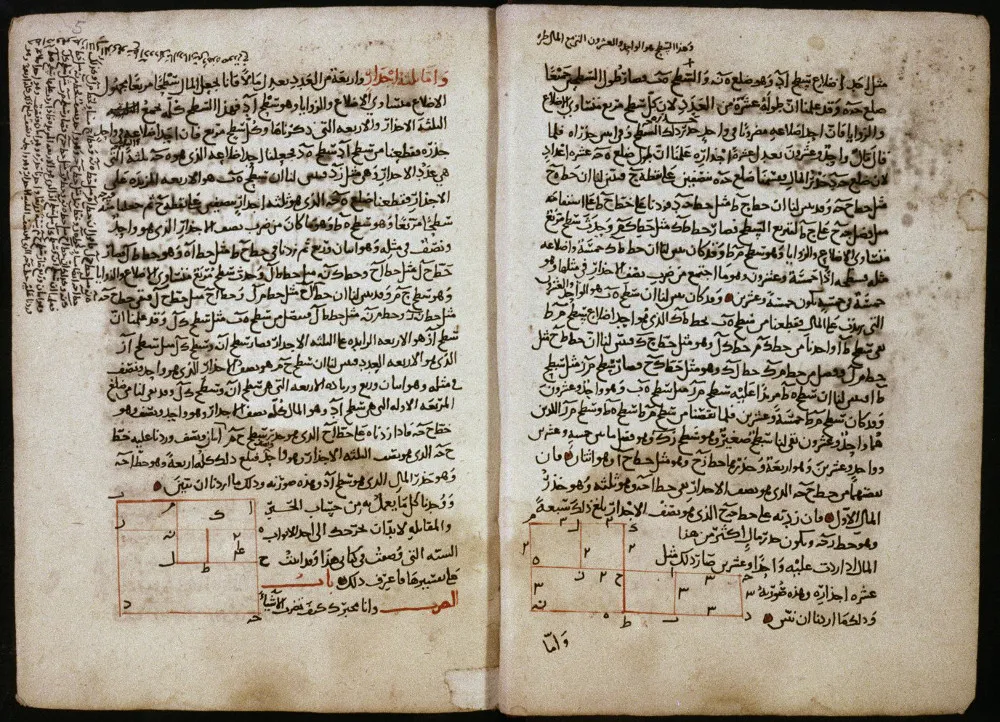
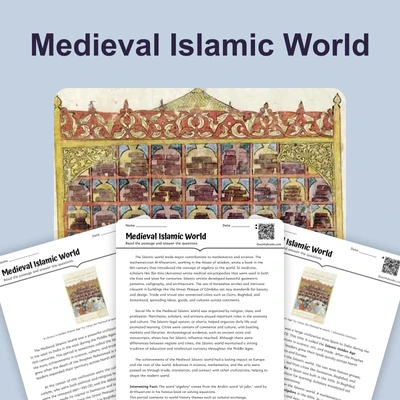
"The Compendious Book on Calculation by Completion and Balancing" by Al-Khwarizmi / Wikimedia Commons.
The Islamic Golden Age was a period from the 8th to the 14th centuries when the Islamic world became a leader in science, medicine, mathematics, and literature. During this era, cities such as Baghdad and Cairo grew into thriving centers of learning and culture. The achievements of this period have had a lasting impact on the world, helping to shape the development of human knowledge.
Baghdad, founded in 762 CE, quickly became a major hub for scholars. The city was home to the House of Wisdom, a great library and research center where scientists, philosophers, and translators from different backgrounds worked together. In the House of Wisdom, scholars translated ancient Greek, Persian, and Indian texts into Arabic, making important works available to a wider audience. One famous mathematician, Al-Khwarizmi, wrote books on algebra and arithmetic that were later translated into Latin and used in European universities. His work introduced the Hindu-Arabic numeral system and the concept of algorithm, which is essential in modern mathematics and computer science.
Advances in medicine were also significant during the Islamic Golden Age. The Persian physician Ibn Sina, known in the West as Avicenna, wrote “The Canon of Medicine,” which became a standard medical text in both the Islamic world and Europe for centuries. Hospitals in cities like Baghdad and Cairo developed new ways to treat patients, including the use of pharmacies and quarantine methods to prevent the spread of disease. Doctors recorded case studies and experimented with surgical techniques, showing the value of observation and evidence in medical practice.
The Islamic Golden Age also inspired great works of literature and art. Poets such as Rumi and Al-Mutanabbi wrote about love, knowledge, and faith, creating poetry that is still celebrated today. Story collections like “One Thousand and One Nights” reflected the diverse cultures of the Islamic world. The spread of paper-making, learned from Chinese inventors, made books more available and helped preserve knowledge for future generations.
This era was marked by curiosity and a respect for learning. Scholars from different religious and cultural backgrounds worked together, exchanging ideas and building on each other's discoveries. As a result, the Islamic Golden Age connected the ancient world with later civilizations and helped spread knowledge across continents.
Many achievements from the Islamic Golden Age still affect our lives today. The scientific method, algebra, and medical practices developed during this period are fundamental to modern science and medicine. The era shows how the cooperation of people from many backgrounds can lead to great progress.
Interesting Fact: The word "algebra" comes from the Arabic word "al-jabr," which appears in Al-Khwarizmi’s book on solving equations.
The achievements of the Islamic Golden Age connect to world history themes of cultural exchange, innovation, and the movement of ideas across regions.
Comprehension quiz (8 questions)
1. What was the House of Wisdom?
2. Who wrote 'The Canon of Medicine'?
3. Which city became a major center of learning?
4. What was a result of translating ancient texts?
5. Why was the spread of paper important?
6. How did scholars work in this era?
7. Algebra was first developed in Europe. True or false?
8. What is an algorithm?
Perfect for the way you teach
- Build comprehension skills
- Auto-graded quiz
- Differentiated reading
- Read together at home
- Improve fluency
- Quiet reading time
- Reading curriculum support
- Independent practice
- Track Lexile growth