Medieval Christian Worship
Interactive passage with audio narration, comprehension questions, and printable PDF.
By completing this purchase you agree to our Terms of Use and Privacy Policy. Your subscription renews automatically until you cancel. You can cancel anytime from your account settings. All sales are final and non-refundable. Digital content is available for download in your account immediately upon purchase.
What's included
Medieval Christian Worship preview and details
About this printable Medieval Christian Worship reading passage (Grades 5-8)
Sample passage and quiz from Medieval Christian Worship
Reading passage and comprehension quiz preview
Medieval Christian Worship
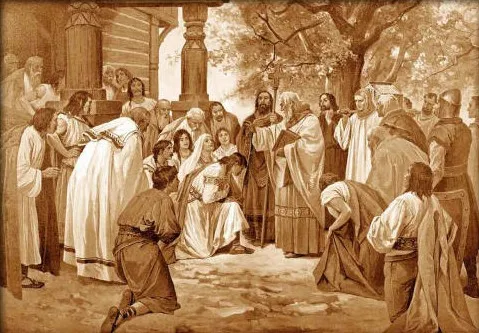
"Věnceslav Černý - The Arrival of the Apostles Cyril and Methodius to Moravia" / Wikimedia Commons.
During the Middle Ages, religious life was central to the daily experience of people in Europe. Most people were Christians, and their beliefs shaped the rhythm of the week, the year, and even their community. The main way people expressed their faith was through public and private acts of worship. Key practices included attending Mass, honoring saints, going on pilgrimages, venerating relics, and celebrating holy days.
Attending Mass was the most important ritual for most medieval Christians. Mass was a religious service held in churches every Sunday and on special feast days. The ceremony included prayers, the reading of scripture, and the sharing of bread and wine, which people believed became the body and blood of Christ. Churches ranged from small village chapels to grand cathedrals like Notre-Dame in Paris, built between 1163 and 1345. Mass was not only a spiritual event but also a social gathering for the entire community. Historical records, such as the accounts of the English monk Bede (died 735), show how Mass brought people together and reinforced a shared sense of belief.
Pilgrimages were journeys to holy places, often requiring weeks or months of travel. People believed that visiting a sacred site, such as the tomb of Saint James at Santiago de Compostela in Spain, could bring spiritual rewards or healing. Pilgrims carried badges or tokens as proof of their journey, and some left written accounts, like the 12th-century "Pilgrim’s Guide" to Santiago. Pilgrimages were open to rich and poor, but only those who could afford to leave their work or families could participate regularly. These journeys also encouraged trade and cultural exchange along the routes, connecting distant regions of Europe.
Medieval people honored saints, who were seen as holy men and women able to intercede with God. Churches often kept relics—objects connected to saints, such as bones or clothing—in special containers called reliquaries. People believed that relics had spiritual power and could protect or heal the faithful. For example, the shrine of Saint Thomas Becket in Canterbury Cathedral, England, became a famous pilgrimage site after his death in 1170. Some relics were so important that kings and nobles competed to own them, as shown in inventories and royal charters from the period.
Holy days were special dates on the calendar when work stopped and people celebrated religious events. These included Christmas, Easter, and many local saints’ days. Festivals often blended religious rituals with music, food, and games, creating a sense of community. Over time, some practices changed—for example, new saints were added, and pilgrimage routes shifted as wars or disasters affected travel. Still, the basic patterns of worship remained a constant part of medieval life.
These practices mattered because they shaped identity, reinforced social bonds, and gave meaning to daily routines. They also reflected the social hierarchy: priests and monks led ceremonies, while ordinary people participated in different ways depending on their status. Understanding medieval worship helps us see how religion influenced culture, politics, and even art in Europe for centuries.
Learning about religious practices in the Middle Ages connects to broader themes in world history, such as the role of belief systems, cultural exchange, and the power of ritual in shaping societies.
Interesting Fact: In medieval Europe, some churches displayed relics so valuable that they were guarded day and night, and special festivals drew crowds of thousands from many countries.
Comprehension quiz (8 questions)
1. What was the main religious service?
2. Which cathedral was built from 1163-1345?
3. Who could lead religious ceremonies?
4. Why did people go on pilgrimages?
5. How did relics affect towns?
6. What is a reliquary?
7. Mass was held every Sunday. True or false?
8. What does 'hierarchy' mean?
Perfect for the way you teach
- Build comprehension skills
- Auto-graded quiz
- Differentiated reading
- Read together at home
- Improve fluency
- Quiet reading time
- Reading curriculum support
- Independent practice
- Track Lexile growth